
PiedmontMountains and climate

The survey, conducted by AstraRicerche on behalf of the Piedmont Region, aimed to investigate the perceptions, impact and expectations generated by climate change among professions linked to mountain tourism. At 76.6% of respondents, ski instructors represented the largest category within the statistical sample considered.
Thursday 8 October 2026 12 minutes reading time
In addition to ski instructors, the sample also included cycling tourism guides/accompanying guides (17.8% of respondents), mountain hut managers (5.4%), mountain guides (5.4%) and mid-mountain guides (4.5%).
A large majority of the sample (91.2%) carries out only one mountain profession.
Over the past 12 months, the mountain profession they practiced was not the main source of income for 58.1% of respondents, representing a secondary source of income; conversely, it accounted for the main source of income for 26.1% and the sole source for 15.8%. Particularly for cycling tourism guides and ski instructors, income from their mountain profession is, in the vast majority of cases, a secondary source of income. For mountain hut managers and mountain guides, on the other hand, its economic importance is almost always exclusive or predominant. Among respondents under 30, the mountain profession they practice represents the sole or predominant source of income in as many as 70% of cases.
The mountain profession is primarily practiced in winter, by 82.2% (also reflecting the significant proportion of ski instructors in the sample), but the figure for those who work in seasons other than winter is significant: well over one in three respondents, or 37.8% (summer above all, at 32.4%, but one in five also work in autumn and spring).
Some 44.6% of the sample permanently reside in a mountain municipality in Piedmont, while a further 13.2% reside there permanently but only during the working season. A total of 42.3% do not reside there permanently and commute. In particular, mountain hut managers and mountain guides stand out for permanently residing in a mountain municipality in Piedmont: these are the professionals whose income from practicing a mountain profession is most frequently their sole or predominant source of income.
Almost one in two respondents has perceived a reduction in the length of their working season over the past five years. This applies in particular to ski, cross-country skiing and snowboard instructors and mountain guides. Conversely, cycling tourism guides and mountain hut managers are notable for perceiving an increase in the length of their working season. Some 79% of respondents reported a reduction in their income linked to a mountain profession over the past five years, while 84% noted a decrease in the length of the working season.
IClimate change and the resulting extreme weather events (droughts, floods and heatwaves) have had a strong impact on mountain professions over the past five years: 68.1% believe that their activity has been significantly hindered, with a particularly high impact on mountain hut managers and ski instructors.
The main cause limiting activity is identified as the lack of natural snow, but three out of four respondents also point to problems arising from the increase in violent and sudden storms and the retreat of glaciers, which make hiking and mountaineering routes less safe. Other critical factors include the greater unpredictability of daily weather conditions, an increase in landslides and mudslides on trails, a shorter winter season, difficulties in securing water supplies, and changes to local flora and fauna.
The analysis shows that mountain hut managers suffered the greatest negative economic impact (64% of respondents), followed at a distance by mountain guides and ski instructors.
A significant proportion of the sample reported modifying their range of services and investing capital in order to adapt to climate change.
For more than half of the sample, the impact of seasonality on their economic stability is significant. This is particularly evident among mountain hut managers (91%) and those for whom income from their mountain profession is their sole source of income (79%) or, in any case, their predominant source (83%).
Looking ahead to the next 10 years, the scenario that almost nine out of ten respondents foresee for mountain tourism involves an increase in tourism linked to wellness and escaping the summer heat (87.8% of respondents). Among the other scenarios most frequently predicted, 80.8% expect more hikers/trekkers/walkers, 71.1% see the mountains becoming increasingly popular with families, and 61.1% anticipate an increase in tourism during periods of the year currently considered the low season. There are also further predictions: 70% believe tourism will shift towards higher altitudes, while 58.7% expect fewer skiers.
Over the next 10 years, the vast majority of respondents expect to be affected by one or more changes. Some 32.8% fear having to reduce their activity, while 32.3% fear a decline in the profitability of their profession, which risks no longer being economically sustainable. A total of 27.5% report the risk of having to move to other mountain areas in order to continue their activity, while 10% fear having to abandon their activity and the mountains altogether. Concern about these scenarios is particularly pronounced among younger respondents (and decreases with age); these risks are also reported far more frequently by those who have experienced a reduction in the length of their working season and a reduction in their income in recent years.
In almost every case, respondents have one or more reasons why they definitely want to continue working in the mountains. The main reasons concern their connection with the area and quality of life. The vast majority of the sample say they are willing to supplement or diversify their professional activity so that they can continue to live and work in the mountains, calling for public incentives and specific training programs to undertake this change.
To be able to work in the mountains all year round, there is one aspect that the sample considers decisive, almost unanimously: 96.5% recognize the importance of cooperation among mountain professionals. Among the desired measures, the first priority identified is the creation of a single destination marketing strategy, followed by the need for shared digital platforms for bookings and visibility, the establishment of a network or consortium of operators, the sharing of spaces and costs, and joint professional training and continuing education.
The majority of respondents expect public measures that can help mountain professionals continue their activities. Mountain hut managers, ski instructors and mountain guides hope for economic and tax incentives, as well as bureaucratic and regulatory simplification. Cycling tourism guides call for measures aimed at promoting tourism in the area, while mid-mountain guides expect support for living in the mountains, including housing, services and transport.
© ALL RIGHTS RESERVED
Social media engagement
Latest in Regioni
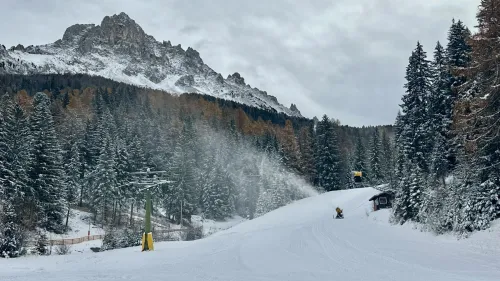
Latemar Dolomites, season starts on November 27 with the new “Obereggen” chairlift
After the abundant snowfall across the entire Alpine arc in recent days, the winter season will begin on Friday, November 27, in Obereggen, a resort 20 minutes from Bolzano. The gates will open as early as 8:30 a.m., with four lifts. From 7:00 p.m., it will also be possible to ski at night. Starting Saturday, November 28, a total of eleven lifts in the Latemar Dolomites ski area will be open, including the link between Obereggen and Pampeago. The lifts in Predazzo will open on Friday, December 4.
2026/2027 SEASON OPENING
26