
South TyrolThe history of skiing

redazione

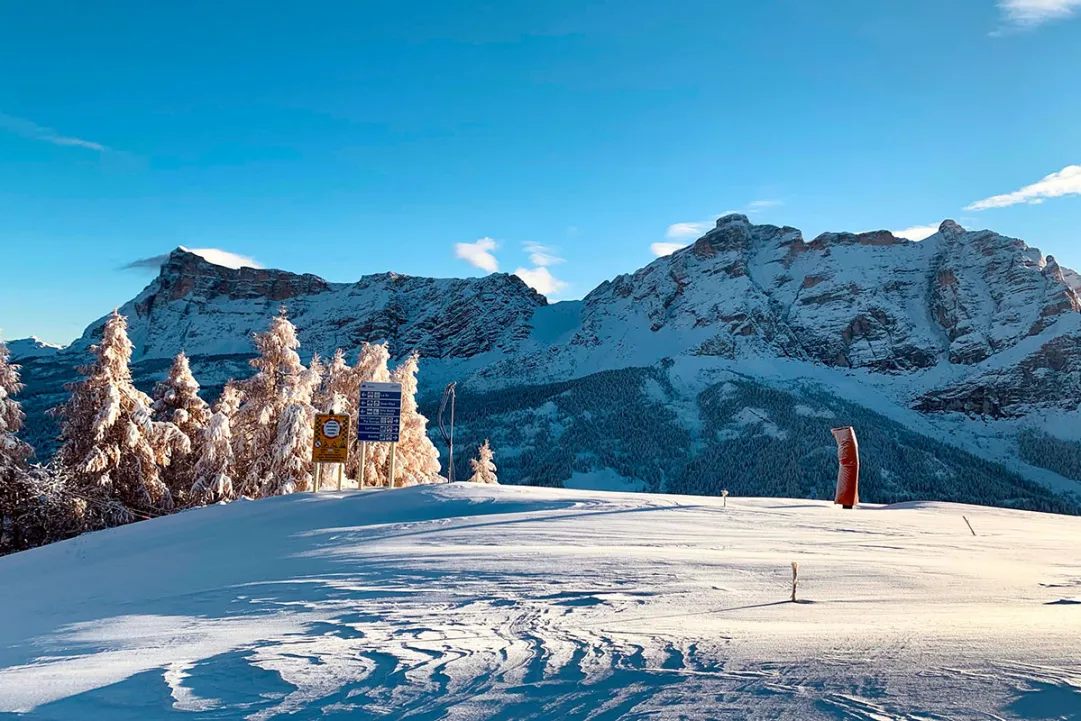
In an article published several months ago by Anna Quinz in the first issue of the magazine Stua, produced by the Alta Badia Tourist Consortium, the origins and rise of the Alta Badia ski area are retraced. After centuries of isolation and an economy based almost exclusively on agriculture and livestock farming, the construction of ski lifts drove tourism development, ushering in a new era of prosperity and economic growth for the entire valley. The area’s ancient agricultural vocation has not been lost and coexists in perfect balance with tourism, ensuring the preservation of a unique landscape, where the care given to the meadows and the characteristic “viles ladine” blend perfectly with the forests, tourist facilities and magnificent Dolomite views.
Tuesday 7 October 2025 6 minutes reading time
The first turning point came at the end of the nineteenth century, when skis appeared on the snow-covered slopes of Alta Badia. The first to wear them were Vigil Pescosta and Jocl Castlunger, both from Colfosco. Castlunger was commissioned to build a mountain hut on the Sella Group and, while travelling across the Alps, discovered the potential of skis, rudimentary but extremely useful for making work in the mountains easier.
In 1934, to allow tourists to discover and appreciate skiing as well, the valley’s first ski school was established in Corvara by Francesco Kostner. The following year, the La Villa ski school was also inaugurated, thanks to the initiative of Pire Costa.
At the time, Alta Badia could be reached by only a few visitors: the valley still had no paved roads, and the long winters required demanding snow-clearing operations, using a horse-drawn snowplough.
In the following years, thanks to improvements to the road network, the first rudimentary ski lifts were built, mainly on the initiative of Erich Kostner. In particular, in 1938, the first sled lift opened in Corvara, on the slopes of Col Alt. Immediately after the end of the war, in 1946, Kostner succeeded in building Italy’s first single-seat chairlift, linking Corvara with Col Alt: the lift was assembled using sheet metal from tanks left over from the war, the engine of a Leitner tractor (which would soon establish itself as one of the world leaders in the construction of ropeway systems) and the gearbox from a Trieste vessel. In a short time, lifts multiplied throughout the valley: in Colfosco, the first drag lifts were opened by Gottfried Declara, while in La Villa, lifts were built by Hermann Pescollderungg and Alfonso Pizzinini, who, through the La Varella company, began developing the Gardenaccia area. In 1960, the bucket lift linking San Leonardo with the La Crusc Sanctuary came into operation. In 1966, it was the turn of the cable car serving the Gran Risa, which would soon become one of the most famous World Cup ski courses.
Alta Badia soon established itself as a favourite destination for skiers, thanks to its ability to create a cohesive system by bringing together the individual business initiatives of numerous small lift operators in a single tourist product of the highest national and international standing. Once again, Erich Kostner was the driving force behind this success: he was responsible for founding the National Association of Cableway Operators (ANEF) in 1978 and for the idea of joining, in cooperation with the valley’s other entrepreneurs, Alta Badia’s various lifts into a single consortium (Ski-Carosello Corvara) linking the villages of Corvara, La Villa and San Cassiano. This was only the first step towards an even greater idea: bringing together several Dolomite ski areas not only logistically (with a single ski pass), but also organisationally and socially. In 1974, what is now known as the Dolomiti Superski Federconsorzi was founded. From the first six valleys with 250 lifts, the system has now grown into a network encompassing 12 valleys, 450 lifts and 1,200 km of slopes, establishing itself as one of the world’s best-known and most highly regarded ski destinations.
© ALL RIGHTS RESERVED
Social media engagement
Latest in Regioni
Latemar Dolomites, season starts on November 27 with the new “Obereggen” chairlift
After the abundant snowfall across the entire Alpine arc in recent days, the winter season will begin on Friday, November 27, in Obereggen, a resort 20 minutes from Bolzano. The gates will open as early as 8:30 a.m., with four lifts. From 7:00 p.m., it will also be possible to ski at night. Starting Saturday, November 28, a total of eleven lifts in the Latemar Dolomites ski area will be open, including the link between Obereggen and Pampeago. The lifts in Predazzo will open on Friday, December 4.
2026/2027 SEASON OPENING
17