
BiathlonOlympic history

YouTube


As the Milano Cortina 2026 Games approach, this series of articles looks back at the history of biathlon at the Winter Olympics. We begin with the first two editions, held in the United States and Austria...
Thursday 1 January 2026 6 minutes reading time
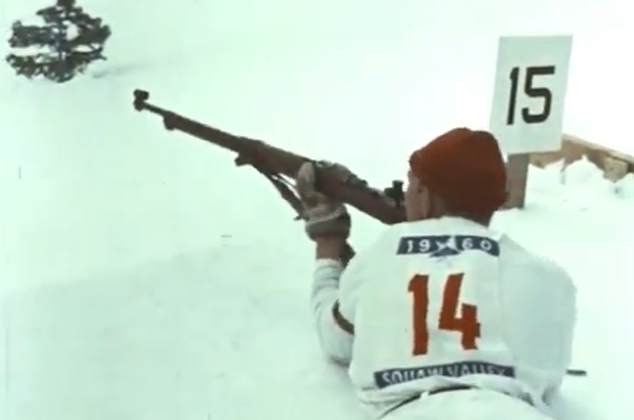
Although a cross-country skiing and shooting event for military patrols was included with medals awarded in the programme of the 1924 Olympics in Chamonix, and held as a demonstration event in 1928 in Sankt Moritz, in 1936 in Garmisch and again in 1948 in Sankt Moritz, the debut of biathlon as an Olympic discipline dates back to the eighth Winter Olympic Games, held in 1960 in Squaw Valley, United States.
The first five-ring appearance was preceded in 1958 by the first edition of the 'World Championships in Olympic Biathlon', held in Saalfelden, Austria, followed the next year by the World Championships in Courmayeur.
Squaw Valley 1960
The race format, held over a distance of 20 kilometres, featured four shooting ranges at varying distances. There were three prone sessions with targets at 200, 250 and 150 metres, and a final standing session with targets at 100 metres; each miss incurred a two-minute penalty, a format clearly intended to reward the best shooters. The weapon used was a 7.62 mm-calibre military rifle.
Thirty athletes from nine nations took part in the race, with no Italian athlete competing; Italy would make its first Olympic appearance in the discipline only in 1972.
Victory went to Sweden's Klast Lestander, the only biathlete to hit all 20 targets in the race, who prevailed despite recording only the fifteenth-fastest skiing time in the field. The silver medal went to Finland's Antti Tyrvainen, who made three errors in the first two shooting ranges, while Soviet Aleksandr Privalov, who arrived at the final range with a lead of more than two minutes, paid dearly for three errors that relegated him to third place.
20 km individual
- 1. Lestander Klast (SWE)
- 2. Tyrvainen Antti (FIN)
- 3. Privalov Aleksandr (USSR)
Innsbruck 1964
With Sweden's Lestander retired, the Soviet athletes were the great favourites. Vladimir Metanin, fourth at Squaw Valley, had won the 1962 and 1963 World Championships, while Aleksandr Privalov, the great disappointment of four years earlier, had finished second at the 1961 World Championships. Tyrvainen was also in contention; after winning Olympic silver, he had also finished second at the 1962 and 1963 World Championships.
The race was marked by many twists and turns, but in the end Metanin confirmed himself as the best of the field, making no errors after recording the third-fastest skiing time. At the finish, the twenty-four-year-old Norwegian Olav Jordet celebrated second place, while Privalov took third, with both having been recorded with one error at the final range.
In those days, athletes shot at paper targets or wooden silhouettes, and the procedure required them to be checked directly at the end of the race. The inspection cancelled Privalov's error and awarded him the silver medal, moving Jordet down to the third step of the podium.
20 km individual
- 1. Metanin Vladimir (USSR)
- 2. Privalov Aleksandr (USSR)
- 3. Jordet Olav (NOR)
© ALL RIGHTS RESERVED
Social media engagement
FONDO, SCELTI DAI LETTORI

BOTTERO SKI
ARC TEC - squadretta in allumino 88
24.00 €


14