
BiathlonOlympic history

Getty Images

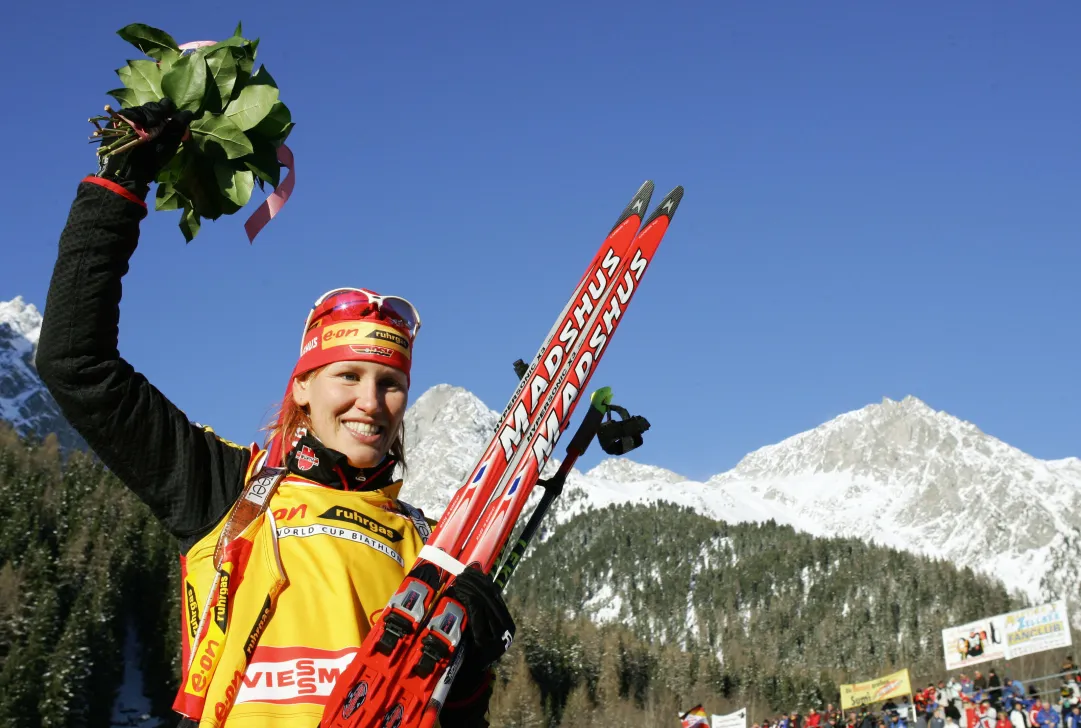
After adding the Pursuit to the Olympic programme in 2002, the IBU and IOC added the Mass Start from the Turin Olympics onwards, an event held over four shooting ranges with the 30 best biathletes in the race starting together. The number of Olympic biathlon titles up for grabs rose to 10, and Germany won 5 of them—four in the men’s events, in addition to Kati Wilhelm’s gem in the women’s Pursuit—and 11 of the 30 medals available.
Monday 26 January 2026 14 minutes reading time
The dominant athlete of the Salt Lake City edition, Ole Einar Bjoerndalen, arrived in Cesana San Sicario after once again winning a quartet of gold medals at the 2005 World Championships, but with some concerns about his condition, having had to interrupt his training in January because of a seasonal illness.
That did not prevent him from recording the fastest skiing time once again on 11 February 2006, but two errors in the first two shooting ranges prevented him from confirming the Gold medal. He was beaten by 16 seconds by Germany’s Michael Greis, who incurred only one penalty at the first standing shooting range. The Bronze medal went to the winner in the same event in 1998, Norway’s Halvard Hanevold, who, with two penalties, finished 1 minute and 8 seconds behind the winner. Twenty-four-year-old Valtellina native Christian De Lorenzi was in contention for a medal until the final shooting range; after leaving the third shooting session, he was fourth with the same time as Greis, but at the final range he made his only shooting error, and the one-minute penalty cost him the medal. He finished seventh, 33 seconds from the Bronze medal.
Three days later in the Sprint, Bjoerndalen dropped off the podium. Three errors at the shooting range relegated him to 11th place. In a star-studded podium, Germany’s Sven Fischer succeeded him in the event’s Olympic roll of honour. The Silver medalist in this format at Salt Lake City, he produced a perfect shooting performance to finish 8 seconds ahead of Norway’s Hanevold, who also went 10/10 and had won the 20 km Olympic title in 1998. The Bronze medal, with one error, went to Frode Andresen, who had also finished second in the Sprint in 1998.
After Fischer made two errors at the first shooting range, Hanevold and Andresen took command of the Pursuit. While the former continued strongly, the latter dropped out of the medal battle with three errors at the second range. Halfway through the race, Hanevold led France’s Defrasne by 30 seconds and Bjoerndalen by 45 seconds, despite the Norwegian’s error in the second shooting session. Three errors at the third range took Hanevold off the podium, while Defrasne and Bjoerndalen continued strongly. Coming from behind, Fischer, who had also made two errors at the second range, was closing in. The French leader made two errors in the final shooting session, while Bjoerndalen incurred only one penalty loop, but the advantage was 34 seconds, and even a monstrous final lap by the Norwegian was not enough to make up the gap, which was just 6 seconds at the finish. The Gold medal went to Vincent Defrasne, the Silver to Ole Einar Bjoerndalen and the Bronze to Sven Fischer.
In the first Olympic Mass Start, Bjoerndalen made a flying start and, halfway through the race, with no errors in the two prone shooting ranges, led Michael Greis and Poland’s Tomasz Sikora by 20 seconds. The Norwegian made one error at the first standing range and was caught by the Pole, while the German, after one error, trailed the pair by almost 30 seconds. A mistake by Sikora at the final range left him to battle for the Gold medal with Greis on the final lap, while Bjoerndalen missed twice. At the finish, Greis, winner of the 20 km, took Gold with a 6-second advantage over Sikora and 12 seconds over Bjoerndalen.
Such a formidable team could only prevail in the Relay as well, but Germany struggled more than expected. Ricco Gross did not make the difference in the opening leg; it was Michael Roesch on the second leg who took command, with a 25-second lead over a surprising Italy after excellent legs by De Lorenzi and Vuillermoz. Despite Sven Fischer serving a penalty loop, the German team maintained an 18-second lead over Russia, while France and Sweden battled for third place. Italy dropped to seventh. On the final leg, Michael Greis cruised towards his third Gold medal, with a 21-second lead over Russia. At 45 seconds, Raphael Poiree and Bergman battled for the Bronze medal, which went to France in a photo finish. Italy finished eighth.
In the women’s event, the wind dominated the opening 15 km. Russia’s Svetlana Ishmuratova handled the weather conditions best, incurring only one error at the third range. The classification at the end of the race initially showed Russia’s Olga Pylyova in second place, having already won Gold in the Pursuit at Salt Lake City, but she failed the doping test because of the presence of a stimulant and was disqualified. The Silver medal passed to Germany’s Martina Glagow and the Bronze to Russia’s Albina Akhatova.
The outcome of the Sprint was also surprising, with France’s Florence Baverel-Robert prevailing thanks to a 10/10 shooting performance. She finished just over 2 seconds ahead of Sweden’s Anna-Carin Olofsson, who until four years earlier had competed in cross-country skiing, taking part in the 2002 Olympics without notable results. The Bronze medal went to Ukraine’s Liliya Yefremova, 7 seconds behind. Michela Ponza finished 13th.
The Pursuit soon became a one-woman show by Germany’s Kati Wilhelm, who started 18 seconds behind but took the lead after the first range. Despite a penalty loop at the first standing range, she won by more than a minute over Martina Glagow, slowed by two errors in the prone stages. As in the 15 km, the Bronze medal went to Russia’s Albina Akhatova. Michela Ponza, after one error at the final range, finished fifth, 46 seconds off the podium.
The first Olympic title in the mass-start event went to Sweden’s Anna-Carin Olofsson, who finished 19 seconds ahead of Kati Wilhelm after both made one error. Once again, Uschi Disl had to settle for a consolation medal, taking Bronze 40 seconds behind the winner. Michela Ponza could not repeat her Pursuit performance and finished 11th with one error. Russia won Gold in the Relay, with a 50-second advantage over Germany and a two-and-a-half-minute advantage over France.
Men’s 20 km Individual
- 1. Greis Michael (GER)
- 2. Bjoerndalen Ole Einar (NOR)
- 3. Hanevold Halvard (NOR)
Men’s 10 km Sprint
- 1. Fischer Sven (GER)
- 2. Hanevold Halvard (NOR)
- 3. Andresen Frode (NOR)
Men’s 12.5 km Pursuit
- 1. Defrasne Vincent (FRA)
- 2. Bjoerndalen Ole Einar (NOR)
- 3. Fischer Sven (GER)
Men’s 15 km Mass Start
- 1. Greis Michael (GER)
- 2. Sikora Tomasz (POL)
- 3. Bjoerndalen Ole Einar (NOR)
Men’s 4x7.5 km Relay
- 1. Germany
- 2. Russia
- 3. France
Women’s 15 km Individual
- 1. Ishmuratova Svetlana (RUS)
- 2. Glagow Martina (GER)
- 3. Akhatova Albina (RUS)
Women’s 7.5 km Sprint
- 1. Baverel-Robert Florence (FRA)
- 2. Olofsson Anna-Carin (SWE)
- 3. Yefremova Liliya (UKR)
Women’s 10 km Pursuit
- 1. Wilhelm Kati (GER)
- 2. Glagow Martina (GER)
- 3. Akhatova Albina (RUS)
Women’s 12.5 km Mass Start
- 1. Olofsson Anna-Carin (SWE)
- 2. Wilhelm Kati (GER)
- 3. Disl Uschi (GER)
Women’s 4x6 km Relay
- 1. Russia
- 2. Germany
- 3. France
© ALL RIGHTS RESERVED
Social media engagement
Most read in Sport invernali
Fede, the shock announcement: Brignone retires. “My leg hurts too much, I’ve decided to end my career. I’ll open one last starting gate”
In a video released by FISI, the Italian champion announced that she had decided to call it a day: the two days on skis in Cervinia did not give her the answers she had hoped for, and Federica will compete in one final race to say goodbye to everyone. The most successful woman in the history of Italian skiing is leaving the sport.
13