
BiathlonOlympic history

Getty Images

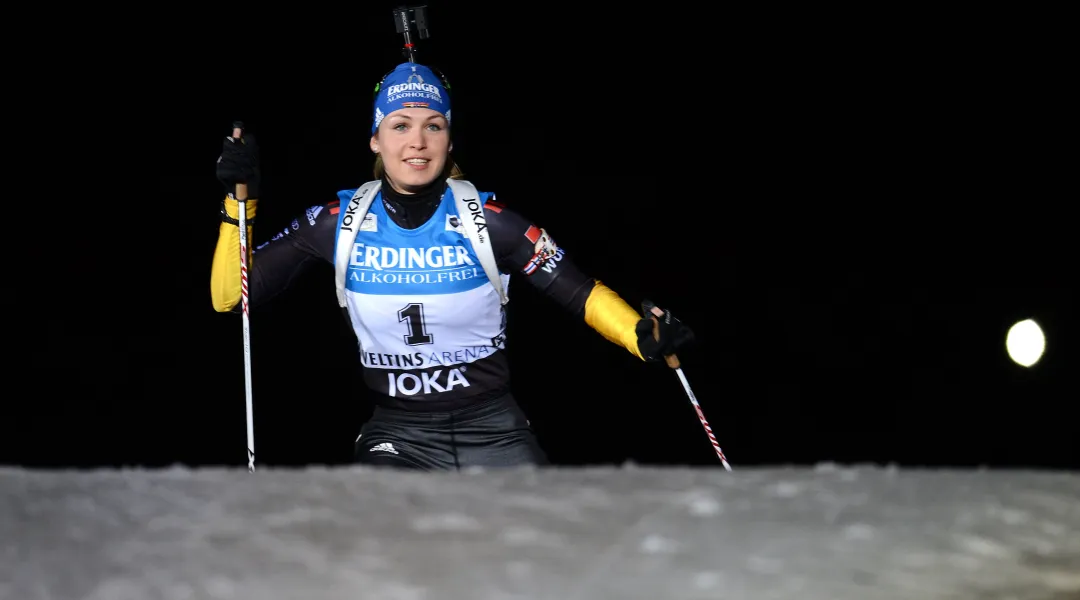
After the Turin Olympics, the world of women’s biathlon was swept by a hurricane from Bavaria. A young girl born on 9 February 1987, named Magdalena Neuner, burst onto the scene.
Tuesday 27 January 2026 14 minutes reading time
After making her debut at the highest level in the 2005/06 season, the German girl experienced her first full World Cup season at the age of 19 in 2006/07. She won her first race, the Oberhof Sprint, in January 2007 and was not entered in the Junior World Championships, instead being sent to the World Championships in Anterselva. At 19 years and 359 days, she won the world title in the Sprint and repeated the feat the following day in the Pursuit.
The following season, in Oestersund, she became World Champion in the Mass Start and became the youngest biathlete to win the overall World Cup. After a transitional season with many physical problems, the 23-year-old Bavarian arrived at the Vancouver Olympics with the stated aim of winning an Olympic title.
The programme at Whistler Olympic Park began with the Sprint, where, with both athletes making one mistake, Magdalena Neuner was beaten by the Russian with a Slovak passport, Anastasia Kuzmina, by one and a half seconds and had to settle for the Silver medal. Frenchwoman Marie Dorin took the third step of the podium; despite a clean shoot, she was overtaken on the final lap and finished 11 seconds behind the winner.
Three days later came revenge in the Pursuit. Neuner and Kuzmina stayed together until the second shooting bout, where a mistake by the Slovakian made the difference. The German was able to race alone, and in the first standing session Kuzmina failed to take advantage of the opening left by the leader, who herself made a mistake and had to ski a penalty loop. Magdalena Neuner could race towards the first Olympic title of her career despite another mistake at the final shooting bout. At the finish, the German had a 12-second lead over Anastasia Kuzmina and a 28-second lead over Frenchwoman Marie-Laure Brunet, who, without mistakes, climbed from sixth place in the Sprint to the Bronze medal.
The 15 km brought a bad day for the German, who was extremely fast on skis but sometimes inconsistent at the shooting range. She made three mistakes, and the fastest skiing time was not enough to take her beyond tenth place in the race won by Norway’s Tora Berger, with a 20-second lead over Kazakhstan’s Yelena Khrustalyova and 30 seconds over the 23-year-old Belarusian Daria Domracheva.
In the Mass Start, our Lena began at a disadvantage after a mistake at the first shooting bout, which left her in eighth place halfway through the race, around 20 seconds behind compatriot Simone Hauswald, who had recorded two flawless prone sessions. Two mistakes in the first standing bout sent her slipping backwards, and as they left the final shooting bout, Russia’s Olga Zaytseva had a seven-second lead over the German pair. Magdalena Neuner produced a spectacular final lap, catching the Russian and beating her by six seconds to win her second Gold medal, leaving Zaytseva with the Silver and Hauswald with the Bronze. After the race, Neuner announced that she did not want to take part in the relay because of the mental fatigue she had accumulated and to give another teammate the chance to win a medal. The Olympic title went to Russia, which finished 33 seconds ahead of France and 37 seconds ahead of Germany.
At the end of the Games, Magdalena Neuner expressed the feeling that she had run out of motivation after winning everything; she decided to continue through the 2012 World Championships in Ruhpolding. In her final two seasons, she won another overall World Cup, her third, and five world titles, three of them individual, across two editions. She retired just after turning 25 as the most decorated biathlete in history.
In the men’s competition, 36-year-old Norwegian Ole Einar Bjoerndalen was seeking his sixth Gold medal after winning four Olympic titles in individual events and one in the relay at previous editions, but in the Sprint and the Pursuit two unexpected protagonists won the Gold medals.
In the Sprint, the weather conditions, with heavy snowfall, favoured those starting in the first group. The Gold medal went to Frenchman Vincent Jay, who, thanks to a clean performance at both shooting bouts, finished 12 seconds ahead of Norway’s Emil Hegle Svendsen, who made a prone mistake, and 14 seconds ahead of Croatia’s Jakov Fak. Bjoerndalen made three mistakes at the first shooting bout and finished only 16th.
In the Pursuit, Sweden’s Bjoern Ferry, eighth in the Sprint, made only one mistake and managed to make up more than a minute on Jay, who had two penalty loops, beating him at the finish by 30 seconds. The Silver medal went to Austria’s Christoph Sumann, 16 seconds behind the Swede, after two standing-shooting mistakes. France’s Jay won the Bronze medal. Bjoerndalen arrived at the final shooting bout in third place, but two mistakes dropped him to seventh.
Ole Einar Bjoerndalen came very close to the Olympic title in the 20 km. The Norwegian was at least a minute faster on skis and made one mistake at the first standing shooting bout, but was still in contention when he made a fatal mistake at the final shooting bout. Bjoerndalen finished less than 10 seconds behind compatriot Svendsen, who made only one mistake, and won the Silver medal ex aequo with Belarusian Siarhei Novikau.
In the Mass Start, spectators saw Russia’s Yevgeny Ustyugov win, producing a flawless performance, but in 2020 the Russian was found guilty of blood-value manipulation revealed by analysis of his biological passport and, at the end of an interminable proceeding in November 2024, the Court of Arbitration for Sport in Lausanne decided that all of Ustyugov’s results from January 2010 through the end of the 2014 season should be annulled. A few months ago, in September 2025, the IOC announced that during the Milan-Cortina Olympics the Vancouver Gold medal would be awarded to the athlete who had finished second, 21-year-old Frenchman Martin Fourcade, who had finished the race just 10 seconds behind the Russian despite making three mistakes. The Silver medal would go to Slovakia’s Pavol Hurajt and the Bronze to Austria’s Christoph Sumann.
The doping case and Ustyugov’s disqualification also excluded Russia from the final relay standings, where it had finished third. Ole Einar Bjoerndalen won his sixth Gold medal as Norway’s fourth leg, following Hanevold, Tarjei Boe and Svendsen. The Norwegians finished 38 seconds ahead of Austria and one minute and 24 seconds ahead of Sweden.
Men’s 20 km Individual
- 1. Svendsen Emil Hegle (NOR)
- 2. Novikau Siarhei (BLR)
- 2. Bjoerndalen Ole Einar (NOR)
Men’s 10 km Sprint
- 1. Jay Vincent (FRA)
- 2. Svendsen Emil Hegle (NOR)
- 3. Fak Jakov (CRO)
Men’s 12.5 km Pursuit
- 1. Ferry Bjoern (SWE)
- 2. Sumann Christoph (AUT)
- 3. Jay Vincent (FRA)
Men’s 15 km Mass Start
- 1. Fourcade Martin (FRA)
- 2. Hurajt Pavol (SVK)
- 3. Sumann Christoph (AUT)
Men’s 4x7.5 km Relay
- 1. Norway
- 2. Austria
- 3. Sweden
Women’s 15 km Individual
- 1. Berger Tora (NOR)
- 2. Khrustalyova Yelena (KAZ)
- 3. Domrachava Daria (BLR)
Women’s 7.5 km Sprint
- 1. Kuzmina Anastasia (SVK)
- 2. Neuner Magdalena (GER)
- 3. Dorin Marie (FRA)
Women’s 10 km Pursuit
- 1. Neuner Magdalena (GER)
- 2. Kuzmina Anastasia (SVK)
- 3. Brunet Marie-Laure (FRA)
Women’s 12.5 km Mass Start
- 1. Neuner Magdalena (GER)
- 2. Zaytseva Olga (RUS)
- 3. Hauswald Simone (GER)
Women’s 4x6 km Relay
- 1. Russia
- 2. France
- 3. Germany
© ALL RIGHTS RESERVED
Social media engagement
Latest in Sport invernali
Klaebo seeks to join Bjoergen at 114 World Cup wins. Mocellini and the Italian women start as outsiders: start list for the Ruka classic sprint
Saturday will see the second day of racing in the Finnish opening triple, with the classic sprint on the programme. Norway are targeting another victory, with Johannes Klaebo the overwhelming favourite (he has Marit Bjoergen's World Cup wins record in his sights). For Italy, the best card to play is Simone Mocellini, followed by Elia Barp and Davide Graz. Among the women, the Swedes are in the front row, but the young Italians will give it a try. Qualifying starts at 8:45 a.m. Italian time (9:45 local time), with the final stages from 11:15 a.m.
13