
BiathlonOlympic history

screenshot YouTube


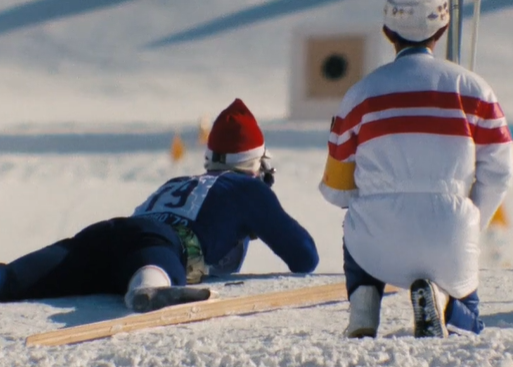
At Grenoble in 1968, the Olympic Biathlon programme was expanded with the introduction of the relay, while four years later in Sapporo saw the first participation of Italian athletes.
Friday 2 January 2026 9 minutes reading time
The Grenoble Olympics introduced several new features to the Biathlon events. The individual race aligned all the shooting ranges at a single distance of 150 metres and introduced the now-classic sequence of the 20 km, alternating prone and standing sessions. A variable penalty for errors was introduced; the target consisted of two sections, and every shot outside them cost two minutes, while every shot missing the innermost section incurred only a one-minute penalty.
After two World Championships had been held in 1966 and 1967, the men’s relay made its appearance in the Olympic programme and would never leave it, with a format involving a 200-metre penalty loop for every missed target at the two shooting ranges faced by each team member.
Grenoble 1968
The four-year period following the dominance of the Soviet biathletes in 1964 saw growing Norwegian competition. The 1965 World Championships were won by Olav Jordet, bronze medallist at Innsbruck, and those in 1966 by Jon Istad, but in 1967 Viktor Mamatov returned the Soviet flag to the top of the podium.
The individual race was, however, dominated by Norwegian Magnar Solberg, who was added to the team only at the last moment, relegating Jordet to the role of reserve. Solberg, the only competitor not to incur any penalties during the race, built his victory after being two seconds behind the Soviet Gundartsev after the first shooting range. Halfway through the race he had a one-minute lead over his rival, who had also yet to make a mistake. The Norwegian pulled away after the third shooting range and won the gold medal. Soviet athlete Tikhonov, who recorded the fastest skiing time, took silver with two errors, while Gundartsev, also with two errors, won the bronze medal.
The Soviets got their revenge in the relay, where Tikhonov, leading off and despite one error, built a 45-second advantage over Sweden and a one-minute-and-45-second lead over Norway. Nikolay Puzano, Viktor Mamatov and Gundartsev only had to manage the situation to win the gold medal, finishing almost two minutes ahead of Norway and more than four minutes ahead of Sweden.
20 km Individual
- 1. Solberg Magnar (NOR)
- 2. Tikhonov Aleksandr (URSS)
- 3. Gundartsev Vladimir (URSS)
4 x 7.5 km Relay
- 1. Soviet Union
- 2. Norway
- 3. Sweden
Sapporo 1972
During the Olympic four-year period, Aleksandr Tikhonov established himself as the dominant force, with world titles in 1969 and 1970 and a second place in 1971, while leading the Soviet squad to three consecutive world titles. The surprise Grenoble winner, Magnar Solberg, did not disappoint either, winning two bronze medals even though once again he was called up to the team only at the last minute. For the first time, an Italian team also took part, including Willy Bertin, a 27-year-old financier from Piedmont’s Val Pellice, who found himself playing a leading role.
Solberg immediately took command and was leading the race after the first shooting range, while Tikhonov, already with three penalties, was back in the pack. During the first standing session, the Norwegian made one error and handed the lead to Sweden’s Arwidson. Bertin, after one penalty at the first shooting range, shot clean in the standing position and was second halfway through the race, 49 seconds behind the Swede.
The Italian was still perfect at the third shooting range and moved into the lead, followed by East German Hansjoerg Knauthe, who, like the Italian, had made just one error in the first session and was 32 seconds behind him. Solberg, despite another penalty, moved up to fourth thanks to his skiing pace. After the race, Bertin told journalists that he had been informed of his position and had suddenly felt drained. The consequence was four fatal errors at the final shooting range, which sent him tumbling to a disappointing 16th place.
None of the pursuers made a mistake, and Magnar Solberg confirmed himself as Olympic champion, with the silver medal going to Knauthe and the bronze to Arwidson. In a great comeback, Soviet athlete Tikhonov, despite four penalties, narrowly missed the podium, finishing fourth, 21 seconds behind the medal position.
The relay format became the one known today, with three spare rounds and penalty loops if these were not enough to clear the targets. After a subdued start by Tikhonov, who was only ninth after two penalty loops at the standing range, Rinnat Safin brought the Soviet Union back into first place, which it held through Ivan Byakov and Viktor Mamatov to win the final gold medal. Almost three minutes behind, silver went to Finland, while East Germany won the bronze medal. A disappointed Norway finished only fourth. Italy was tenth among the thirteen participating nations.
20 km Individual
- 1. Solberg Magnar (NOR)
- 2. Knauthe Hansjoerg (DDR)
- 3. Arwidson Lars-Goran (SWE)
4 x 7.5 km Relay
- Soviet Union
- Finland
- East Germany
© ALL RIGHTS RESERVED
Social media engagement
Latest in Sport invernali
Klaebo seeks to join Bjoergen at 114 World Cup wins. Mocellini and the Italian women start as outsiders: start list for the Ruka classic sprint
Saturday will see the second day of racing in the Finnish opening triple, with the classic sprint on the programme. Norway are targeting another victory, with Johannes Klaebo the overwhelming favourite (he has Marit Bjoergen's World Cup wins record in his sights). For Italy, the best card to play is Simone Mocellini, followed by Elia Barp and Davide Graz. Among the women, the Swedes are in the front row, but the young Italians will give it a try. Qualifying starts at 8:45 a.m. Italian time (9:45 local time), with the final stages from 11:15 a.m.
17