
Alpine Skiingwomen’s World Cup
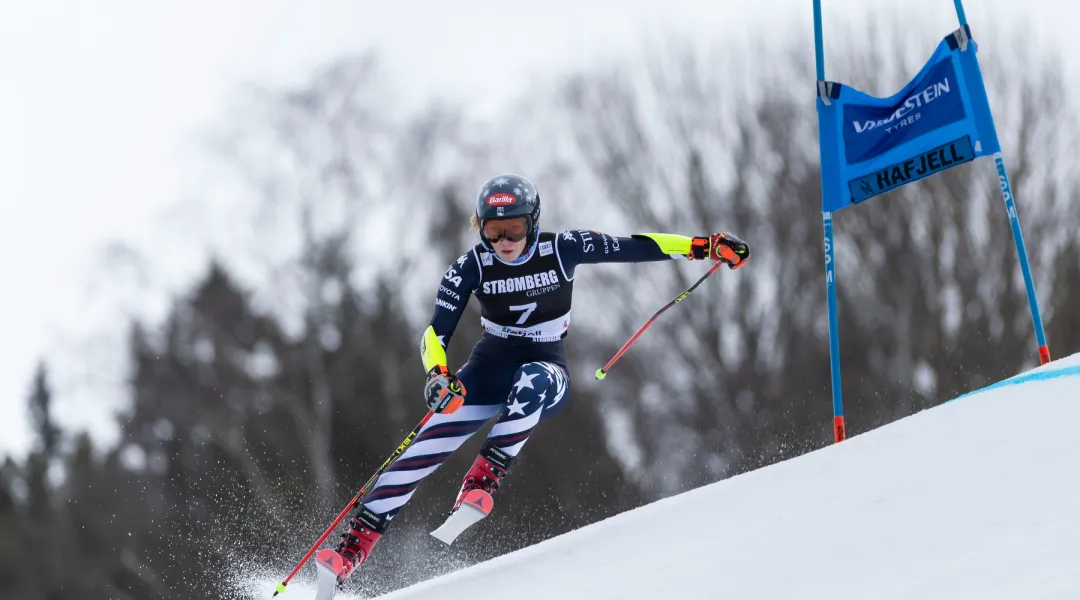

GEPA Pictures

At 31, and after winning her sixth overall World Cup title—not to mention three Olympic titles and eight world championship titles—the American superstar opened up on a wide range of topics through her podcast "What's the Point". We have put together a comprehensive summary...
Friday 31 July 2026 11 minutes reading time
Objectively speaking, Mikaela Shiffrin might no longer have any motivation left in her career, already a very long one (her first victory came at the end of 2012), in which she has won everything, and more than once: from her recently secured sixth overall crystal globe, matching Annemarie Moser-Proell, to her Olympic hat-trick, completed with her victorious slalom run in Cortina a few months ago, to her eight gold medals at the World Championships—even though Crans-Montana 2027 lies on the horizon—and an incredible 110 World Cup victories, quite simply an unreachable figure for anyone else.
Now it is about passion, enjoyment and... curiosity. The Edwards-born champion herself emphasized this concept in the latest episode of “What’s the Point”, the successful podcast Mikaela has promoted extensively over the past year. “Why do you keep going? My honest answer” was the theme of the episode, in which the American superstar, who a couple of weeks ago returned from several days of official commitments, particularly in New York, opened up about every aspect of her life. “Right now I just want to find out what the future holds for me and see whether the work I’m doing at this stage of my career can have a positive impact on the future.
When will I retire? I’m often asked that, and it’s normal. We’ll see what this journey still has in store for me.”
She won nine of the ten slaloms in the last World Cup season (with her second place in Kranjska Gora the only exception), but more than anything else Shiffrin is proud of how she handled the second run of the Olympic race mentally—the run that returned her to the top of the podium at the Games after eight years (12 if we consider her favorite discipline, since she won the slalom only in Sochi in 2014). “It has always been about sensations and how you manage to make your turns.
I had a big lead, but I gave it everything, and it was the best slalom run I’ve ever done on that course.”
There is also great satisfaction, above all, in the extremely difficult comeback she made in giant slalom after what happened in the crash at Killington at the end of November 2024. She had fallen to 30th in the WCSL (just think of the two races in Sestriere a year and a half ago, which were disastrous from a sporting perspective and came immediately before she claimed her 100th victory on the top circuit in her stronghold, slalom), and she even risked having to start from far down the starting lists for 2025/26. Instead, she went on to reclaim the overall title. Last season, the 1995-born Colorado native had already rediscovered consistency and a podium finish, in Spindleruv Mlyn, as well as the speed to win—as shown by the fact that in Are she made a serious mistake late in the first run after creating a huge gap over her rivals.
Of course, Shiffrin was not at her best on every course in the wide-gate discipline, but starting in Soelden she will have another boost of confidence as she sets off in the first seeded group: “It’s truly a fundamental step for me and for the team. Finding my way back in giant slalom gave me an additional incentive to keep going. In my view, the level is now really extremely high and has risen considerably compared with recent years—for example, when I won the world title (in Méribel in 2023, ed.).
Seeing this, I wasn’t discouraged; on the contrary, I found the challenge exciting. I don’t know whether I’ll be able to start winning regularly again, but there were moments during the past season when I felt that level was within my reach. Other times, less so—and that makes me want to keep discovering new things.”
Finding herself up there in super-G is even more complicated, and in this case everything has changed somewhat since her downhill crash in Cortina in January 2024: “When I returned to the start gate in the speed events (referring to 2025/26), it was nerve-racking, demanding but also exciting in part. I pushed myself outside my comfort zone, and every time I crossed the finish line—even when I was far from the best—I always thought, ‘I want to do it again.’ But to perform well in super-G, I still have to work on many areas. My brain has to process the speed, the gates, the terrain, the snow and all the forces that come into play at a different pace.”
What about commitments outside skiing, such as the various appearances in July, including the FIFA World Cup final? Mikaela describes herself as naturally introverted, and says, “I’m certainly much more comfortable with a helmet on my head and behind my goggles than making small talk on a red carpet, which for me is a bit like walking into a school cafeteria without knowing where to sit. It doesn’t come naturally to me at all.”
At the same time, she is also keen to make skiing known beyond certain boundaries, and many projects (such as her own podcast) are aimed in that direction. She also wants to speak openly about issues such as grief, post-traumatic stress disorder and mental health—situations she has had to come to terms with in recent years because of what happened to her, particularly the death of her father Jeff in February 2020—as well as young people’s opportunities to access sport, medical research and climate change.
She also emphasizes that a top-level athlete’s season certainly does not consist only of five months of racing. In the postseason, it is time for equipment testing; between June and July, the reigning World Cup champion worked hard on her physical training (“I generally do it twice a day, for a total of 4–6 hours depending on the schedule”), fitting everything around her media and sponsor commitments. Her team even takes proximity to a well-equipped gym into account when choosing accommodation for Mikaela’s travels.
From the end of August, South America (Shiffrin should once again split her time between Argentina and Chile), then a return to Europe in early October to finalize her preparations for the Soelden opener. “Basically, I spend a total of 4–5 weeks a year at my home in Colorado. Aleks (her fiancé, Kilde, ed.) and I try to manage everything and appreciate the little time we can spend together. One thing I know for sure is who I want to spend my life with.”
The final summary? “I simply love skiing, and I feel there is still so much more for me to discover.”
© ALL RIGHTS RESERVED
Social media engagement
Latest in Sport invernali
Klaebo seeks to join Bjoergen at 114 World Cup wins. Mocellini and the Italian women start as outsiders: start list for the Ruka classic sprint
Saturday will see the second day of racing in the Finnish opening triple, with the classic sprint on the programme. Norway are targeting another victory, with Johannes Klaebo the overwhelming favourite (he has Marit Bjoergen's World Cup wins record in his sights). For Italy, the best card to play is Simone Mocellini, followed by Elia Barp and Davide Graz. Among the women, the Swedes are in the front row, but the young Italians will give it a try. Qualifying starts at 8:45 a.m. Italian time (9:45 local time), with the final stages from 11:15 a.m.
2