
Alpine Skiingthe interview

ufficio stampa

From her relationship with Lindsey Vonn to meeting Roberto Baggio, as well as her relationship with the wife of her ski technician Barnaba Greppi, “who was decisive in giving me the idea of having the plate removed from my leg earlier after the injury in Ponte di Legno.” The Olympic champion opened up on Gianluca Gazzoli’s hugely popular podcast: the interview, recorded before her departure for South America and published today, is truly packed with insights and anecdotes: we have summarised them.
Thursday 25 September 2025 20 minutes reading time
A two-hour conversation, ranging across a thousand topics and revealing some particularly interesting tidbits.
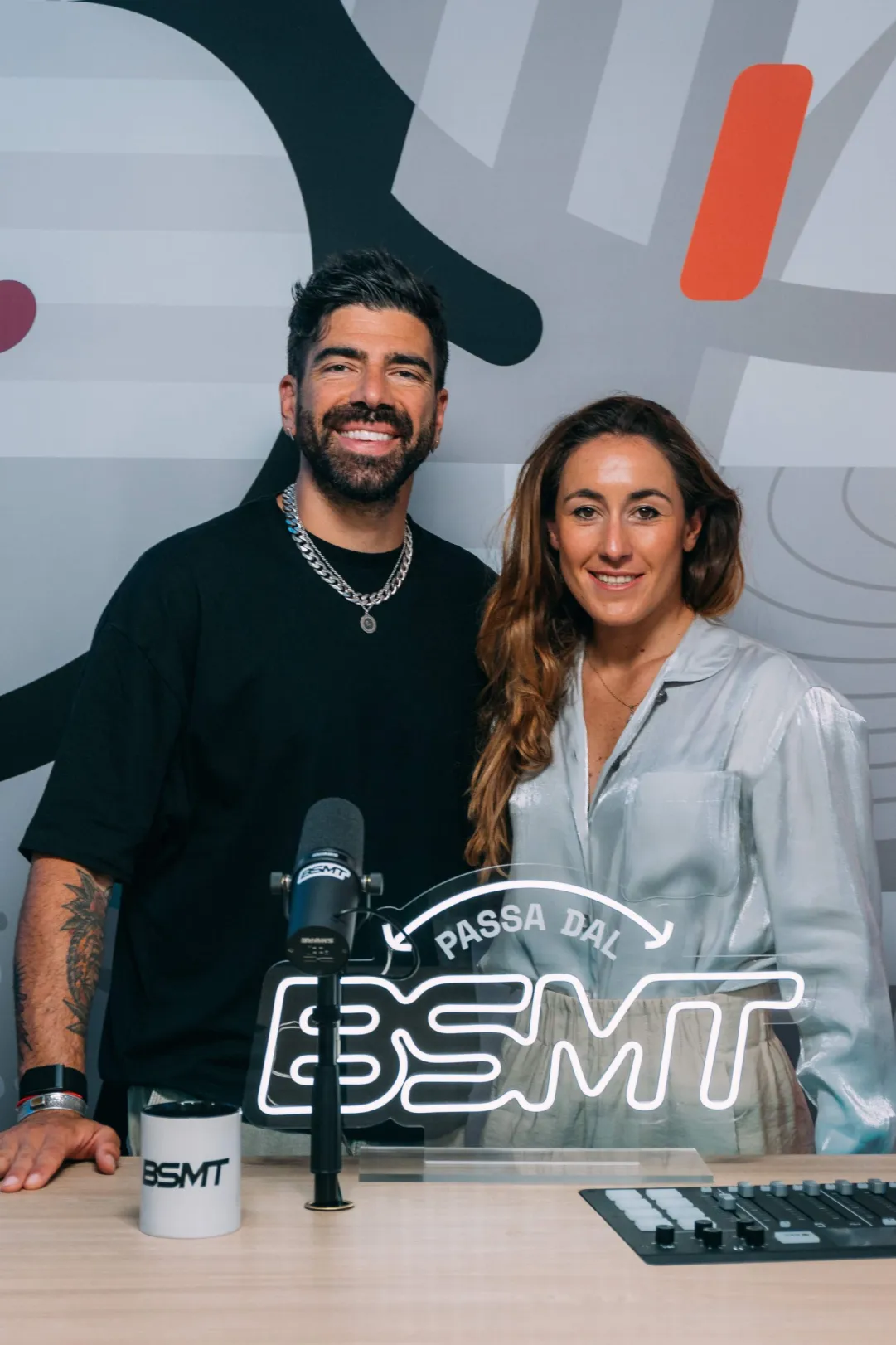
Sofia Goggia appeared on BSMT as the special guest of the first episode of a new season of “Basement”, the hugely popular podcast created and hosted by Gianluca Gazzoli (available on YouTube and Spotify). The Bergamo-born star opened up before leaving for Argentina (the episode was published at noon today).
“In my life I have never given anything up precisely because I chose something else,” Sofia said at the start of the podcast, where she immediately revealed her phobia of dolls, “to the point that when we stay in guesthouses in Austria, where there are always dolls, I feel sick.” Dry-land training is always extremely demanding, so much so that she “can’t wait to go to Argentina almost so I can rest.”
The very few days she has spent skiing with friends (“I think two in my entire life, three years ago in Val Gardena, and then, if I can, early in the season in Foppolo first thing in the morning, but it depends on the race dates”).
Sofia spoke about the memorabilia she owns, “in particular the three bibs signed for me by Ingemar Stenmark, Lindsey Vonn and Aksel Lund Svindal, for the celebration held at the 2019 World Championships in Åre. I also have a wardrobe full of my race bibs; I usually don’t want to give them away, although it does happen sometimes. The World Cups and the Olympic gold medal are in my house, just as Lindsey has a wonderful trophy cabinet. My relationship with her? We also keep in touch outside winter; every now and then we send each other messages and care about each other as people. We have great esteem and respect for each other. It isn’t something to be taken for granted, but we both know that the competition starts at the starting gate and ends when we cross the finish line.
She had to stop because every race was a risk given all her problems, but the semi-prosthesis they fitted allowed her to do things in everyday life that made her think, “Why not try skiing again?” But she returned for just one race, the Olympic downhill in Cortina, on her home track. She was heavily criticised and had a little difficulty finding her rhythm, but she was incredibly brave to put herself back on the line and has already returned to the podium. When I heard the first rumours, I asked her whether it was true and she immediately said yes, adding that the results in New Zealand had been good. I immediately thought it would be nice to share a podium with her.
Then I also thought about my concerns for her, since we are talking about a sport with a high degree of risk and I didn’t know what condition she would be competing in, but everything went well straight away.”
The injury-ridden past somehow connected Goggia and Vonn, Sofia admits: “But on the day she was seriously injured in the super-G in Schladming in 2013, my first World Championships, where I finished fourth, I had already had two ACL injuries. We always recognised and respected each other because we knew the suffering we had experienced. When I won the Olympics in 2018, she told me that if there was anyone who could do it—beat her (Lindsey won bronze, ed.)—it was me.”
“I tore my first ACL at 14,” the Olympic champion recalls, “but perhaps getting injured so young brought me into a dimension in which I no longer suffered mentally because of injuries; they were simply another challenge to overcome. Except for last year’s injury (at the beginning of February 2024 in Ponte di Legno, ed.), which was truly devastating: I was getting into great form in giant slalom, I missed a gate by a few centimetres and my foot got caught in the base of the pole. Even before I came to a stop, I already knew I no longer had any feeling in my foot. My tibial plafond was shattered and I told everyone that my dream ended there.
Beyond the conventional words in the FISI statement, I was convinced that this time I would not come back. I went to Roberto Baggio’s house; he was extremely kind and invited me in for coffee. It had been three months since the injury, I was in a complete mental blackout and thought my career was over, even though I had immediately started working on my recovery. He told me, ‘I didn’t think you had this awareness,’ and that meeting gave me so much; I wanted to go to someone who could truly understand me. He found a great deal of peace in Buddhism. At one point he took my arm and said to me, ‘You decide for yourself; everything else is just a load of b******t.’ He and his wife had found me in a state of extremely high stress.”
The recovery during summer and autumn 2024 went better than expected, “also because I was lucky. The plate was hurting me; one final training camp at Stelvio was planned, followed by Argentina from 17 August to give me more time. At the end of July I went to see my ski technician Barnaba Greppi and his wife, ‘Bibi’, who had suffered that type of injury when she was a skier. She told me that things would go better without the plate. I went home with that thought in my head and, once I returned to Stelvio, where I could feel every vibration, I discussed the idea with my coaches and doctors so I could return directly at Copper Mountain, even though that meant giving up that phase of preparation. It was the right decision, even if at the time it seemed like a bizarre idea: we waited a month while doing strengthening work, and on 7 September the plate was removed. I returned to the slopes within about 50 days, getting back on snow at the end of October in Val Senales. From the very first moment I put my boot on, the feeling of not being in pain freed me. And in America I was truly my usual self, despite having had very few days on skis.”
She also recalled the Beijing Olympics, which she contested while injured after her fall in Cortina: “But after the first training run I realised I could do it, even though the coaches feared I would not make it to the finish and that I might only worsen the situation. That ‘yes’ I shouted at the finish—although I normally don’t shout at the finish line—was liberating, but at that very moment I knew perfectly well that my advantage over Nadia Delago (41 hundredths, ed.) would not be enough for gold.
Given the situation, I would have signed a thousand times for that silver, but when you are there, it is obvious that you give 100% to win. You have no excuses and you put yourself on the line.”
PyeongChang 2018? “My first Olympics; that downhill was one of the best days of my life. I have always found the five rings irresistibly fascinating. Having the chance to experience and achieve my dream was a source of immense pride. Until the previous season, I had essentially achieved nothing in the World Cup, although a string of podiums and my only two victories then came in the pre-Olympic events, by a few hundredths over Vonn in the downhill and super-G. The following summer was difficult in terms of managing everything. I wasn’t used to being famous and that Olympic season had started poorly, but I still arrived at the Games leading the downhill standings.
It was unbelievably cold in PyeongChang. I shared a room with Evelyn Insam (the former Italian ski jumper, ed.) and, as I have already had occasion to say, I always experienced the Olympic Village without practically interacting with anyone. At the Games I am on a mission, with my headphones on but no music, nothing, just to isolate myself.”
Gazzoli asked Goggia about her third Olympic opportunity, namely the huge goal of Milano Cortina 2026: “I’ll be brief: first I qualify, then I’ll think about the Olympics when I’m there, in the moment. There’s no point thinking about it now, although it’s clear that I replay that course in my head several times a day, and have done for months. Our sport, however, is unpredictable and full of variables. The key to arriving there in the best possible shape is to think about one World Cup race at a time.
The best approach, as the great Alberto Tomba said in a documentary about him, speaking about himself in the third person, is: ‘We’re at the Olympic Games, so let’s play.’ That phrase, which sounds banal, is the key.”
They also discussed her approach to social media, which has always been distinctive for the Bergamo-born skier: “I admit that I occasionally read the comments and, although over the years many agencies have offered to help me with scheduled posts and so on, I have always been very reluctant because I like sharing the emotions of the moment. If a piece of content doesn’t come from my own head, I will never reach people.
This is who I am; I want to stay this way, and besides, I really like writing.”
“In 2021 I took advantage of the Luiss scholarships for dual careers,” Sofia said about her studies. “I have three exams left to graduate in Political Science, and I will be ready in 2026. I have always loved studying, but if there had been a Philosophy course, I definitely would have enrolled in that!”
Giovanni Malagò is no longer president of CONI, having had to step aside after his terms in office for the new assembly that elected Luciano Buonfiglio: “It is a shame that an exemption was not granted for the Olympics. Giovanni oversaw the entire project, and I was sorry that this opportunity was taken away from him eight months beforehand. He was a great president, always willing to listen to athletes and a true man of sport.”
On Federica Brignone’s lengthy enforced absence: “She suffered an injury that was worse than mine in many respects, and it came after the best season she had ever had—an incredible season. Then, on an ordinary day, you get injured like that and everything changes completely. Mentally it is very difficult. She had her crutches removed after three months, and I don’t know how she is managing it, having had no serious problems throughout her career. I called her immediately and, since I also had work to do in Turin, I took the opportunity to visit her. I can only wish her the very best.”
And while Cortina remains “the most beautiful course and my magical place,” when discussing examples from the past Goggia speaks of the Valanga Azzurra, “which I absolutely love: watching those athletes with rudimentary skis and boots, semi-padded suits and helmets that barely deserved the name, on courses where everything was shaking, with pine needles and hay bales at the sides—the true romantic spirit of a downhill skier.
I have always described myself as an excellent thief, because I have always taken inspiration from others to improve. For example, in 2018 there was a section of the Olympic downhill that Nadia Fanchini handled well, whereas I always got it wrong in training. This bump had to be tackled at 100 km/h; you had to take pressure off by changing direction in the turn and land already prepared. She had perfect timing, and I watched that video over and over again.
Fortunately, I managed it on race day.”
There could also be a project with Red Bull (which has supported Sofia for years) and Arianna Tricomi in the near future: “She is an extraordinary freerider and we used to compete together as youngsters. She wants to take me to Alaska. I like the idea of powder skiing, but we will have to calculate the timing carefully.”
© ALL RIGHTS RESERVED
Social media engagement
Latest in Sport invernali
Hector to open the Killington giant slalom, with Scheib third, followed by Rast and Shiffrin: 11 Italians to start, led by Della Mea
The start list for today’s giant slalom on the "Superstar" (first run at 3:30 p.m. CET, second at 6:30 p.m.), in conditions expected to be challenging and with the last winner in Vermont wearing bib 1, while Moltzan will start sixth in red after her teammate, who is seeking her first victory in this race following the accident two years ago. Overall leader Lara Colturi, on a course set by her father Alessandro, has bib 9, while Della Mea has drawn 13. After the technical break will come Goggia (16), making her season debut, and Zenere (bib 18), with Bassino bib 29 and Pirovano and Trocker following outside the top 30.
87