
Alpine Skiingthe interview

Pentaphoto

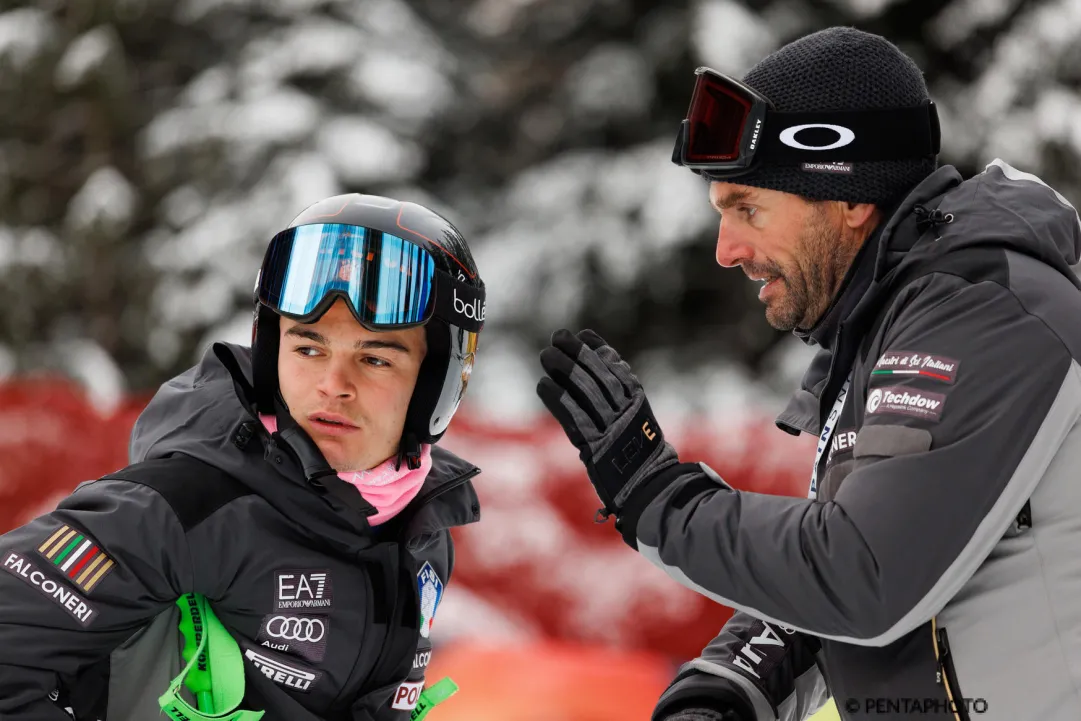
The coach of the Norwegian slalom team spoke to “Après-Ski”, interviewed by our Umberto Volpe and Fabio Poncemi on all the issues concerning not only his team, from Atle Lie McGrath’s bid for the World Cup slalom title to Kristoffersen’s “hunger” (“an extraordinary champion also because of his mentality”) and Haugan’s back problems, but also the Italians he coached until 14 months ago. Here he is, covering every angle...
Friday 13 March 2026 15 minutes reading time
On Thursday evening, Simone Del Dio was a guest on the programme “Après-Ski – Il club dello sci alpino”, hosted by Umberto Volpe, alongside another NEVEITALIA editor, Fabio Poncemi, who chatted with the coach, originally from Bardonecchia by adoption, and in charge of the Norwegian slalom team since this season.
There has been no shortage of satisfaction after his departure from the Italian national team the previous year, during the season, somewhat as happened to Mauro Pini in 2025/26, although the major remaining objective, the World Cup slalom title currently led by Atle Lie McGrath ahead of the final race, is still to be secured.
The 2000-born skier, already a three-time winner this season, experienced the immense bitterness of skiing out in the second Olympic run after dominating the first on that surreal day, which ended with Atle desperate and “taking refuge” in the woods beside the Stelvio. His response was that of a champion, winning at Kranjska Gora last Sunday for a one-two finish by Del Dio’s athletes, with Kristoffersen second by just one hundredth: “First of all, I have to say it was a surprise to find Podkoren in such condition in March. There was enough snow even for the warm-up slope, and we had two great races,” explained the coach of Genoese origin. “It is a beautiful hill in its own right, and next year we will almost certainly return in January, which will help further.
Of course, at the Olympics neither McGrath nor Haugan won a medal in the giant slalom and slalom, so the haul was not positive, although Kristoffersen took bronze, Timon finished fourth and Atle was leading after the first run. The morning after he went out, I accompanied him to the airport and tried to leave him with something to carry forward into the rest of the season, which still had a lot to offer. At home, he managed to recover the energy he had lost and put together a fine giant slalom in Kranjska, finishing fourth, and then won the slalom.
He was mentally in a good place, confirming that the phrase ‘you either win or learn’ applies to everyone. With my athletes, I have experienced three fourth-place finishes at the Olympics and one victory with Noel. I can understand what it means to go out in a single race, which is different from all the others, but you must not beat yourself up if things do not go as you hoped.”
Atle’s bid to compete in multiple disciplines has been halted twice, by serious injuries in 2021 and 2023, but according to Del Dio, given the current World Cup and this type of calendar, it will be difficult to revive it: “We have discussed it. He raced the super-G in Copper Mountain—very well, finishing 12th—but his energy immediately dropped, he trained poorly afterwards and was not ready for Beaver Creek.
I have my own opinion, and I fear it is impossible to do both slalom and super-G, also because of the calendar, which I believe, rather like in tennis, will increasingly force athletes to sacrifice races and disciplines, somewhat diminishing the value of the overall title. Even Meillard has often had to give up the super-G, and with next year’s programme, also considering Campiglio’s return after Alta Badia, it will already be difficult to race all the giant slaloms and slaloms.
Then you also have to consider that, with this Odermatt, to challenge him you would have to win almost all the technical events; only “Marcellino” (referring, of course, to Marcel Hirscher) could have done it. Atle likes it and needs it too, but training is one thing and racing is another. Super-Gs, moreover, are often half-downhills, and you have to invest entire weeks in them.”
He considers the season-long performance of his Norway in giant slalom “positive, although the boys generally have a higher level in slalom. Atle immediately made the podium in Sölden and, amid highs and lows, perhaps with Haugan not consistent on every slope, when it comes to Kristoffersen, the results have certainly been there. Henrik has surpassed 100 World Cup podiums; whenever he gets the chance, he does not let it slip, truly an extraordinary champion. I’ll tell you an anecdote: in Wengen, immediately after his 100th podium, he was ‘black’ because he wanted to win. That tells you about his temperament, just as at Kranjska Gora when he finished second.
Some people may not like him, but if he had not been like that mentally, he probably would not have had this career. He is exactly as you see him, one of those athletes who does not let even a crumb fall from the table.”
There was also discussion of the development of Solberg and Grahl-Madsen, “with the former someone I have followed from the beginning and who is certainly very good in terms of consistency in slalom, having missed the giant slalom final only in the last race,” as well as Timon Haugan’s back problems. He had led the slalom standings in red until January before suffering from the physical issue that had plagued him almost since the start of the season. “It became difficult. We had also considered sacrificing the giant slalom, and then it is clear that in slalom, as soon as you have some hesitation, you start checking your skiing and mistakes also follow.
He has skied very little so far. I have now seen him training at the volumes he had in the summer; he is a great worker and needs the runs, needs to feel strong, and this problem has had a major impact.”
As for Marco Odermatt, who will celebrate his fifth consecutive overall World Cup title in the coming hours, the coach from Bardonecchia by adoption has no doubts: “He may have lost something in giant slalom in terms of his advantage, partly because the competition has grown, but we cannot underestimate the energy he expends throughout the block of speed races, especially from Val Gardena onwards, as well as the particular circumstances of an Olympic year.
In terms of consistency, he is a truly monstrous athlete, and what he is doing is stratospheric, managing everything so well.” Regarding Noel, whom he guided to the 2022 Olympic title but who, barring poor performances by McGrath and Pinheiro Braathen in the Hafjell final, will see the slalom title he has never won in his career slip away this winter as well: “It is difficult to say exactly how he has experienced his season, although I still have an excellent relationship with him,” Simone replied. “From what I saw in Kranjska Gora after the mistake, or if I think of the second run in Schladming, he still has sequences like an athlete who may be a level above the others. Perhaps he has lost some consistency because, in his case too, he must always live with his back problem.”
And then there is “his” Italy, which has not made the slalom podium since Vinatzer finished second in Kitzbühel in 2025, has not won for more than nine years and, in the technical disciplines overall, including giant slalom (where the last victory dates back to February 2012, ed.), is experiencing a deep crisis. “It is difficult to generalise about the group,” began Del Dio’s analysis, after leading the Italians until the post-Adelboden period 14 months ago. “Speaking about individuals, I would say that Tommy Sala has always been a skier who is beautiful to watch; you expect him to reach the podium from one day to the next.
He came close at Palisades Tahoe. Achieving it at that moment could have helped him in terms of confidence; he could always have been in the top five, and then came the injury. I saw him return well, comfortable with his equipment and also in piste conditions that he may have struggled with before. Then he experienced a decline, which is physiological when returning after a cruciate ligament tear.
Vinatzer made the podium at the World Championships, then committed himself to the dual-discipline project, making unexpectedly rapid progress in giant slalom. Alex is always under pressure because people expect him to save Italy’s technical disciplines. Then there are the young athletes, and with Saccardi there is now an athlete who is ready, but others will also benefit from his development. In my view, the situation is not so catastrophic; it is true that the results do not reflect the athletes’ ability.
As in the case of Della Vite, who is one of the most modern giant slalom specialists around: he has certainly had problems, although I cannot say whether they were related to his approach or something else. He has not achieved what his potential would suggest—truly, he has a lot more in him.”
© ALL RIGHTS RESERVED
Social media engagement
Most read in Sport invernali
Fede, the shock announcement: Brignone retires. “My leg hurts too much, I’ve decided to end my career. I’ll open one last starting gate”
In a video released by FISI, the Italian champion announced that she had decided to call it a day: the two days on skis in Cervinia did not give her the answers she had hoped for, and Federica will compete in one final race to say goodbye to everyone. The most successful woman in the history of Italian skiing is leaving the sport.
2