
Alpine Skiingthe interview
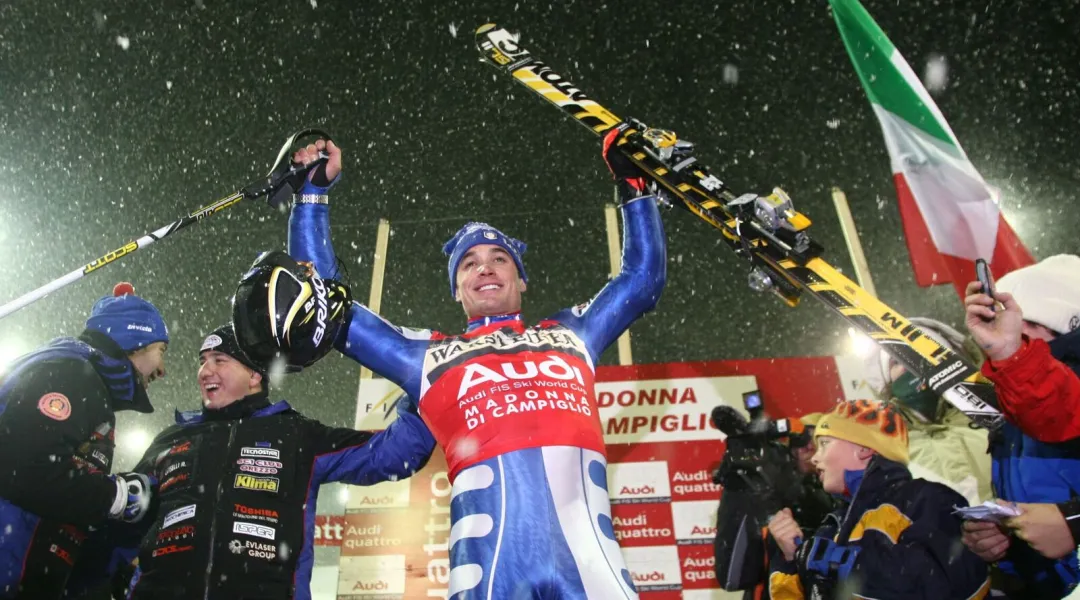

foto Bisti

We interviewed the Livigno champion not only to celebrate the 20th anniversary of the last Italian victory on the Canalone Miramonti: with Giorgio Rocca, we discuss the state of health of Italian slalom ("Vinatzer needs to work on the mental side"), Hirscher's latest comeback attempt ("I have enormous respect for him, but he can't return to the top"), and the Olympic challenges in his Valtellina. "Bormio will not be an ordinary race; an incredible amount of work has been done in Livigno that will be useful for the future." And much, much more in this conversation with the multiple world medallist.
Monday 17 November 2025 18 minutes reading time
Giorgio Rocca was the symbol of Italian slalom in the first few years after the Tomba era, a champion capable of winning eleven times in the World Cup and claiming the crystal globe in the discipline during the magical 2005/06 season of five consecutive victories (before the Olympic disappointment that cannot take anything away from an extraordinary winter), in addition to three bronze medals at the World Championships, including the combined event at the home championships in Bormio 2005 (following his first World Championship podium in Sankt Moritz in 2003).
Having celebrated his 50th birthday last August 6, the Livigno star is experiencing the build-up to the Madonna di Campiglio slalom together with the 3Tre organising committee. The race is scheduled to take place on the Canalone Miramonti next January 7 and will be even more special because we are now marking the 20th anniversary of the last Italian triumph in the Trentino “night race”—Rocca’s own victory on December 12, 2005.
And so, between last week’s flight to London and the second stop of the “3Tre on Tour”, scheduled for this evening in Milan, we caught up with Giorgio for a long conversation about the many issues in top-level skiing, starting from those very sweet memories that the Valtellina champion has always summed up with a very clear idea. “Campiglio remains the finest victory of my career.”
That evening, Raich and Palander joined you on the 3Tre podium, and you had become a father just a few weeks earlier (your firstborn, Giacomo, was born on November 21, 2005, ed.): what kind of emotions did that slalom give you in the middle of your spectacular winning streak?
“My family was with me in the room. It was a little strange because the baby was about to experience his first race; when I think that he is now at university, it feels strange. The time had come for me to win in Campiglio: after two second places, I was feeling good and relaxed, with the ability to stay focused on what I had to do. I remember the incredible turnout; they told me there would be more than ten thousand people since I had already won during the season. That evening, you could begin to see, on a small scale, what Alberto (Tomba, ed.) brought to the Canalone Miramonti. He was my idol, and it later became customary to receive his SMS messages between runs.
I was fourth after the first run (27 hundredths behind Benni Raich, ed.), with a little less stress. I immediately realised that I had skied an excellent second run. The piste had been prepared to perfection, with incredible grip, and then the snowfall made everything magical, also because it was still perfectly visible under the artificial lighting.”
Technically, how difficult was it compared with your other great victories?
“I can say that Atomic really gave me tremendous support. Just think, we went to Argentina with 37-38 pairs of slalom skis to find the right one for every condition. We were perfectly in sync; you could see the passion of the people working there and I trusted them completely. At that point, the opponents were trying to figure out what I had that they didn’t. It’s not as if Raich and Palander and I exchanged any particularly profound thoughts after the race, apart from congratulations. When you win that much, people start to resent you too!”
Your relationship with the organising committee led by Lorenzo Conci later became very special, with your role as ambassador for the slalom that symbolises Italian skiing.
“Since 2012, the year Campiglio returned permanently to the World Cup calendar, they immediately offered me a role in communications. I can honestly say that, beyond the working relationship, I found a family, and the fact that I was already so attached to the event because of that memory of the 3Tre did the rest. It is the Italian resort that has given me the greatest notoriety, together with the World Championship races in Bormio.”
We clearly remember when you also finished ninth in the giant slalom on an extremely tough piste like the Gran Risa (in 1998, ed.): did you ever truly believe in becoming an all-rounder, or at least in having a second “strong” discipline?
“In 1999 I was among the top 15 in the world, but with the evolution of skis everything became more complicated. I felt competitive on difficult, icy terrain—in conditions that were more suited to slalom, so to speak. I wasn’t bad in downhill either, which I needed for the combined events at major championships (with the World Championship bronze in Bormio 2005 and the Olympic medal I narrowly missed in Turin 2006). I liked being an all-rounder, but at the same time it distracted me, because after a while slalom also becomes boring: if you don’t ski at least 25,000 gates a year, you can’t stay at the top.”
How much did your retirement, announced at the temple of Kitzbuehel after the adductor injury you suffered in training—and which cost you your last Olympic chance in Vancouver—affect you? You had started that season well, with eighth-place finishes in Levi and Alta Badia...
“I was competitive, even though my right knee, the one I had surgery on in 1996, was hurting terribly. At a certain point, you realise that the time has come. In hindsight, the conditions in Vancouver might have made things difficult for me, but I believed in it. And suddenly I found myself commentating on Razzoli and his gold medal—a twist of fate, considering that Giuliano had been a course setter in Turin.”
There has been a lot of talk about comebacks following those of Pinheiro Braathen, Vonn and Hirscher. What do you make of the eight-time World Cup winner? Hermann Maier said he believes he could even win at the Olympics (HERE are the “Herminator”’s comments, ed.).
“I never considered doing it myself. When it’s over, it’s over. But it’s clear that you always want to be the best, and in the first few years after retirement you still have that desire: your mind wants one thing and your body another. If you ask me about Marcel, whom I also ‘thrashed’ at the beginning of his career, I’ll tell you that I have enormous respect for everything he has achieved—truly a great champion—but things cannot be as they were before. First of all because of his age, and secondly because of the evolution of equipment and therefore of technique: he still skis as he did six years ago, and the change has been too great. We also have to bear in mind that he had a style all of his own. Braathen himself, who in fact never stopped skiing even during his season on the sidelines, still struggled to return to winning ways with a different date of birth. And we’re talking about a phenomenon.”
With your GR Mountain, a highly regarded ski school, you certainly have no shortage of commitments.
“That’s the backbone of it. Then there’s the part connected to the Olympics, which is giving us positive feedback, as a company that organises outdoor activities, not only skiing. And then there are my children, although they’re now all moving ahead at full speed: Francesco is studying in Birmingham, Tommaso has already made his World Cup debut in Downhill (a mountain bike discipline, ed.), and Giacomo is at university, as well as the nine-year-old little one who... hasn’t tried skiing yet. No, I never wanted to push them into my sport.”
Returning to competition, how do you see the Italian slalom team, which made its debut yesterday in Levi... with a great deal of suffering?
“I know Mauro Pini. He has always been used to working with women, and many things are changing for him too, but he has found a disastrous situation in terms of habits and routines. The youngsters certainly lack a benchmark who is skiing fast. After Tomba, I was initially the only one, then Manfred and Razzo came along, and everyone developed. Alex (Vinatzer, ed.) unfortunately is incredibly inconsistent. He should work more on the mental side rather than on performance: he has never suffered a serious injury, he hasn’t had any revolutions in terms of equipment, and he needs to do better.”
The men’s Olympic slalom will take place in Bormio, which you also know well from that 2005 World Championship challenge. It isn’t one of the circuit’s classic pistes and perhaps isn’t even considered particularly difficult, but...
“It will be demanding, actually, because the upper section is completely different from the lower one, where if you don’t carry speed onto the flat, you’ll never get out of it, and the start has been raised a little. Of course it isn’t a classic piste, but with the bumps that have been created it will be an interesting slalom. And I can tell you that the downhill will also change a lot between December and February, in terms of visibility and probably with the snow surface less hard.”
There has been a lot of talk in recent weeks about flag bearers and torchbearers: you were still competing at the Turin 2006 Games, but you read the athletes’ oath and... what role do you dream of having at Milano Cortina 2026?
“The director put enormous pressure on me, telling me that I simply couldn’t get anything wrong. On January 30, I will carry the Olympic torch in Livigno. I hope to be involved in the ceremony that will take place in my hometown, and I want to say that Livigno has really done an incredible amount of work. Our legacy will be significant, because the resort has been completely transformed as a tourist destination by making the most of this great opportunity. I’m very happy about it.”
© ALL RIGHTS RESERVED
Social media engagement
More details
Most read in Sport invernali
Fede, the shock announcement: Brignone retires. “My leg hurts too much, I’ve decided to end my career. I’ll open one last starting gate”
In a video released by FISI, the Italian champion announced that she had decided to call it a day: the two days on skis in Cervinia did not give her the answers she had hoped for, and Federica will compete in one final race to say goodbye to everyone. The most successful woman in the history of Italian skiing is leaving the sport.
29