
Alpine Skiingmen’s World Cup

GEPA Pictures

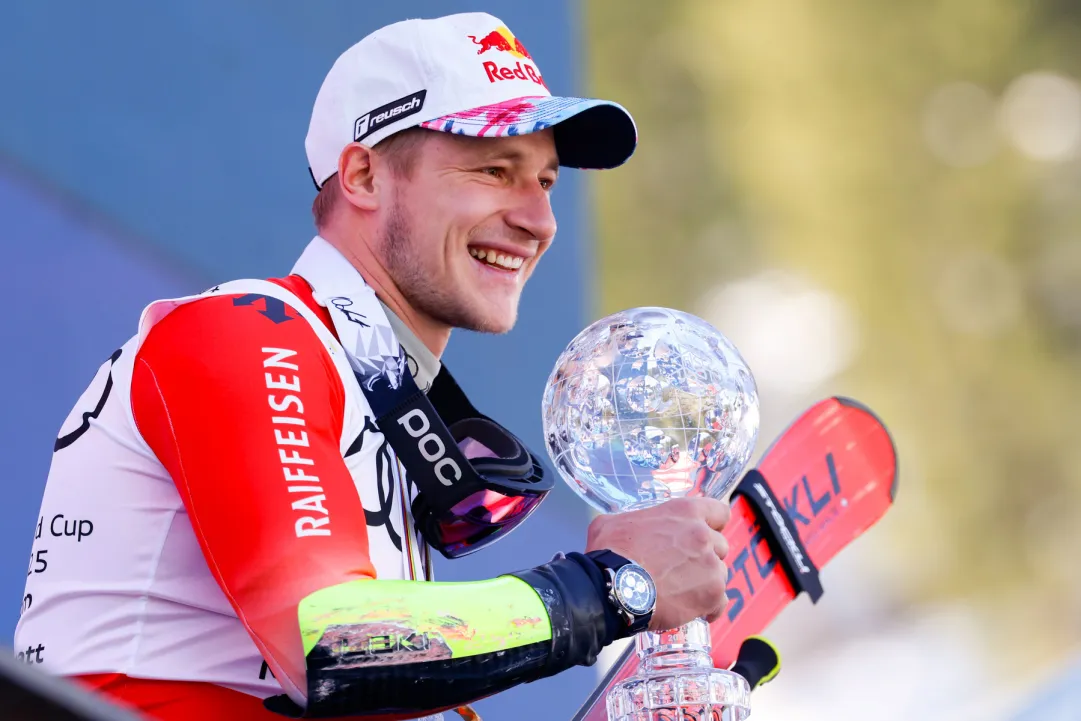
After the women’s circuit, NEVEITALIA presents the men’s season, starting from the Swiss phenomenon’s double four-pack of crystal globes. He wants a fifth overall title like Girardelli and is looking for a flying start on Sunday in Soelden. His compatriot and world slalom champion Meillard appears to be the first rival; we will see how far Pinheiro Braathen can go, while Schwarz’s level remains an unknown. In downhill, it is an all-out battle, with von Allmen and Paris aiming to challenge “Odi”.
Friday 24 October 2025 43 minutes reading time
After presenting the women’s season yesterday (HERE you can read the full report), it is time for our “5x5” for the men’s World Cup, which starts on Sunday with the Soelden giant slalom.
The top five favourites in the five standings (overall, downhill, super-G, giant slalom and slalom), plus the outsiders and the Italian form guide, looking ahead to the Olympic winter. The World Cup will feature 38 races, as in the original calendar for last season, although with a slightly different distribution: there will be one fewer slalom (11) and one more speed race, with nine downhills as well as nine super-Gs and giant slaloms.
The new additions? Livigno, with the super-G on 27 December, and, a month earlier, the Copper Mountain stop. After all the classic venues, there will be a pre-World Championship appointment in Crans-Montana, as well as the return of Courchevel—with speed races on the Eclypse—after appearing only at the 2022 Finals and the following year’s World Championships.
There is a clear favourite for the overall title, so naturally we start there: Marco Odermatt, seeking five in a row.
OVERALL: MEILLARD MAY BE ODERMATT’S ONLY RIVAL, BUT BRAATHEN...
Marco Odermatt: at 28, the Nidwalden ace is at the peak of his maturity and still shows the same hunger, despite already winning everything and, over the last two seasons, securing four globes like Hermann Maier around the turn of the millennium. His lead over the rivals has always been enormous, also because of the serious injuries suffered by Schwarz and Kilde when the Austrian and Norwegian were his two direct opponents with the greatest points potential. This time, however, “Odi” could find someone within his own national team capable of staying at least in his slipstream.
Loic Meillard: the 1996-born skier from Neuchatel is the true all-round World Cup man, ranging from slalom to speed, although the disappearance of the combined events removes the theoretical advantage offered by his characteristics. Back problems at the start of last season cost him dearly, especially as he had largely set aside super-G, but in the new year he returned to his level in the technical events and finished brilliantly, beating Odermatt repeatedly in giant slalom after his triumphant Saalbach World Championships. If he can put fear into his teammate in the wide gates, he may at least think about challenging him, naturally making the difference in slalom, where there are many opportunities.
Henrik Kristoffersen: last year he again finished second (his eighth overall podium, without ever winning the title), around 40 points ahead of Meillard, and he is an absolute guarantee across the 20 technical races. The problem is that his maximum potential haul is probably 1,300–1,400 points; only a significant “blank” from Odermatt would make that enough to fight for the overall globe. His great objective will be the Olympic gold he still lacks, as well as the discipline globes after reclaiming the slalom title, his kingdom.
Lucas Pinheiro Braathen: at 25, if there is one man who can think about the future—and probably also the present, in the second season of his “new career”—in the overall standings, it is Brazil’s standard-bearer. Even when he still raced for Norway, he showed that he could broaden his base to super-G, clearly intending to challenge for the “big globe”. Injuries slowed his progress, together with the sabbatical winter required to change nationality. Now we will see what “Pinheiro” offers in 2025/26, starting in Soelden, where he will face King Odermatt head-on. His samba could make the difference in the 11 slaloms on the calendar: if he is consistent between the rapid gates, there will be plenty of entertainment...
Marco Schwarz: until 28 December 2023, “Blacky” was very much a candidate for the overall title, which had always been the goal of his career, as he himself stated unequivocally. Last season was his return after cruciate-ligament surgery and was fairly good overall, although we have not yet seen the Carinthian on the podium. By putting super-G back on the menu, the Austrian ace will try to move closer to the all-round concept that he may have taken too far two winters ago, when he was injured in the Bormio downhill. Schwarz knew, however, that beating Odermatt required performing well in all four disciplines. It is difficult to imagine him returning to that level, although the coaches also swear that his speed potential is exceptional. This winter will be crucial in determining whether the “big globe” can still be an objective rather than a dream.
Outsiders and Italians: Raphael Haaser, fresh from his giant-slalom world title, has all the qualities to perhaps fight for the final top five if free from the injuries that held him back last season, given his super-G ability, where he is an absolute benchmark. For Kilde, expected to return after almost two years at the start of December in Beaver Creek, 2025/26 should simply be about regaining good competitiveness, with no World Cup objective (not even a discipline title, barring miracles). Norway also has three other potential front-runners, although probably not for the final podium: Timon Haugan, who has also improved in giant slalom and is now a slalom phenomenon; Atle Lie McGrath, who, like his “twin” Braathen, stopped just as his versatility was becoming concrete; and Alexander Steen Olsen, who also has both technical disciplines in his repertoire but is struggling with his usual knee and will miss the opener, where he triumphed a year ago.
There is also Fredrik Moeller, already a super-G winner but still to be assessed in downhill (and in giant slalom, where he will race in Soelden), as well as another phenomenal youngster, Lukas Feurstein, who finally broke through at Sun Valley. Among Swiss speed specialists, the von Allmen–Monney duo can certainly approach the overall top five with downhill and super-G points alone.
What about Italy? Three names could finish in the final top ten, realistically the only credible objective for Dominik Paris, Alex Vinatzer and Mattia Casse. In any case, they will focus mainly on the discipline standings and, as February approaches, the major Olympic challenges.
DOWNHILL: VON ALLMEN FOR HIS FIRST TITLE, BUT “ODI” WON THE LAST TWO...
Franjo von Allmen: the discipline world champion finished second last season, taking his first major World Cup successes after winning the world title (although he had already won a super-G in Wengen). Race by race he is gaining confidence: a downhill “monster” ready to take the sceptre from captain Odermatt. The double Beaver Creek challenge on 4–5 December could favour the defending champion and will be important in shaping the battle, which will not be limited to the two of them...
Marco Odermatt: he won the last two trophies narrowly, with the final cancellations certainly not disadvantaging him, although in 2024/25 the contest with his younger teammate was already decided. His first downhill objective is to win the Streif, but he is now competitive on every course, as shown by what he achieved on the Saslong and again in Wengen, the two venues where he has so far won.
It is clear that he is not yet dominant in this discipline, and the new force emerging within his own team is intimidating.
Dominik Paris: six final podiums and fifth place in each of the last two seasons, “Domme” is one of the greatest downhillers in history, as his number of victories clearly shows. He has never won this trophy, however, and the Olympic season may be his last chance. In the final part of winter 2024/25 he fully rediscovered the level that had seemed lost, particularly in Bormio: he narrowly missed a medal at the World Championships, dominated in Kvitfjell and also looked excellent in super-G. The Val d’Ultimo jet can challenge the Swiss, although the early calendar—with two Beaver Creek downhills followed by the Saslong, where he won in 2023—is unhelpful, since he has never performed well there.
Alexis Monney: he finished third last year, completing an all-Swiss podium, and together with von Allmen was downhill’s true “revolutionary”, consistently at the top in every setting. He won on the Stelvio and was beaten by the narrowest of margins on the Streif. His skiing is remarkably solid and his feel is truly innate, worthy of the best Feuz, to whom everyone compares him.
Cameron Alexander: enormous potential, but another setback—the cruciate-ligament injury suffered in training at the World Championships, where he would have defended his 2023 bronze—raises doubts about his return, although he was able to complete the crucial summer camp in South America. On the podium between Bormio and Kitzbühel before getting hurt, the Canadian is capable of anything, above all in the Olympic race...
Outsiders and Italians: Kilde’s situation was already mentioned in the overall section; for the former discipline world silver medallist, only time will tell what he can do in downhill. Another veteran, Vincent Kriechmayr, did not make our top five, but he will be there in the great classics despite having less consistency than in the recent past, partly because of physical problems. James Crawford won in Kitzbühel and remains inconsistent, but with a good preparation he could finally be in top shape from the start, beginning with the Copper Mountain super-G. Justin Murisier won in Beaver Creek last year and wore the red bib for the first time, but then had more lows than highs and is unlikely to fight for more than a few podiums, especially since the Valaisan must always manage himself after the major knee problems of his career.
There are also Cochran-Siegle, who will be much more than a wild card especially in the Bormio Olympic race; Nils Allegre, leading a France still without Sarrazin; Miha Hrobat, now a fine certainty for Slovenia; and the return of Niels Hintermann, whom it would be good to see back at the front soon.
Besides Paris, Italy will rely mainly on Mattia Casse, who finished the season with an elbow injury in Kvitfjell but over the past three years has reached a level that gives him chances in almost every race. It will also be fascinating to see how far Florian Schieder can go, and especially Guglielmo Bosca and Giovanni Franzoni. The Milan native who moved to the Aosta Valley essentially lost last winter to his Beaver Creek injury; the Garda skier, meanwhile, had the opportunity to show high-level consistency and improved in downhill too. At 24, he is ready to prove that he can be the future of Italian speed.
SUPER-G: THE KING SEEKS FOUR IN A ROW, HAASER COULD BREAK THROUGH
Marco Odermatt: the Buochs phenomenon is seeking a fourth consecutive discipline trophy. In 2024/25 he won three times—in Beaver Creek, Kitzbühel (for the first time) and Crans-Montana—as well as taking the world title after an unforgettable performance. This may be the discipline in which he has shown the biggest margin over his rivals, although every super-G is different. After the disappointment in Beijing, the Olympic race will be even more important, but beyond the Bormio event, “Odi” clearly starts as the favourite for this globe.
Franjo von Allmen: he won in Wengen and produced spectacular performances in this discipline too. His competitiveness can be total, although he still needs to learn a few tricks on certain courses, Beaver Creek above all (Copper Mountain will be new for everyone). We rank him second among the favourites, captivated by his hunger and innate speed, which he can show beyond downhill. He will, however, sometimes need to rein in his instinct, because super-G also requires tactics—and good Franjo still has to improve in that area.
Vincent Kriechmayr: the discipline’s master went without a win last season, partly because of the injury he suffered in Wengen. He has won nine races and the globe in 2021, as well as the Cortina world title. He may not take the risks of some rivals with higher peaks, but class and experience will count in many settings, keeping him in contention for the trophy. Consistency is certainly not lacking in the Wunderteam veteran.
Raphael Haaser: Austria’s second spearhead is the giant-slalom world champion, although his best performances have come in super-G. He came close to winning in Kitzbühel last winter, immediately upon returning from the knee injury suffered in Val d’Isère. He still needs his first World Cup victory, but he is mature and the world title can only increase his confidence. The unknown is the equipment change; otherwise we would have placed him comfortably in the top three.
Fredrik Moeller: he started last season brilliantly, winning in Bormio, but the injury suffered in Wengen, although not serious, greatly complicated his plans and partly ruined the Saalbach World Championships. He can become one of the best specialists around, although he also believes in giant slalom and downhill. The 2000-born Norwegian can definitively break through, and we are very curious to see him in action.
Outsiders and Italians: Stefan Rogentin finished second in the last World Cup, although, amid the various injuries suffered by his rivals, it may have been above the expectations for a high-profile super-G specialist. Mattia Casse, who won for the first time by mastering the Saslong, is also very close to the top-five zone in our form guide. The Piedmont skier lost his podium chances last year after a training crash in Kvitfjell. Italy can truly enjoy major satisfaction in this discipline: Dominik Paris roared again in “his” Kvitfjell; “Gugu” Bosca is in the WCSL top ten after retaining his injured-athlete status following a top-five finish in 2023/24 (with a podium in Garmisch); and Giovanni Franzoni is in the top 20, with super-G clearly his strongest discipline.
Other names? Crawford, Monney, the latest World Cup race winner Lukas Feurstein, Sejersted, who took a World Championship podium, “RCS”, and two Austrians, Babinsky and emerging talent Eichberger. In short, super-G offers plenty of contenders—and Kilde is also returning...
GIANT SLALOM: ODERMATT’S FIFTH, MEILLARD’S GROWTH TO STOP HIM AND PINHEIRO...
Marco Odermatt: in his principal discipline, another triumph would give him five trophies in a row since 2022. Last season Odi won “only” three times, finally breaking through in Val d’Isère after a shock start between Soelden and Beaver Creek. He lost to Meillard at the World Championships and in the final two races at Hafjell and Sun Valley, but the contest was already decided. We expect him to be the benchmark, with a good margin, starting at Rettenbach, where he has won twice.
Loic Meillard: runner-up in last season’s discipline standings, he won the final races and, more generally—including Adelboden, where he lost in the final gates, and the Saalbach World Championship—showed an exceptional giant-slalom level when free from physical problems. His back forced him to miss the Rettenbach opener in 2024. This time everything seems fine, and the native of Neuchatel canton must plant some doubt in Odermatt’s mind from the very beginning if he is to have a chance.
Lucas Pinheiro Braathen: he could break up the Swiss dominance, perhaps the only skier with the potential to challenge Odermatt and Meillard from Rettenbach, a course he loves like few others. After his comeback season, which inevitably carried some doubts, he wants Brazil’s first victory and then intends not to stop. In last year’s opening races in Soelden and Beaver Creek he amazed the world with two superb results despite his starting bib. Since Odermatt is unlikely to be as generous as in autumn 2024, the start will be even more important for “Pinheiro”.
Henrik Kristoffersen: since 2022 he has won only in Kranjska Gora (three times) in the wide gates, but he remains a highly reliable specialist, even if he prefers slalom, as his decade-long record at this level shows. He was second in Soelden 12 months ago, despite never loving the venue, but a poor result on Sunday would not be a warning sign: his races will come from the Gran Risa onwards...
Alexander Steen Olsen: he has won twice, in Soelden and on the Schladming night, although he still lacks some consistency. The problem for the 24-year-old Viking is the same knee, which stopped him again in the pre-season and forced him to give up the Soelden opener. There is time to recover before Copper Mountain and Beaver Creek; there we will understand whether everything is in place to fight at the top in a discipline in which he is already a benchmark.
Outsiders and Italians: will Marco Schwarz return to his pre-injury giant-slalom level? It is a legitimate question, but the Carinthian should still be considered a top-five contender or close to it. The same applies to Norwegians Haugan and McGrath, although slalom remains their principal discipline and they can be dangerous in practically every race.
Alexis Pinturault will race only giant slalom in this new and final post-injury season. His class and palmarès are immense in the discipline he has loved most; we will see whether he can produce a late flourish. Joan Verdu is also seeking one, free from the knee problems that stopped him before last year’s opener and determined to give Andorra its first historic victory. Then there is world champion Haaser, never yet on a World Cup podium in giant slalom and needing to climb the WCSL quickly; Kranjec and Zubcic, both disappointed by last season, should not be underestimated from Rettenbach onwards, where the Slovenian Olympic silver medallist has taken three podiums.
Thomas Tumler enjoyed his breakthrough winter, with a sensational Beaver Creek victory and world silver, while maintaining impressive consistency that keeps him among the contenders. Stefan Brennsteiner, perhaps on the level of Schwarz and Haaser, is an Austrian benchmark and, with Steen Olsen absent, will start among the top seven in Soelden.
The Italian giant-slalom team under new coach Mauro Pini has three spearheads. Luca De Aliprandini returned to the podium in “his” Adelboden; Vinatzer faded in the second half of last season after a strong start between Soelden and, partly, Alta Badia; and everyone is hoping to see the best of Pippo Della Vite. The Bergamo skier has the qualities to approach the top five, but everything must come together, including his mental confidence. In his case this is also because he is still relatively young—although at 24 one must... race. It will be a key factor for the national-team staff to manage carefully.
SLALOM: HK94 THE SAFE BET, NOEL WANTS TO BREAK THE CURSE AND THE CANDIDATES ARE... COUNTLESS
Henrik Kristoffersen: given that overturning the previous season’s hierarchy is the easiest thing in the world in today’s slalom, HK94 can only be the leading light after an extremely solid campaign capped by the fourth discipline trophy of his career, while forgetting the Saalbach World Championship disappointment. The Bormio Olympic race could complete the circle of a legendary career, but the Norwegian star will do very little calculating towards February. He has wonderful memories of Levi, then Gurgl awaits before the great classics and the defence of his throne begins.
Clément Noel: fourth, four points behind Meillard in second, the Olympic champion once again saw the World Cup objective disappear. He has won 14 times—four last season, which was affected by his injury in the Val d’Isère giant slalom—but has never won the globe. By effectively giving up giant slalom, he can focus 100% on finally winning that blessed crystal trophy. At 28, the time has come...
Timon Haugan: on the eve of last winter he announced that he wanted to win the globe. He did not come far short, triumphing in Alta Badia with an extraordinary run, in Schladming and in the Sun Valley Finals, but he made too many mistakes to challenge his teammate for the trophy. There is no doubt he is mature enough, but the competition is fierce.
Loic Meillard: he is the reigning world champion and perhaps the most controlled athlete of all. It is difficult to imagine him missing a race; his consistency could make the difference in winning his first globe, which would also greatly help his overall bid. At the same time, the many commitments—especially if he races all the super-Gs—will take something away from his preparation and sharpness between the rapid gates. He has the experience to manage everything; this too will show whether Loic can become a truly great champion.
Lucas Pinheiro Braathen: he came very close to returning to victory in the discipline in which he won the World Cup in 2022/23. He took second in Adelboden and again reached the podium between Kitzbühel and Hafjell, needing a partially transitional winter to show that he could once again dominate between the rapid gates. Back in the first starting group, he will play his cards from Levi onwards, with the first objective—just as in giant slalom—to break through and make everything a little easier.
Outsiders and Italians: there are truly many names capable of winning the final standings, beginning with Atle Lie McGrath, who in Wengen reclaimed a victory missing for almost three years after the serious injury at the Courchevel World Championships. He has extraordinary quality but needs much more consistency. Daniel Yule has changed equipment for the first time in his career; we will see whether the Valais veteran can consistently return to the front. The same applies to AJ Ginnis after his injury and to Schwarz, given everything we know about the Carinthian over the last two years.
Austria is also counting strongly on Feller and Gstrein, but we must always remember Linus Strasser, who knows how to win, the “wild horses” Steven Amiez and Kristoffer Jakobsen, and Tanguy Nef, who has shown excellent consistency.
Alex Vinatzer, with only a runner-up finish on Kitzbühel’s Ganslern in 2024/25, must quickly return to the top 15 and then find the foundation that will make him more stable. The national team is awaiting Tommy Sala’s return—seen only in Levi almost a year ago before tearing his cruciate ligament and again in Senales—and a more concrete Kastlunger, to have more cards to play in a discipline where Italy is objectively struggling enormously: the last victory came almost nine years ago.
© ALL RIGHTS RESERVED
Social media engagement
Giant slalom Male Soelden (AUT)
 ODERMATT Marco
 SCHWARZ Marco
 MCGRATH Atle Lie
2025/26 World Cup
Monday 10 November 2025
Men’s World Cup
Thursday 6 November 2025
NEVEITALIA live
Monday 27 October 2025
World Cup standings
Sunday 26 October 2025
Men’s World Cup
Sunday 26 October 2025
Latest in Sport invernali
Klaebo seeks to join Bjoergen at 114 World Cup wins. Mocellini and the Italian women start as outsiders: start list for the Ruka classic sprint
Saturday will see the second day of racing in the Finnish opening triple, with the classic sprint on the programme. Norway are targeting another victory, with Johannes Klaebo the overwhelming favourite (he has Marit Bjoergen's World Cup wins record in his sights). For Italy, the best card to play is Simone Mocellini, followed by Elia Barp and Davide Graz. Among the women, the Swedes are in the front row, but the young Italians will give it a try. Qualifying starts at 8:45 a.m. Italian time (9:45 local time), with the final stages from 11:15 a.m.
4