
Alpine Skiingthe interview

Getty Images

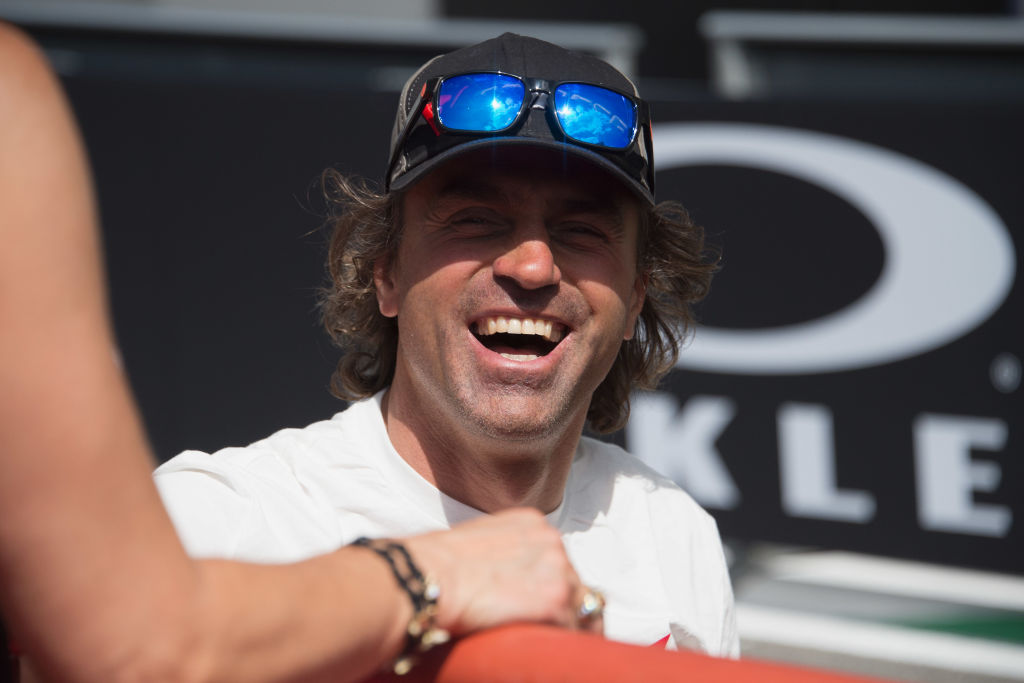
The Ampezzo champion, on the sidelines of the presentation of his book "Non ho fretta ma vado veloce", held yesterday evening in Ronco Scrivia, opened up to our Umberto Volpe. Just hours before the Hahnenkamm-Rennen weekend, we could not miss the chance to speak with the legendary "Ghedo"; many topics were covered, from safety in racing to the Olympics in his Cortina, as well as praise for a highlander like Innerhofer. And that bet in Kitz which led to the famous split on the final jump...
Friday 23 January 2026 16 minutes reading time
During Kitzbuehel week, it is impossible not to think of Kristian Ghedina, one of the greatest downhill racers in the history of alpine skiing, who managed to win on the Streif in 1998. The Jet d'Ampezzo is associated with the Austrian speed temple not only because of that victory, but also for the spectacular split he performed on the final jump, at 137 km/h, in 2004.
In recent weeks, with less than fifteen days now remaining until the start of the Milano Cortina Games, the former Cortina speed specialist has been touring various locations in northern Italy to present the book portraying his life and career, "Non ho fretta ma vado veloce": a collection of truly interesting and fascinating stories and anecdotes.
During the presentation held in Ronco Scrivia, in the province of Genoa, we had the pleasure of having the Ampezzo champion as our guest: numerous topics were discussed, starting with safety in speed events and training. “For speed events, the courses are prepared at least three weeks in advance, with all the necessary nets and protective measures put in place to safeguard the athletes. In training, the coaches set up just a few nets on the morning itself at the most dangerous points, but nowadays it is unfortunately impossible to compare racing and training when it comes to safety on the course.
In my opinion, it would be enough to do what they do in motorsport: the federations should commit to and invest in creating proper training circuits used exclusively for that purpose, but equipped with all the precautions taken for a World Cup race. Perhaps then the tragedies of Matilde Lorenzi and Matteo Franzoso could have been avoided”.
And on how safety in racing has changed: “Compared with when I was racing, significant progress has been made regarding safety on the course: nowadays, they try to send athletes through sections where there may be fewer risks, and athletes are taken through longer turns so that their speed is dissipated more. The courses are clearly wider, so there is more room; the switch to carving skis in 2000 was also important, providing ever greater safety in what we did on the snow.
Zero risk will never exist in speed events, but many other things have improved today: athletes pay much more attention to their physical and mental preparation ahead of a race. The data available nowadays on equipment is also much more precise than in the past. In my opinion, making airbags mandatory was a major step forward for athlete safety".
Returning to the present, we could not fail to ask Kristian for his opinion on the Italian speed teams, with the Games just two weeks away and the Stelvio in Bormio and the Olympia delle Tofane, “his” course in Cortina, set to take center stage. “I am very pleased with Giovanni Franzoni’s latest results: a new face in the Italian team is always good for the movement, and I am sure that on a technical course like the Stelvio he can comfortably play his cards for a great result.
Having a young athlete at the front is also an incentive for the whole team; I am sure that a Franzoni in this kind of form, together with Dominik Paris, who will race on “his” course despite his ankle problem, can really achieve a lot: the dream of two downhill medals is not impossible…”
“We also have excellent cards further back: I am thinking of Mattia Casse, as well as Christof Innerhofer, if he is selected. What Inner is doing this season is fantastic; at 41, he has completely rediscovered himself, even though almost everyone by now considered him finished: seeing him at the Games would truly be a fantastic finale”.
As for the women’s speed events, is a Vonn-Goggia duel in store? “In my opinion, yes; it will be a great duel between them,” Ghedina says confidently. “They both love that kind of course and, for me, they are a step above everyone else. Sofia has not been at her best lately, but I am sure she will find herself again in Cortina.
And what can you say about Lindsey? To return at 40, after already winning World Cups, Olympic medals and World Championship medals, is truly something incredible. Honestly, her comeback surprised me: finding the motivation again after more than five years away from the world of skiing is something to be admired”.
We could not ask a great downhill racer which courses suited him best and where, instead, he encountered the most difficulties: “A course I never loved, despite being an icon of alpine skiing, was the Stelvio in Bormio. I did not like the fact that it was almost entirely in the shade, because I struggled to go fast in the ‘dark’, and it always put you to the test physically, being truly gruelling.
Moreover, I was someone who liked to let the skis run smoothly through turns, and because I could not see the terrain well, I struggled to express myself at 100%. I think it is still the most difficult course in the White Circus today”.
His answer for the course he loved most, however, included more than one: “If I have to name two, I would say Wengen and Val Gardena. The Saslong was always a bit like my home course, where I won four times, but let’s say that over the course of my career I felt comfortable on practically every track”.
And the most difficult section in the entire World Cup… “for me, the Steilhang on the Streif in Kitz: it is an extremely difficult passage because you come from a turn that can literally throw you out, and if you get the timing wrong you end up straight in the nets, as happened to Bode Miller. It is an extremely narrow path, where you have to be good at carrying a lot of speed so you can use it in the following turns, where there are no particularly steep sections until the Hausbergkante”.
Even after retiring from the White Circus, Kristian continued to love challenges and entered the world of motorsport, on four and two wheels, so we asked him what speed means to him: “Emotion, adrenaline, the air in your face, trying to push any vehicle to the maximum, whether it is a car or a ski; trying to go beyond the limit has always given me a great thrill”.
During his career, he faced numerous legends of the sport, with whom he shared countless challenges: “My two main rivals were Luc Alphand and Hermann Maier. Luc and I also always had an excellent friendship; we would often jokingly say that we should team up against the Austrians, who were the superpower of skiing in those years. Maier, on the other hand, intimidated everyone; beating him during his peak years was extremely difficult, although I did manage it a few times”.
In an era when it is increasingly difficult to find all-round athletes, we asked “Ghedo” why, when he was racing, there was a larger number of skiers competing in all disciplines: “The training programmes were perhaps more similar, whereas now they are quite different between technical and speed disciplines. Even in my time there were not that many; I am thinking of Girardelli, Zurbriggen, Maier and Miller, but nowadays finding someone who achieves good results in downhill and slalom is practically impossible.
The physical work required to prepare for the different specialities also varies considerably: in giant slalom and slalom you have to be more explosive, whereas in downhill and super-G you need more power, endurance and courage”.
There were countless defining races in his career, but we asked him which one he remembers most fondly: “Setting aside the fact that all thirteen World Cup victories and the three World Championship medals are fantastic memories, clearly the success that stayed with me most was my first career victory, which came in my own Cortina. It was 1990, and the race was held there after eight years because there was not enough snow at other venues: winning at home was truly an indescribable emotion”.
Finally, since we are in Kitzbuehel week, we asked him to tell us about his story with the speed temple: “I can consider myself privileged because in 1998 I won the downhill on the Streif, which I think is the most wonderful thing a speed specialist can experience. Kitz has always been like an amusement park; the emotion of looking down the course during inspection from the start gate and seeing how icy it was compared with the previous year is truly priceless.
In 2011, when I was coaching Ivica Kostelic in the speed disciplines, it was so icy that during inspection I almost ran into an athlete because I could not get my edges to bite into the ice; this gives you an idea of how difficult the course was”.
And the famous split on the final jump? “I always like to say that I planned that move at the bar: it was 2004, I was finishing my inspection and arrived at the final jump at a very low speed, so I decided to make this playful, athletic gesture. I reached the finish area and heard my cousin calling me, saying, ‘You’re always the same; you don’t have the courage to do it in the race’ (all in dialect, of course).
At that point, pride took over and, after betting a pizza and a beer, I decided to win the bet at 137 km/h, being the daredevil I have always been. Nowadays everyone would have accused me of seeking publicity, but back then, without social media, it was truly something very unusual”.
© ALL RIGHTS RESERVED
Social media engagement
Most read in Sport invernali
Fede, the shock announcement: Brignone retires. “My leg hurts too much, I’ve decided to end my career. I’ll open one last starting gate”
In a video released by FISI, the Italian champion announced that she had decided to call it a day: the two days on skis in Cervinia did not give her the answers she had hoped for, and Federica will compete in one final race to say goodbye to everyone. The most successful woman in the history of Italian skiing is leaving the sport.
61