
Nordic SkiingMilan Cortina 2026

GEPA Pictures

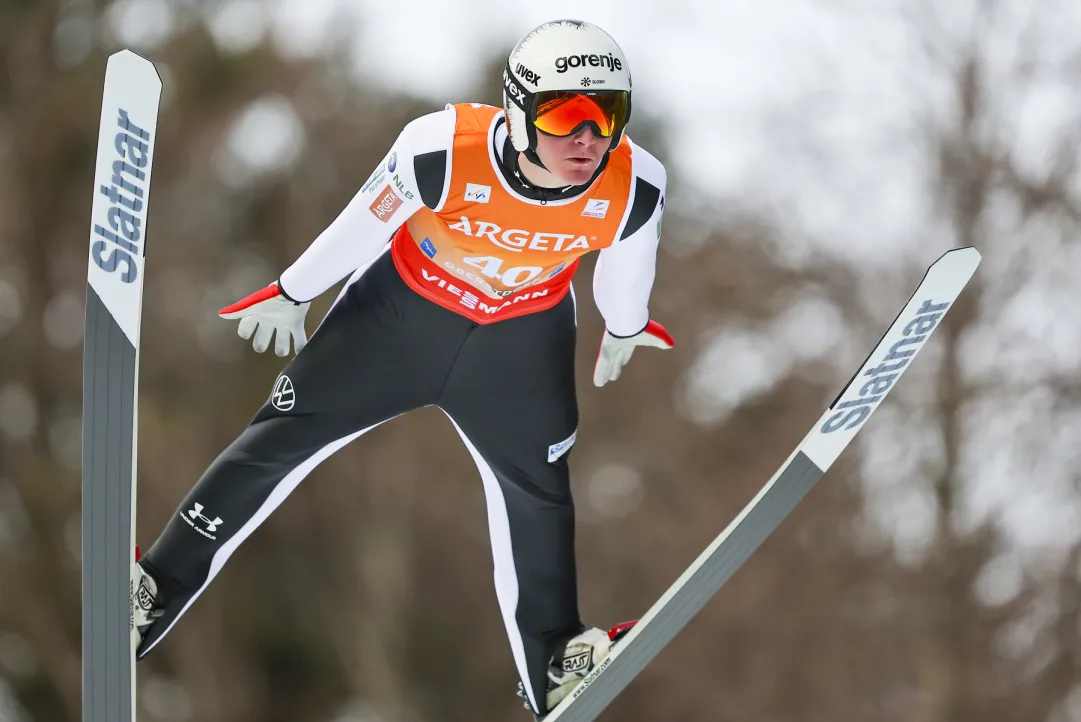
The five-ring event is also drawing closer for ski jumping, with the Slovenian expected to be a leading contender and favorite in the individual events, just like his sister Nika in the women’s competition, in an event that could prove historic for Slovenia. Italy will line up with seven athletes, but without medal ambitions. A few days before the opening ceremony of the Winter Olympic Games, let’s take a look together at all the key details of the discipline: the participants, the schedule and the favorites.
Monday 2 February 2026 12 minutes reading time
DOMEN PREVC ONE STEP FROM LEGENDARY STATUS
All eyes in the build-up are on Domen Prevc: the Slovenian has completely turned his career around since last season, becoming the undisputed ruler of men’s ski jumping. First came the World Championship title on the Large Hill in Trondheim in 2025, then the Four Hills Tournament, bringing the Golden Eagle back to Slovenia ten years after his brother Peter, and finally the world ski-flying title, won last week in Oberstdorf, before the ski accident that ruled him, along with the entire Slovenian team, out of the fight for the title in the team event.
At Willingen (Germany), too, in the last World Cup event before Milan Cortina, he proved clearly superior to the competition, overwhelming his rivals with “five-star” jumps that brought him within touching distance of winning the World Cup, as he could settle the matter as early as the first event after the Olympics, on the ski-flying hill at Bad Mitterndorf.
A year paved with gold, and now a date with history, as in Predazzo Domen could virtually complete the set while awaiting the Crystal Globe and become the second ski jumper in history after Matti Nykänen to win, at individual level during his career, at least one Olympic gold medal, a Ski Jumping World Championship, a Ski Flying World Championship, a World Cup and a Four Hills Tournament.
The Slovenian is the technical favorite in both scheduled events, but the date circled in red is February 14, when the medals will be awarded on the Large Hill. As mentioned, for now the rivals can only watch him from a distance, but in ski jumping everything can change suddenly. Japan’s Ren Nikaido and the Austrians are in medal contention in Predazzo, with the young Embacher the leading figure in a quartet that will also include Jan Hoerl, winner in Val di Fiemme in the Summer Grand Prix, Daniel Tschofenig and Stefan Kraft, who would complete the set like Prevc with an Olympic gold medal.
Germany will rely on Philipp Raimund, selected alongside Wellinger, Hoffmann and Paschke, who won the head-to-head battle with Karl Geiger. Geiger had improved enormously in his latest events, reaching the podium in Willingen, but was left out of the German quartet amid controversy. Japan will also have Ryoyu Kobayashi in its arsenal; he has been inconsistent this season, as well as surprise package Nakamura. Meanwhile, the Norwegians, led by Lindvik, are improving from event to event; he will be joined by Forfang and Sundal.
While Slovenia can also count on a high-quality outsider in Anze Lanisek, in addition to the aforementioned Prevc and Timi Zajc, Poland is placing its hopes in young Kacper Tomasiak, who skipped the World Ski Flying Championships to focus on the Olympic event, where he will compete alongside Wasek and Kamil Stoch, in the final appearance of his career. Three Italians qualified among the 50 places granted by the IOC: Giovanni Bresadola, Alex Insam and Francesco Cecon will be in Predazzo, with the maximum ambition of making the top 30 and giving everything in the mixed team event.
NIKA PREVC IN PURSUIT OF HISTORIC GOLD
If Domen calls… Nika answers. The younger sister of the Prevc family also starts the Olympic event as a favorite, strengthened by the two world titles in Trondheim and on course to win her second consecutive World Cup. Olympic gold would establish her as the most successful ski jumper in history alongside Maren Lundby, with all due respect to Sara Takanashi, who will compete at these Olympic Games but as a complete outsider. The Japanese athlete is indeed the most successful in the World Cup, with 63 wins, but she has always fallen short in events offering medals, both at the World Championships and at the five-ring events. At 20, Nika Prevc could even complete the set with a double and challenge for the title in the mixed team event alongside her brother.
There will be no shortage of challengers, starting with Japan’s Nozomi Maruyama, who has six wins this season in what is undoubtedly the best year of her career, also considering her success on the summer circuit. Norway will rely on Anna Odine Stroem, more dangerous on the Normal Hill, and Eirin Maria Kvandal, who will target the Large Hill event, the first in Olympic history for women’s ski jumping. The Norwegian produced a dream double in Willingen, confirming her excellent ski-flying abilities.
Austria and Canada, meanwhile, have just one medal contender each, led by Lisa Eder and Abigail Strate respectively. Both have won this season and collected podium finishes. Germany is a different matter, as both Selina Freitag and Agnes Reisch could make their mark; both are certainly capable of strong placings, but have few wins. The wildcard comes from China in the shape of Zeng Ping, who has reached the World Cup top 10 several times and finished second in the Oberstdorf event. Four Italians qualified, led by Annika Sieff, who could aim for a top-15 finish and challenge for the top 10. She will be joined by Martina Zanitzer, now established as the team’s number two, Jessica Malsiner and Martina Ambrosi.
THE MILAN CORTINA INNOVATIONS
The events will be held in Val di Fiemme, more specifically in Predazzo, where the two existing hills have been refurbished. The IOC’s policy has led to a sharp reduction in the Olympic quotas for ski jumping, particularly in the men’s event, with 50 male and 50 female ski jumpers admitted to Milan-Cortina, consequently forcing the leading nations into painful choices and notable omissions.
After Sochi 2014, Pyeongchang 2018 and Beijing 2022, where medals had been awarded to women only on the Normal Hill, the women in Val di Fiemme will compete on both the small and large hills, thus bringing their individual events into line with the men’s. In the men’s competition, meanwhile, the innovation concerns the team event: with the traditional event featuring four members per team now consigned to the archives, the Olympics will see the “Super Team”, or pairs event, for the first time.
THE SCHEDULE
Saturday, February 7
6:45 p.m. - First round, women’s Normal Hill
8:00 p.m. - Second round, women’s Normal Hill
Monday, February 9
7:00 p.m. - First round, men’s Normal Hill
8:15 p.m. - Second round, men’s Normal Hill
Tuesday, February 10
6:45 p.m. – Mixed Team
Saturday, February 14
6:45 p.m. - First round, men’s Large Hill
8:00 p.m. - Second round, men’s Large Hill
Sunday, February 15
6:45 p.m. - First round, women’s Large Hill
8:00 p.m. - Second round, women’s Large Hill
Monday, February 16
7:00 p.m. - Men’s Super Team
© ALL RIGHTS RESERVED
Social media engagement
Most read in Sport invernali
Fede, the shock announcement: Brignone retires. “My leg hurts too much, I’ve decided to end my career. I’ll open one last starting gate”
In a video released by FISI, the Italian champion announced that she had decided to call it a day: the two days on skis in Cervinia did not give her the answers she had hoped for, and Federica will compete in one final race to say goodbye to everyone. The most successful woman in the history of Italian skiing is leaving the sport.

38