
Nordic SkiingVal di Fiemme

Newspower.it

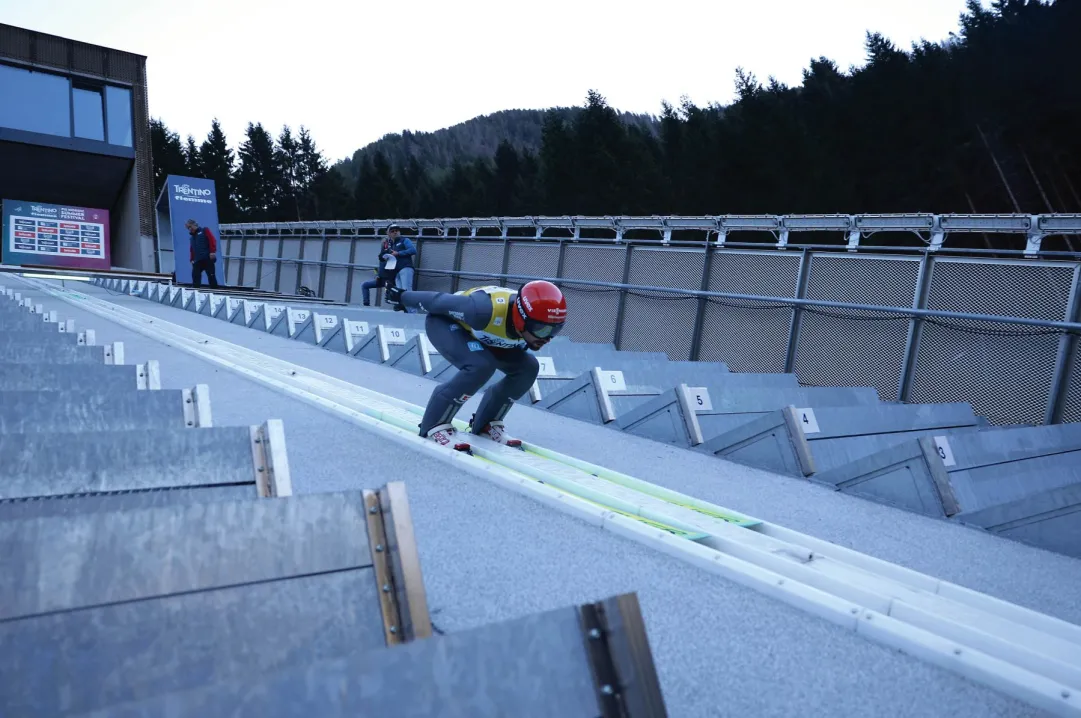
The Val di Fiemme facility, which will host the ski jumping and Nordic combined events at the Games, underwent some modifications after the September test events. The take-off table angle was increased by 0.5°, with the hills now classified as HS107 and HS141. A further test will take place in December, when the Italian Open Championships will be held.
Monday 3 November 2025 9 minutes reading time
A test event is organised before an official competition to verify the operation of the infrastructure, facilities and technologies, as well as many other details related to the organisation of the event itself. This was the purpose of the FIS Nordic Summer Festival held in Predazzo, Val di Fiemme, last September, an opportunity to test in competition above all the new ski jumping hills ahead of the imminent Olympics.
The test event was a complete success, somewhat overshadowed by three falls in the women's competitions, involving, among others, prominent athletes such as Eva Pinkelnig, Alexandria Loutitt and Nordic combined athlete Haruka Kasai, who suffered injuries serious enough to jeopardise their chances of taking part in the February Games.
The organisers of Nordic Ski Val di Fiemme, led by Luca Gianmoena, head of the Olympic ski jumping competitions, and the FIS, with race director Sandro Pertile coordinating the working group, sat down together the day after the event to analyse the data collected.
The first check concerned the correct construction of the structure according to the project drawn up in line with FIS requirements and approved by the sporting body, as well as any other factors that might have triggered the three falls. The recently completed hill proved to be perfectly in line with the project, so the environmental situation was analysed, and an effort was also made to understand why the falls had involved only the women.
Sandro Pertile briefly explained the outcome of the review: "Having assessed the precision and compliance of the construction with the project, we found that the standard basic technical design does not in fact take into account specific environmental factors such as altitude and the local wind, which often varies in strength and direction between summer and winter. The Predazzo hills are among the highest in the world, so the air is thinner than elsewhere, especially in summer.
In addition, in Predazzo we have a wind which, especially in the morning, blows from behind relative to the hill and consequently pushes the athletes upwards. In practice, we understood that with these parameters, thanks to lower aerodynamic resistance after the take-off phase, the trajectory makes the athletes 'plummet', as we say in the jargon".
However, the FIS Nordic Summer Festival also coincided with the adoption of the new suit regulations, amended after the scandal at the World Championships in Norway. Small factors during competition may have triggered the falls. For this reason, it was decided to alter the angle of the take-off table, reducing it by 0.5° on both hills. The technicians therefore lowered the take-off table by approximately 6 cm, an adjustment provided for in the construction of the structure and carried out mechanically using screw jacks. The Normal Hill now has an angle of 11.5° instead of 11°, and the Large Hill 12° instead of 11.5°. Consequently, the classification of the two hills was also adjusted, bringing them to HS107 and HS141.
This is not a new situation in ski jumping, with similar interventions having been carried out, for example, on the prestigious hills in Planica, Tschagguns and Seefeld in Austria. The FIS has therefore amended the regulations on women's suits, widening the circumference at the crotch in order to slightly reduce the jump and facilitate landing. Subsequent tests with local athletes confirmed that the decisions were sound, and attention now turns to the next event on 23 December, the Italian Ski Jumping and Nordic Combined Open Championships.
Race director Sandro Pertile's satisfaction highlights the close cooperation between the municipality of Predazzo, responsible for the facility, the Nordic Ski Val di Fiemme committee and the FIS. It was also crucial that no discrepancies were found in the work, for a ski jumping stadium destined for a great future even after the Milano Cortina 2026 Olympics.
Luca Gianmoena, Ski Jumping & Nordic Combined sport manager, is also satisfied; he was formerly a Nordic combined athlete, as was his sister Veronica, who is still competing. Luca Gianmoena now oversees the management of the ski jumping and Nordic combined events in Predazzo: "The remedial work after the test event is complete, and for us it was essential to carry out jumps after the adjustment to the take-off table. The athletes noticed the difference before and after the change in the angle of the trajectory; obviously, we are looking forward to competing on snow, because the conditions will be different again.
We are confident that we have resolved the inconsistencies and are approaching the Italian Championships on 23 December with great confidence. Numerous foreign teams have contacted us for information about the competition, which will be open and therefore also open to foreign participation".
© ALL RIGHTS RESERVED
Social media engagement
Most read in Sport invernali
Fede, the shock announcement: Brignone retires. “My leg hurts too much, I’ve decided to end my career. I’ll open one last starting gate”
In a video released by FISI, the Italian champion announced that she had decided to call it a day: the two days on skis in Cervinia did not give her the answers she had hoped for, and Federica will compete in one final race to say goodbye to everyone. The most successful woman in the history of Italian skiing is leaving the sport.

14