
Nordic Skiing2025/26 World Cup

Newspower

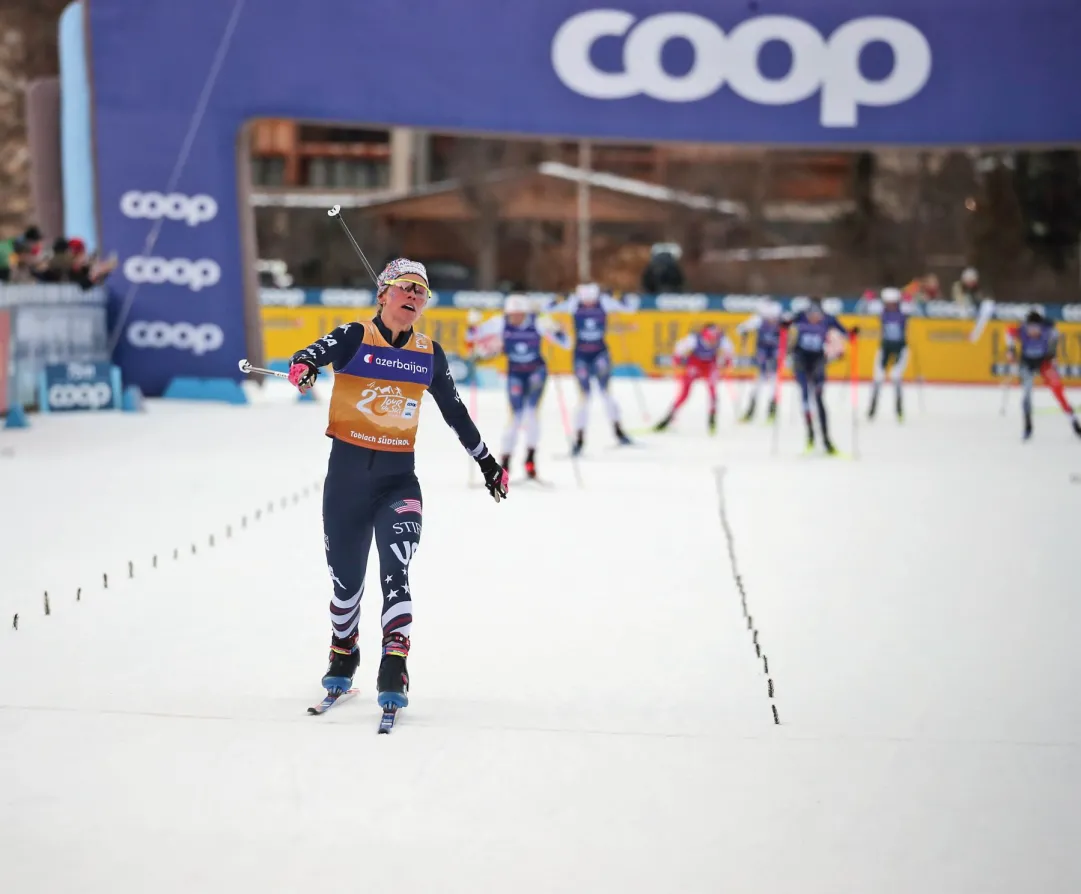
The 2025/2026 winter season in women’s cross-country skiing saw Afton’s class of ’91 claim her third consecutive overall Crystal Globe, as well as the fourth of her career. Once again, the American’s decision, in the final season of her career, to take part in every race prevailed over the Swedes, who, despite dominating for long stretches, skipped a significant portion of the rounds. Italy remains without a podium finish, but the young athletes offer plenty of hope for the future.
Friday 27 March 2026 5 minutes reading time
Jessie Diggins ended her career as an athlete in the best way possible: the Minnesota native, born in 1991, won the fourth overall World Cup of her career, her third in a row, in a winter in which she also claimed an Olympic bronze medal in the 10 km freestyle, in addition to winning the Tour de Ski.
Once again, also thanks to the World Cup scoring system, which rewards consistency near the top of the standings more than a single result, the American’s decision not to miss any race on the calendar proved decisive in securing her fourth Crystal Globe. Although she did not win an enormous number of races—four victories—Jessie almost never dropped out of the top 10 in the distance events, collecting no fewer than eleven podium finishes overall and also winning the distance cup.
The trophy therefore goes to the United States once again, but in this case too, as happened last season, the decision not to skip any rounds meant she arrived at the Italian Games perhaps not in peak condition, missing out on the individual Olympic gold that would have been the finishing touch to her career.
Despite Afton native Diggins winning the overall title, Sweden was the dominant nation in the women’s field: no fewer than 16 victories in 28 races, an impressive record. The top scorer was sprinter Jonna Sundling, with six wins, followed by Linn Svahn on four, Frida Karlsson on three, and Johanna Hagstroem, Moa Ilar and Ebba Andersson with one each. The Scandinavian powerhouse can console itself with an almost total Olympic monopoly: five gold medals in six events, with the unfortunate exception of the relay.
In addition to Diggins’ four victories, Norway’s Kristine Skistad claimed three sprint wins, her compatriot Karoline Simpson-Larsen took two, and, also for the Viking nation, Heidi Weng returned to victory. The other two athletes to win during the season were Finns Johanna Matintalo and Jasmi Joensuu, both claiming their first victories on the top circuit.
For the Italian women, it was another winter without a podium finish, something that has been missing since March 2011, incredibly, but the young athletes showed some positive signs. Maria Gismondi secured sixth place in the 10 km freestyle in Trondheim before falling ill and losing her form for the rest of the season, while Iris De Martin Pinter finished sixth in the freestyle sprint in Oberhof, narrowly missing out on qualification for the final on several other occasions. Both were born in 2004 and, together with the 2000-born Nicole Monsorno and Federica Cassol, could represent Italy’s future in this sport.
As with the men, the absence of the Russians continues to affect the overall spectacle in the women’s field, even though no single nation has established dominance. The return of Dariya Neprayaeva as a neutral athlete, like Savelii Korostelev among the men, has certainly shown that the return of the Russian team could only benefit the discipline, raising the level and the spectacle on the course.
© ALL RIGHTS RESERVED
Social media engagement
Most read in Sport invernali
Fede, the shock announcement: Brignone retires. “My leg hurts too much, I’ve decided to end my career. I’ll open one last starting gate”
In a video released by FISI, the Italian champion announced that she had decided to call it a day: the two days on skis in Cervinia did not give her the answers she had hoped for, and Federica will compete in one final race to say goodbye to everyone. The most successful woman in the history of Italian skiing is leaving the sport.
2