
Nordic SkiingTour de Ski

Newspower.it

The 20th edition of the now-historic midwinter cross-country skiing event leaves both athletes and insiders with plenty of doubts. From an ever-smaller crowd lining the courses to the monotony of the formats on offer (not to mention the new heat mass start): let us explore the reasons behind a decline that, unfortunately, appears unstoppable. But could there be solutions to reverse this trend?
Friday 9 January 2026 11 minutes reading time
"Once upon a time, there was the Tour de Ski": this could be the opening line for the story of the recent history of a competition that, winter after winter, is attracting less and less interest, both from athletes (as well as the entire world working around cross-country skiing) and from the public, whose numbers along the courses hosting the races around New Year have steadily dwindled.
But let us rewind the tape: the Tour de Ski, conceived by Swiss race director Juerg Capol in 2006, was intended to follow the structure of a cycling stage race, with eight races scheduled over ten days and hosted by at least three locations. In the early seasons, beyond the interest generated by its novelty, it was the race formats themselves that kept the competition constantly alive and packed with excitement: the two pursuit races, together with the final climb on the Cermis (unique of its kind in the cross-country skiing world), had made the event the most important competition (comparable to the Four Hills Tournament) in Nordic disciplines after the Olympic Games and World Championships.
If we wanted to identify the first turning point, we would have to look at the 2019 edition, when for the first time the final ascent up the slopes of the Cermis was not held as a pursuit, but as a simple mass start. From that moment on, this change began to leave less room for comebacks in the overall standings, with athletes no longer starting at staggered intervals according to the overall classification (how many times did the good Alexey Poltaranin start out front only to collapse inexorably on the first ramps of the climb in Val di Fiemme) before the final act, but all starting simultaneously.
Thus, the final climb was no longer a merciless pursuit towards Alpe del Cermis, but a highly tactical race that only really comes to life over the final 3 km (out of 10 in total). Despite this change, the stage race still retained a certain appeal: the closely spaced races across several locations, with Italy represented by Dobbiaco and Val di Fiemme, Germany by Oberhof, the Czech Republic by Nove Mesto, and Switzerland by Lenzerheide and Val Mustair, together with the variety of formats on offer, made the contests consistently interesting and exciting.
Even in the editions before 2019, the pursuit races had already been reduced from two to one, with the introduction of mass starts or interval-start races, but the excitement generated by the Cermis still partly concealed this initial shortcoming. Without the famous "Handicap Start" on the Cermis, and with only one pursuit during the event, interest in this competition, which by then no longer represented an absolute novelty, began to decline.
The second major loss came with the 2023 edition, the first without the Russians: for years, the battles between Johannes Klaebo and Alexander Bolshunov had been one of the main reasons why spectators came to the courses and viewers at home followed the races on TV. Without the Russian cross-country skier, as well as the absence of the Russian athletes in the women’s field, the appeal surrounding this competition declined further and further, with the men’s event having by now become a restricted Norwegian national championship.
In recent editions, an increasing number of top-level athletes have chosen to skip the Tour de Ski voluntarily in order to prepare differently for the remainder of the season. Klaebo was forced to withdraw in 2024, partly because of illness, while the Swedes Jonna Sundling and Linn Svahn chose not to take part in the stage race in the edition that has just ended, to recharge their batteries with an eye on the Olympics. Even the FIS decision to award a huge number of points, both for individual races and the final standings, to those taking part in the event has failed to limit the number of “unforced” absences.
Another worrying factor is the limited willingness of the various Alpine locations to host Tour de Ski stages: over the last two winters, the event has taken place entirely in Italy, with Dobbiaco and Val di Fiemme hosting all the races. This is certainly a reason to praise Italy from an organisational standpoint, with impeccable courses, but at the same time it should alert the FIS to the general interest that is steadily fading, in the midst of widespread silence.
The very limited presence of spectators at some races is also worrying (such as the women’s events held in Alta Pusteria). Attendance at Lago di Tesero (which will be an Olympic venue in a month) was certainly not positive either, while the appeal of the Cermis still managed to bring a good number of fans to its slopes.
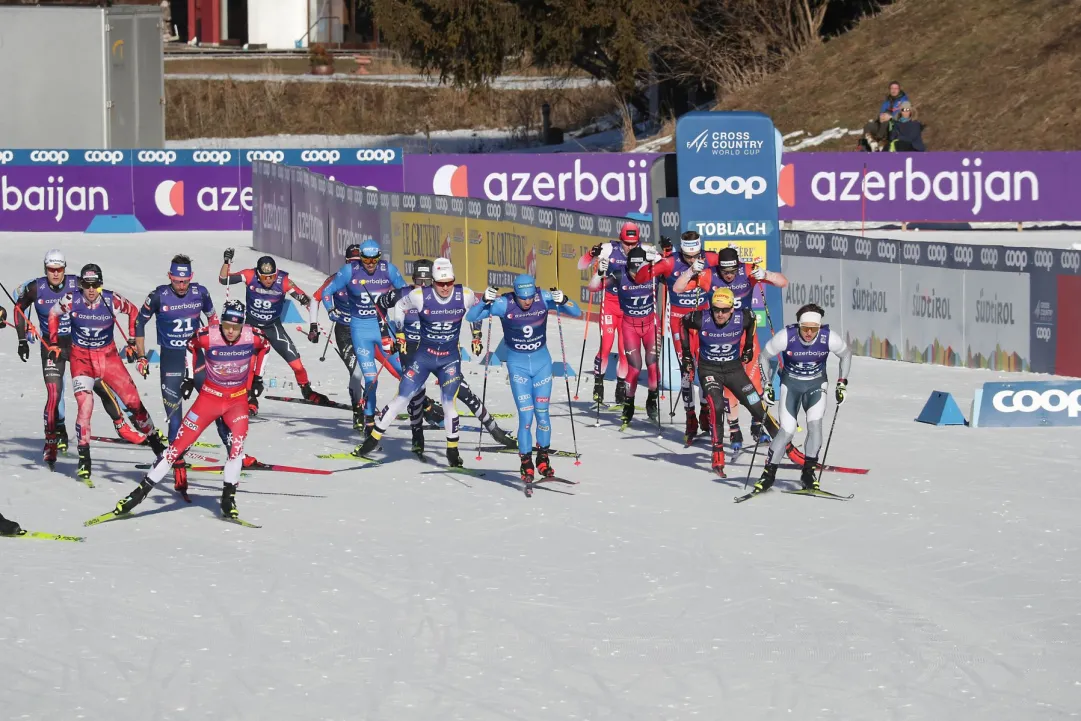
The FIS did try, in some way, to introduce a new feature in this edition, with the 5 km TL heat mass start, but it can comfortably be said that the experiment was a complete failure. It was a literally nonsensical race, in which you had to be lucky enough to find yourself in the right heat, with conditions that were not equal for everyone, also because of the state of the snow and many other factors. It is no coincidence that the top eight men all came from the same heat, with numerous criticisms emerging immediately after the race had ended.
If the federation believes that these formats can bring the public closer to cross-country skiing, unfortunately, this does not appear to be the right approach; on the contrary, it risks creating the opposite effect and driving away an audience that is becoming ever smaller. Criticism has also come from the Nordic nations, particularly Norway and Sweden, which complain about the lack of interest generated by the various race formats proposed by the FIS and are loudly calling for the return of the much-loved pursuit races (only one is currently held).
The federation will have no shortage of advice to listen to and consider in the coming months: although there is no intention to change the current race formats (while the main objective is to increase social and side events to entertain the public), something must be done to avoid completely erasing the history of a twenty-year-old competition that has written important pages in the history of this sport.
© ALL RIGHTS RESERVED
Social media engagement
FONDO, SCELTI DAI LETTORI

BOTTERO SKI
ARC TEC - squadretta in allumino 88
24.00 €


29