
Ski Clothingtutorials
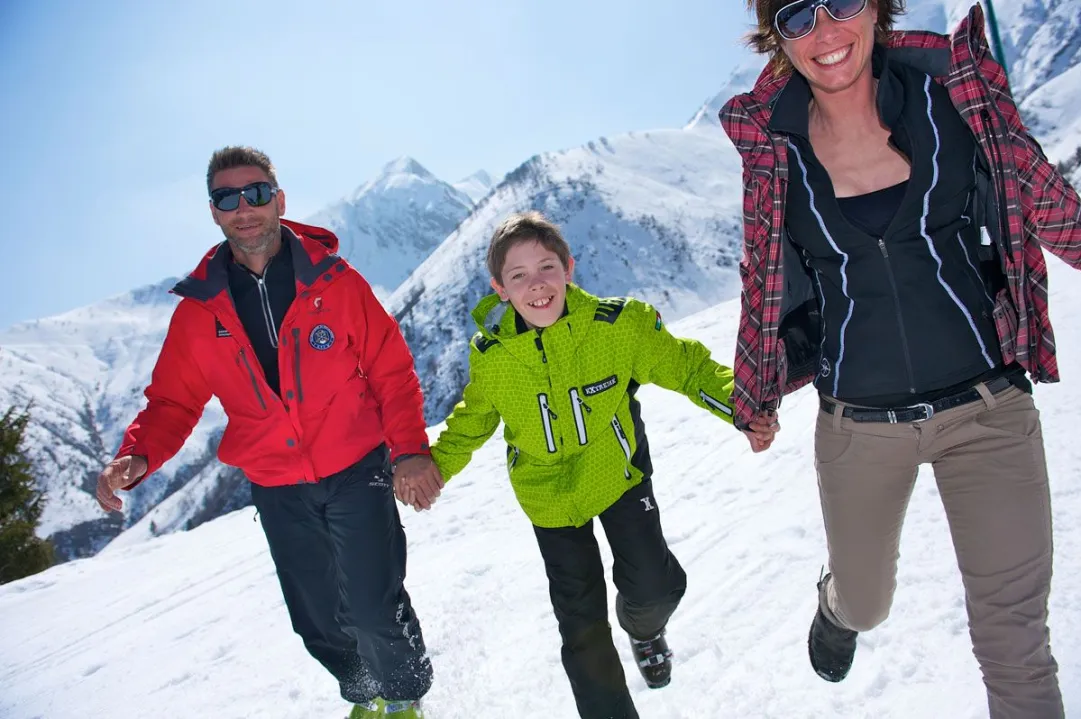

Those who are passionate about skiing and the mountains know very well that clothing is one of the most important things for enjoying the activities without being penalized by the cold and snow. A technical jacket must guarantee not only comfort in movement, but also adequate warmth and thermal insulation, together with waterproofing and breathability.
Tuesday 20 December 2022 5 minutes reading time
Depending on the activities you want to carry out, your needs can change, so choosing a valid one is not as intuitive as you think. The most inexperienced people may tend to choose a jacket by looking only at the look it presents, without considering that out on the snow, the needs will be different. Surely you can turn to well-known brands, for example a good alternative are the Colmar women's snow jackets but if you are undecided let's see together which elements to evaluate.
If you too have decided to get yourself a technical jacket to tackle mountain sports and you don't want to preclude anything, in this article you will find everything you need to know before making your choice.
Choose the right padding
There are different degrees of padding, each more suitable for the type of activity we carry out. In detail:
Natural feather. It is undoubtedly the most opaque padding and suitable for people who are very sensitive to the cold. It is an insulator capable of keeping a person warm throughout the day, however it is not waterproof.
Synthetic feather. It is the cheapest and most suitable solution for humid environments.
Synthetic fabric. This is the cheapest padding, but at the same time it is durable and more compact. It is the perfect fabric for activities with more movement, as the heat retained is less, but it guarantees freedom of movement and breathability.
The impermeability
In the mountains, the climate can change in a short time, so you must always be ready to protect yourself from bad weather. The outer fabric in a snow jacket must be intended to waterproof and protect the person from water.
In the labels it is possible to verify the resistance that the fabric presents. Below a water column of 8,000 it cannot be considered waterproof, even if up to a column of 5,000 it helps to counteract external humidity, when it's not raining.
Then there are two or three-layer technologies, where several fabrics are glued to protect the waterproof membrane:
Three layer fabric. The waterproof membrane is protected by an internal and an external fabric.
Two and a half layer fabric. The waterproof membrane is protected only by an outer fabric, together with a special paint on the inside.
Two layer fabric. The waterproof membrane is protected by an external fabric, while inside it is flanked by an insulating lining.
The breathability of the product
This is the ability of a jacket to disperse the sweat we produce when we move, preventing us from getting wet and taking a breather. This means that the choice must be made by carefully evaluating the type of activity we will carry out. The greater the effort, the greater the breathability of the jacket.
It is measured in vapor transfer resistance (RET) and water vapor transmission rate (MVTR). A well-breathable jacket has a RET value below 10 and an MVTR value above 20,000.
© ALL RIGHTS RESERVED
Social media engagement
CALZE, SCELTI DAI LETTORI
BLUE TOMATO
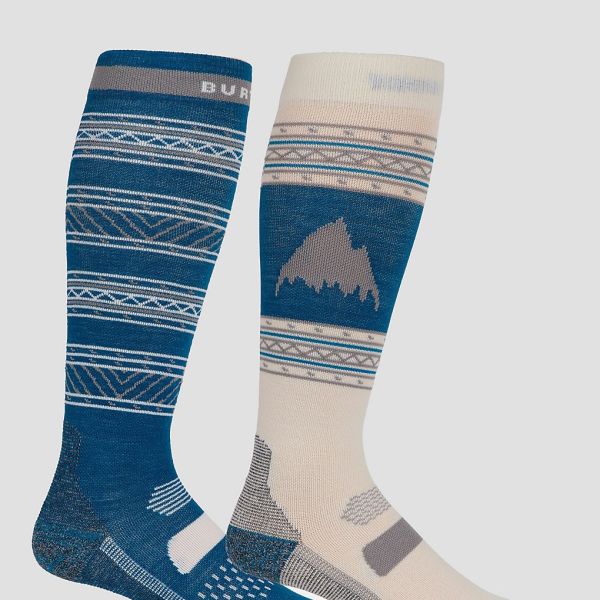
BURTON - performance lw 2pk tech socks nightfall
49.95 €
2