
Ski BootsFITTING THE BOOT SKI

In the past many skiers were buying boots of one or two sizes larger than your measurement, then maybe use two pairs of socks in the hope that your feet remain warm. This behavior is totally wrong. The ski boot must be purchased in the same size of the foot, just as with any other type of shoe. In fact, the shoes now fit to the foot thanks to the warmth as if they were custom made.
Tuesday 6 March 2018 6 minutes reading time
As regards the Flex, as a general rule, the lovers of the stronger and heavier speed they need more rigid and sturdy boots, but should always rely on the analysis of a good boot-fitter that according to the type of skiing and to the physical characteristics can recommend the right boot.
The test of the boot in the store is always done wearing of the thin stockings, so that with the failure of the liner due to the shaping of same, may subsequently compensate the space that is generated in the passing of sponge technical socks differentiated processing, gaining consequently also in warmth and comfort. Wear thick socks when testing may direct us on the choice of a larger boot than necessary.
The first measure to be referred to for the choice of the boot is the length of the foot. The vast majority of ski boots using the 'measurement Mondopoint unit, which is based sull''effettiva length of the foot, in millimeters. The following is an indicative table with the Mondopoint correspondence and the traditional shoes numbers, but this is obviously a simplification.
Lung. foot in mm
217223
224230
231236
237243
244250
251257
258264
265270
271277
278283
284290
291297
298303
304310
311316
317323
European measures Shoes
35
36
37
38
39
40
41
42
43
44
45
46
47
48
49
50
Mondopoint (in cm)
21,722,3
22,423,0
23,123,6
23,724,3
24,425,0
25,125,7
25,826,4
26,527,0
27,127,7
27,828,3
28,429,0
29,129,7
29,830,3
30,431,0
31,131,6
31,732,3
In the video, Stefano Macori shows us how to perform accurate measurement of the length of the foot with the foresight to measure at the foot borne, with the skier up and the weight of the body rests on the feet themselves. The same measurement taken when the skier is sitting may not be correct. Only in rare cases the two feet of a person have the exact same length, then for the choice of any type of footwear you must refer to the measurement of the larger foot.
In order to choose the correct boot it may also be appropriate to measure the width of the plant and the 'height of the neck in order to determine the volume it occupies. Some of boot models are produced in versions with more or less large plant. Usually either narrower models have a width of the forefoot (the so-called "last") of about 97/98 mm, and are quite narrow even overall volume. These boots are in any case also the most suitable for people with narrow feet, narrow and low. Those average fit to have a forefoot width of about 100 millimeters. Finally there are the wide-fit models, essential for those who have the most broad and strong foot. The width of the forefoot can be up to 106 mm.
E '' also important to assess the cuff, especially in the case in which the calves are voluminous. Some of boot models have a back support that can be rimoso to increase the comfort of the upper part of the boot in case of very developed calves.
At the end of the boot choice, the foot should be well wrapped, well-locked, without painful pressure points, while the fingers should be able to move slightly. In general, the first time you put on the boot may seem a little narrower than when you wake; with the 'use of the shoe it tends to settle on the foot.
#SKIBOOT #BOOTFITTING #SKISHOP
© ALL RIGHTS RESERVED
Social media engagement
SCARPONI, SCELTI DAI LETTORI
BLUE TOMATO
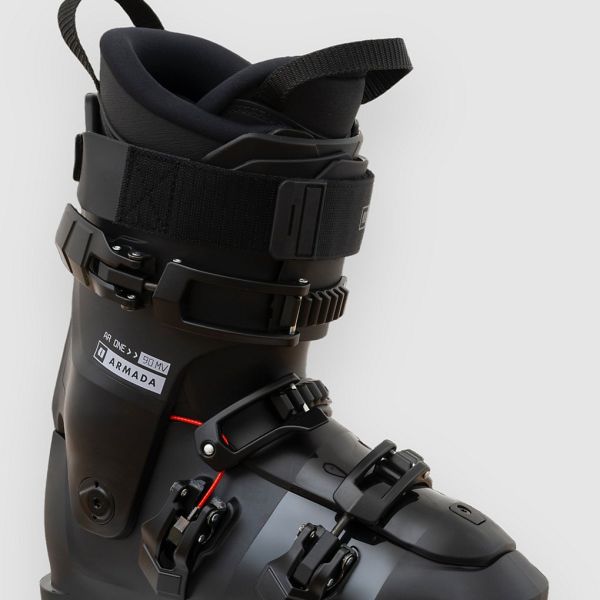
ARMADA - ar one 90 mv 2026 ski boots black
399.95 €
97