
VenetoThe Belluno Dolomites

Giuseppe Pàis Bechèr
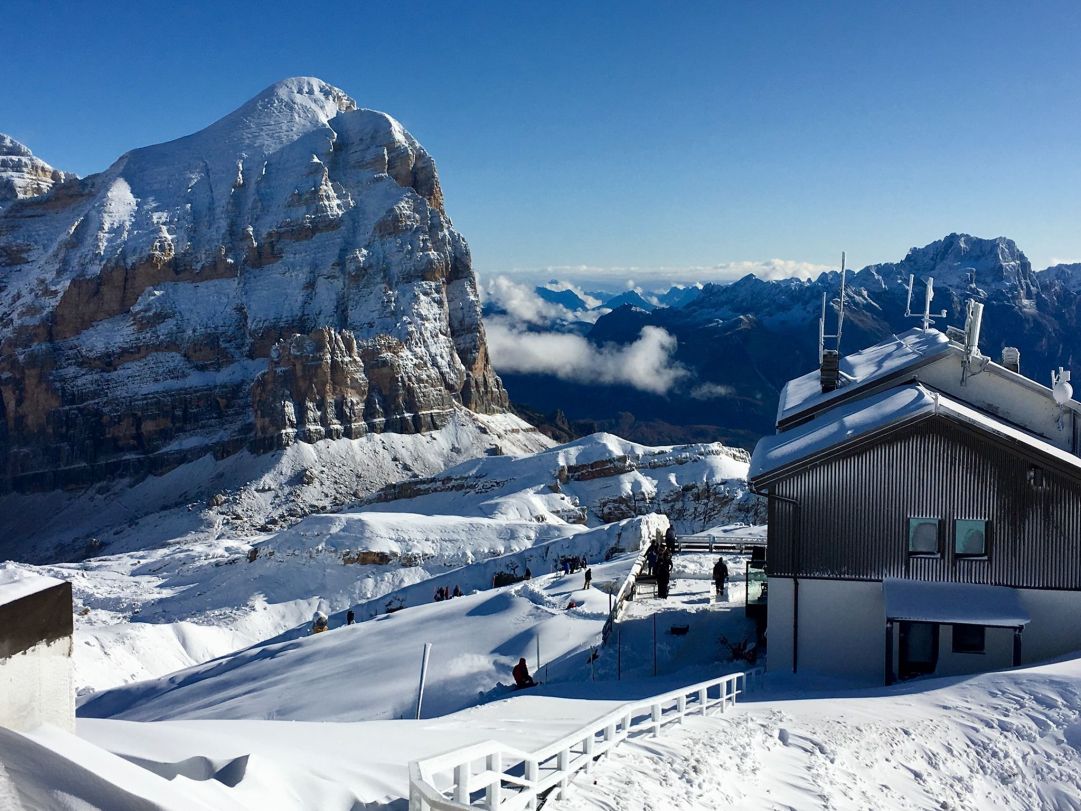
Cortina d’Ampezzo, the “Queen of the Dolomites”, stands at 1,224 metres in the spectacular Ampezzo basin, surrounded by Tofane, Cristallo, Pomagagnon, Faloria, Sorapiss and Croda da Lago. The beauty of the landscape, its sporting history, mountain huts and elegant town centre make Cortina a destination that goes beyond skiing, combining the mountains, glamour and Ladin tradition.
The official Cortina Skiworld ski area claims 120 km of slopes and 35 lifts, but this figure also includes the ski areas of San Vito di Cadore, Auronzo and Misurina, covered by Neveitalia in separate profiles. Cortina’s skiing is centred on the three main sectors of Tofana, Faloria-Cristallo and 5 Torri-Lagazuoi. The slopes start at around 1,224 metres in the basin and reach 2,835 metres at Lagazuoi; the lifts on Tofana go as high as 3,244 metres at Cima Tofana, although the skiable terrain ends lower down.
Tofana is the largest and most complete area. In the lower section, between Socrepes and Pocol, wide, easy slopes, beginner areas and runs suitable for children, beginners and families predominate. As you ascend towards Piè Tofana, Duca d’Aosta, Pomedes and Ra Valles, the terrain gradually becomes more technical. Some of the Dolomites’ most famous descents are found here, including Olimpia delle Tofane, venue for the women’s World Cup, the 2021 World Championships and the 1956 and 2026 Olympic Games, as well as Vertigine Bianca, Labirinti, Canalone, Forcella Rossa and Col Drusciè A. This is the sector best suited to intermediate and expert skiers, while still offering plenty for those who are learning.
In recent years, the lifts on Tofana have been progressively modernised. The Freccia nel Cielo gondola climbs from the centre of Cortina to Col Drusciè, while cable cars and high-altitude lifts continue towards Ra Valles and Cima Tofana. The fast Tofana Express chairlift serves the heart of the ski area, and the new gondola access towards Socrepes has increased transport capacity around the beginner areas and Olympic slopes. Some older lifts remain, but the system is modern and efficient along the main routes.
On the opposite side of the basin lies the Faloria-Cristallo ski area. From the centre of Cortina, the cable car quickly reaches Faloria, at over 2,100 metres, where the slopes open onto a sunny and highly scenic plateau. The red Faloria Normale, Tondi and Slittone runs are ideal for intermediate skiers, while Vitelli, Scoiattolo, Stratondi, Bigontina and Canalone Franchetti offer more demanding pitches and sections. The altitude and exposure generally ensure good snow quality and often allow skiing well into spring.
From Faloria, you can reach the Cristallo sector, served by the lifts at Rio Gere, Son Forca and Padeon. The slopes pass through a magnificent Dolomite setting, beneath the walls of Cristallo and Pomagagnon. The sector is now smaller than in the past, as the lift to Forcella Staunies is no longer in operation, but it retains attractive red and blue runs and a quieter atmosphere. Faloria-Cristallo is not linked to Tofana on skis: to change sides of the valley, it is necessary to descend to the valley floor and use the ski bus or car.
The third area is 5 Torri-Lagazuoi, perhaps the most striking from a scenic point of view. The slopes run among the rocky towers of Averau, Nuvolau and Cinque Torri, in an open and sunny setting. Wide, enjoyable blue and red runs predominate, making the area particularly suitable for families and intermediate skiers. There are also technical descents such as Lino Lacedelli, used for training and competitions.
The Cortina Skyline gondola link allows visitors to travel from the Son dei Prade and Tofana area to 5 Torri without using a car. From here, it is possible to continue towards Col Gallina and Passo Falzarego, taking the cable car up to Lagazuoi at 2,835 metres. Among the most characteristic routes are the scenic Super8 Ski Tour and the Armentarola descent, approximately 7.5 km long, which crosses the Lagazuoi valley between rocky walls and icefalls before reaching the gates of Alta Badia.
Overall, Cortina offers slopes for all ability levels, but it is best suited to intermediate and expert skiers, who can alternate between long, scenic red runs, Olympic courses and numerous black runs. Beginners will find the most favourable areas at Socrepes, Pocol and Col Gallina. The main limitation is the division into separate sectors: Tofana and 5 Torri are linked by the Cortina Skyline, while reaching Faloria-Cristallo still requires a road transfer.
The winter offering also includes cross-country skiing in the Fiames area, snowshoeing, ski mountaineering, sledging and numerous mountain huts that can also be reached by non-skiers. In summer, Cortina becomes one of the Alpine capitals of hiking, climbing and via ferrata routes. The lifts provide easy access to Tofana, Faloria, Cristallo and 5 Torri, while the Socrepes Bike Park, mountain-bike trails, walks in the Ampezzo Dolomites Nature Park and Great War itineraries round out an active tourism offering available for much of the year.
© ALL RIGHTS RESERVED
56
Social reactions
56

© ALL RIGHTS RESERVED
Latest news from Cortina d'Ampezzo

Alpine Skiing
Fabio Poncemi, Sunday 14 June 2026
Veneto
Fabio Poncemi, Thursday 21 May 2026
Milano Cortina 2026
Cora Bettoni, Monday 29 December 2025
Companies
Angelo Bonorino, Thursday 4 December 2025
Veneto
Apollonio–Socrepes gondola lift: Lazio Regional Administrative Court to rule on 27 August
Angelo Bonorino, Wednesday 20 August 2025VIDEO


56