
Piedmont
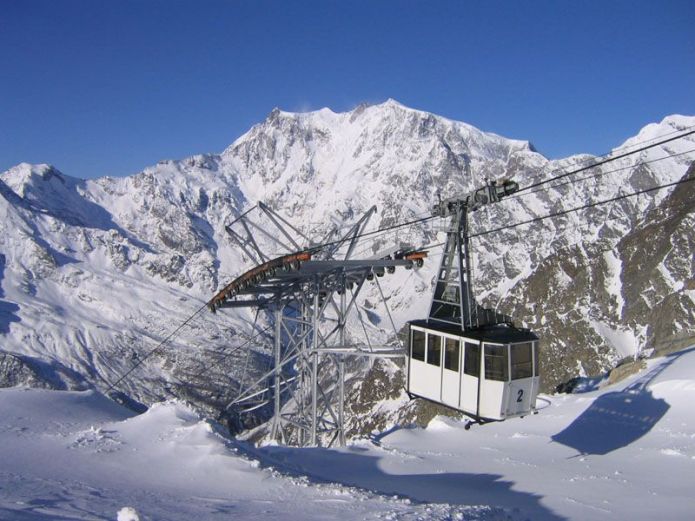
Macugnaga stands at an altitude of around 1,300 metres, at the head of the Anzasca Valley, facing the spectacular eastern wall of Monte Rosa. Around 2,600 metres high and carved by couloirs and glaciers, it is the most imposing wall in the Alps and gives the resort an environment of almost Himalayan proportions. The village also retains a strong Walser identity, recognisable in the ancient wooden and stone houses of the hamlets of Staffa, Pecetto and Borca, as well as in the characteristic Dorf settlement.
Macugnaga’s ski offering has historically been divided between two separate areas that are not connected ski-in/ski-out: Belvedere, reached from Pecetto, and Monte Moro, accessed by the cable car departing from Staffa. Overall, the resort is traditionally credited with around 35 km of pistes, spread between the village at 1,300 metres and the 2,868-metre Passo del Monte Moro.
The Burki-Belvedere sector extends between Pecetto, at around 1,390 metres, and Belvedere, located at over 1,900 metres at the foot of the glacier of the same name. The lower slopes, such as Fontanone and those of Alpe Burki, generally have accessible gradients and are suitable for beginners, families and intermediate skiers. Higher up, the runs descending from Belvedere become more technical, alternating steep sections, larch forests and panoramic stretches at the foot of the Rosa’s wall. Artificial snowmaking covers a large part of the main descents.
Monte Moro, on the other hand, offers more alpine and spectacular skiing. The pistes run through an open high-altitude environment, between the Swiss border and Alpe Bill, with a potential vertical drop of more than 1,000 metres. The San Pietro, Lago, Ruppenstein and Moro-Bill runs are mainly suitable for intermediate and expert skiers, while the wild Meccia piste is opened only when conditions are favourable. The altitude ensures colder snow, but the sector is exposed to the wind and piste openings may be intermittent.
The lift system consists of historic and not particularly fast facilities: two two-seater chairlifts run from Pecetto to Belvedere, while two cable-car sections connect Staffa with Alpe Bill and the Passo del Monte Moro. At altitude there is also a chairlift, drag lifts and magic carpets. The lifts provide access to extraordinary surroundings, but the age of the structures and the mountain’s complex hydrogeological conditions have progressively increased the need for works, inspections and new projects.
The 2025/2026 winter season ended without the possibility of skiing in either of the two areas. The Belvedere chairlifts did not obtain the necessary authorisations in time, despite the general overhaul works, also due to issues concerning protection of the area from the risk of landslides and avalanches. Monte Moro, meanwhile, remained closed following the accident involving the cable car in December 2025 and the subsequent seizure of the facility.
In summer 2026, the Pecetto–Burki–Belvedere chairlifts and the first section of the Staffa–Alpe Bill cable car returned to operation, while the link between Alpe Bill and the Passo del Monte Moro remained closed. These reopenings represent an initial positive sign, but when planning a winter holiday it is essential to check directly which lifts and pistes are actually available. The summer reopening alone does not guarantee that the two sectors will be fully operational for skiing.
When fully accessible, Macugnaga is a resort capable of satisfying different types of visitors: Belvedere is more compact and suited to families, while Monte Moro offers substantial vertical drops, more challenging pistes and interesting opportunities for ski touring and freeriding. It is not, however, the ideal destination for those seeking modern lifts, fast connections and many kilometres of uninterrupted skiing.
Cross-country skiing takes place, snow conditions permitting, on the trails between Pecetto, Isella and Val Quarazza. The Pecetto track offers around 4 km of easy, panoramic skiing, while more technical loops and the route leading towards Lago delle Fate start from Isella. The winter offering is completed by snowshoeing, skating, ice climbing and ski-touring routes, activities that must be undertaken only after carefully assessing mountain conditions.
Macugnaga retains a very strong summer vocation. Excursions to the glacier and the Zamboni-Zappa refuge start from Belvedere, while Val Quarazza and Lago delle Fate offer more accessible walks. The resort is also one of the cradles of mountaineering on Monte Rosa. A stay can be rounded off with a visit to the Dorf, with its Chiesa Vecchia and centuries-old lime tree, the Walser House Museum in Borca, the Mountain Museum and the Guia Gold Mine, the first underground gold mine in Italy open to visitors.
© ALL RIGHTS RESERVED
9
Social reactions
9

© ALL RIGHTS RESERVED
Latest news from Macugnaga


Piedmont
Davide Franchi, Monday 13 July 2026
Piedmont
Davide Franchi, Wednesday 13 May 2026
Tourism
Davide Franchi, Tuesday 25 March 2025
Piedmont
Nevicate abbondanti a Macugnaga: da domani apre la seggiovia Ruppenstein al Monte Moro
Davide Franchi, Tuesday 18 March 2025




9