
Alpine SkiingAlpine Skiing - Wengen

Getty Images

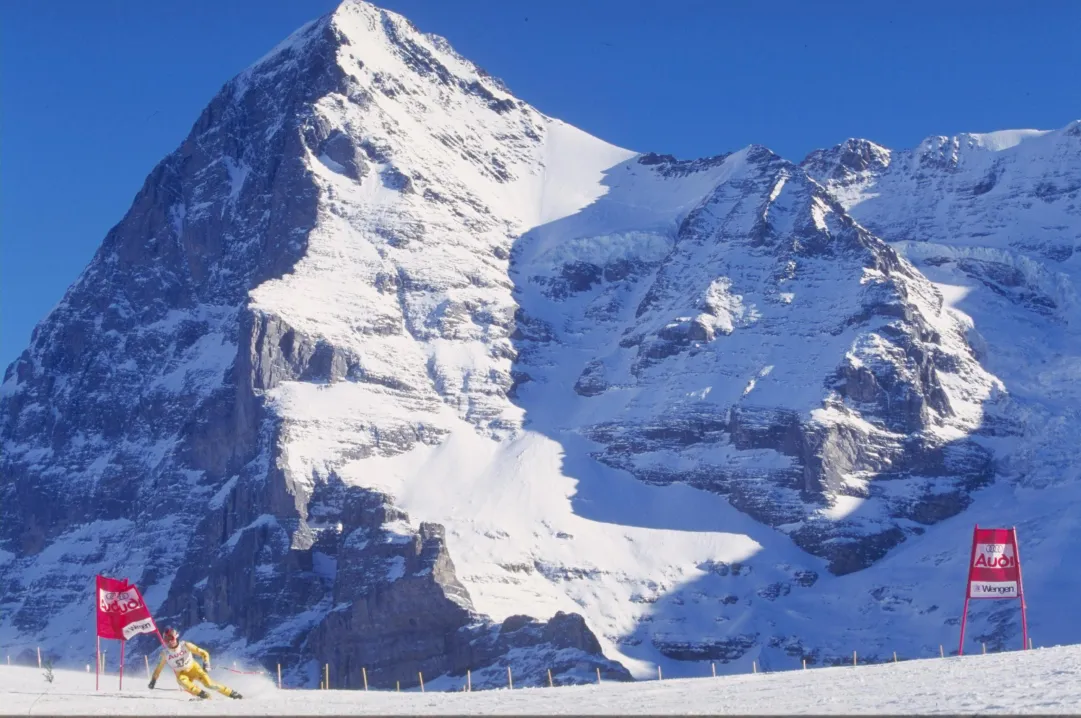
The second of three scheduled races in Wengen is the most intense. The descent which takes place on the Lauberhorn is among the oldest and most fascinating of the whole World Cup.
Friday 13 January 2017 9 minutes reading time
The Lauberhorn in Wengen is the longest run of the Men's World Cup with its 4480 meters long and more than 1000 meters in altitude. The first part is the sheer smoothness, with Russisprung, jump Bernhard Russi, designer of the current path, the only pitfall of the first fifty seconds of the race. The Traversenschuss, beaten interrupted by a seemingly trivial but often decisive double curve, enter sull'Hundtschopf, jump of about forty meters between two rocks before the Minschkante (jump Minsch, Swiss downhill skier who crashed here in 1965) and the Canadian Corner, long-hander who betrayed many Canadians at the time of the Crazy Canucks, hence the name. The Kernen-S, narrow chicane named in honor of the 2003 winner and star of a terrifying fall a few weeks before he won the World Championship gold at Sestriere 1997 launches athletes under Wasserstation tunnel, especially when passing the legendary athlete and train overlying intersect. After the long Hanneggschuss where you get to exceed 150 kilometers per hour, come the final difficulties: first the Austrian Hole, a series of three bumps now virtually removed in 1954 betrayed Toni Sailer, Anderl Molterer and Walter Schuster; then the Finish-S, as amended several times over the years after the many accidents that caused more or less serious damage and it is even more complicated by the fact that athletes arrive there after two minutes of the match.
The Wengen Downhill is held since 1929, when Ernst Gretsch, president of the Ski Club of Wengen, signed the founding document of a race that was held unofficially since 1924. Of course, with the birth of the World Cup, such evidence He came to be part of it since the first edition and still remains one of the most prestigious on the calendar.
In all, 78 editions of the Wengen downhill played from 1929 to date, 43 of which are valid for the World Cup. The absolute most successful rider is the Swiss Karl Molitor, who prevailed by 6 times between 1939 and 1947, however, taking advantage of the lack of competition in the years of World War II. Considering only valid evidence for the Crystal Ball, however, the record holder is Franz Klammer, who won 3 times between 1975 and 1977. There are few guys able to repeat: in fact boast two achievements alone Marc Girardelli (20 and 21 January 1989, the year in which the Lauberhorn also played in a recovery), Stephan Eberharter (January 12, 2002 and January 17, 2003), Bode Miller (always January 13, 2007 and 2008) and Kristian Ghedina (January 20, 1995 and January 18 1997).
The Cortina is one of four Italians able to impose itself on the Lauberhorn: with him also Zeno Colo in 1948, Herbert Plank January 9, 1976 and Christof Innerhofer 19 January 2013. Ghedina also holds the track record in 2'24 "23, a time not more approachable because of the various changes made to protect the safety of the athletes, which nevertheless did not prevent Johan Clarey to establish another record, the speed with downhill skiing, 161.9 km / h touched in 2013 sull'Hanneggschuss.
Returning to the winners, are 7 boys in activities to have won the Wengen downhill: besides Innerhofer, Carlo Janka (16 January 2010), Klaus Kröll (15 January 2011), Beat Feuz (14 January 2012), Patrick Küng (18 January 2014), Hannes Reichelt (18 January 2015) and Aksel Lund Svindal, who won the last edition of January 16, 2016.
At the podium level, Austria is master of Wengen. Considering only the races valid for the World Cup, Franz Klammer and Hannes Reichelt boast the leadership of this special ranking with 5 podiums apiece, followed by another 4 white and red eagle, Peter Wirnsberger, and Bode Miller. Italy at home, in addition to the victories already reported, Plank also won second and third place, Innerhofer third, while Peter Runggaldier, according to January 22, 1994, and Peter Fill, the third January 13, 2007, complete a series of nine podiums Total in Wengen Downhill valid for crystal ball.
The Wengen Downhill will be held, weather permitting, Saturday, January 14 with the first athlete to be released by the pound at 12.30.
© ALL RIGHTS RESERVED
Social media engagement
Downhill Male Garmisch-Partenkirchen (GER)
 GANONG Travis
 JANSRUD Kjetil
 FILL Peter
Alpine Skiing - United States
cruciate ligament for Steven Nyman, unharmed however Erik Guay
Friday 27 January 2017
Alpine Skiing - France
Valentin Giraud Moine it broke both legs after the fall in Garmisch-Partenkirchen Downhill
Friday 27 January 2017

FIS Alpine
Travis Ganong wins the terrible first downhill in Garmisch-Partenkirchen, third Peter Fill
Friday 27 January 2017

Alpine Skiing Men
Garmisch downhill: Paris with 5, 9 Fill to point the specialty Cup
Thursday 26 January 2017SCARPONI, SCELTI DAI LETTORI
MAXISPORT
HEAD - raptor 60 bambino
102 €
2