
South Tyrol
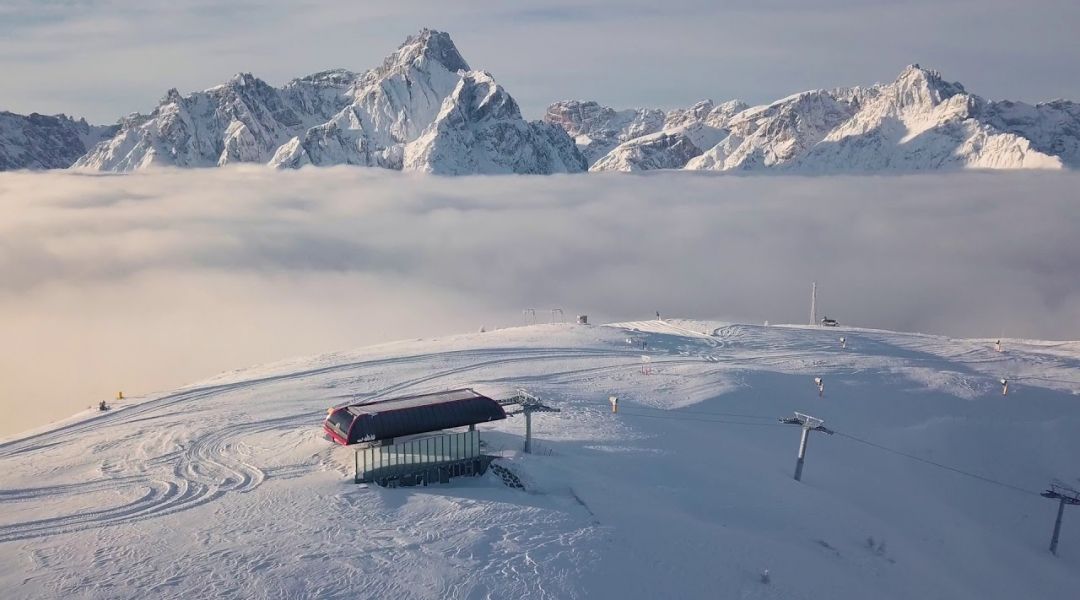
3 Zinnen Dolomites is the large ski area of Alta Pusteria, extending across Sesto, San Candido, Dobbiaco, Villabassa and Braies, in the heart of the UNESCO World Heritage Dolomites. The slopes overlook the Sesto Dolomites, the Haunold and the famous Sesto Sundial, while the Tre Cime of Lavaredo, although not directly accessible by lift, represent the landscape symbol of the entire region.
The official website lists 115 km of slopes and 31 lifts, distributed approximately between the 1,130-metre valley floor and the approximately 2,200 metres reached on Mount Helm. The overall figure includes the large Mount Helm-Staffal-Orto del Toro-Rotwand carousel, Mount Haunold in San Candido, the smaller lifts in Dobbiaco and Braies, Kreuzberg Pass and the Val Comelico Ski Area.
The heart of the ski area consists of the slopes on Mount Helm, Orto del Toro and Rotwand, linked ski-in/ski-out by modern gondolas. You can enter the carousel from Versciaco, which is also conveniently accessible by train, or from Sesto with the Helmjet gondola. From Mount Helm, you cross Orto del Toro to reach Signaue and Rotwand, making it possible to enjoy highly varied days on skis with few transfers.
The lift network is modern and fast, consisting largely of detachable gondolas. Among the new features for winter 2026/2027 is the new Helmissimo gondola from Versciaco to Mount Helm: a ten-seater lift replacing the previous gondola, reducing the journey time to less than eight minutes and increasing capacity to 3,250 people per hour. The project also includes widening the long run back to the valley and upgrading the artificial snowmaking system.
Mount Helm is the sector best suited to intermediate and advanced skiers. Long red runs descend from the upper section towards Versciaco and Sesto, with significant vertical drops and wide trails on which to maintain a fast pace. The Helmissimo run, which descends to the valley floor at Versciaco, is one of the longest and most complete descents in the area. Orto del Toro offers panoramic, flowing slopes and also provides the natural passage towards Rotwand.
Rotwand alternates family-friendly slopes with considerably more challenging descents. The most famous is Holzriese, divided into two black variants: the steepest section reaches a stated gradient of 71% and is considered one of the steepest walls in South Tyrol. The Signaue and Porzen slopes also offer technical sections, while the upper area features more accessible trails and mountain huts overlooking the Sesto Dolomites.
Mount Haunold, directly accessible from the centre of San Candido, is not linked ski-in/ski-out to Mount Helm but retains its own identity. The slopes, predominantly blue and red, are particularly suitable for families, ski lessons and anyone looking for a less demanding day. There is also a black run, a long toboggan run and some evening skiing on floodlit slopes. The ski areas at Rienza in Dobbiaco and Braies are even more compact and are aimed primarily at beginners and children.
The ski area also offers the Giro delle Cime, a ski tour crossing Mount Helm, Orto del Toro, Rotwand, Kreuzberg Pass and Padola. Some sections are covered using the SALTO Ski Shuttle: Val Comelico is included in the 115-km offering and uses the same ski pass, but the connection with Alta Pusteria is not yet entirely ski-in/ski-out. The slopes and features of the Veneto side are described in the dedicated Val Comelico and Padola section.
The variety of the ski area means that there are slopes for every level, but its main characteristic is the quality of its red runs: long, wide, well-groomed and generally less crowded than those in the more famous areas of Dolomiti Superski. The black runs on Mount Helm and Rotwand satisfy expert skiers, while Haunold, Braies and Dobbiaco complete the offering for families and beginners. However, the distance between some sectors requires the use of the train or ski buses.
The Puster Valley railway is a distinctive feature of the resort: Versciaco station is located next to the gondola departure point, and the Ski Pustertal Express also allows visitors to travel towards Kronplatz. Artificial snowmaking covers a large proportion of the slopes, while the relatively low elevations are offset by favourable exposure and the generally cold climate of Alta Pusteria.
The area is also one of Italy’s most important destinations for cross-country skiing, with an extensive network of linked trails between Dobbiaco, San Candido, Sesto, Fiscalina Valley, Braies and the Austrian border. Dobbiaco’s Nordic Arena hosts international competitions and provides access to the historic Dobbiaco-Cortina railway trail. The winter offering is completed by toboggan runs, snowshoe excursions and numerous walking routes through the snow.
In summer, Alta Pusteria is one of the main starting points for visiting the Tre Cime di Lavaredo, Fiscalina Valley, Lake Dobbiaco and Lake Braies. The lifts on Mount Helm, Rotwand and Haunold provide access to panoramic trails, family routes, mountain-bike itineraries and high-altitude mountain huts. The San Candido-Lienz cycle path is also very popular, following the Drava Valley downhill into Austria.
© ALL RIGHTS RESERVED
14
Social reactions
14

© ALL RIGHTS RESERVED
Latest news from Alta Pusteria
South Tyrol
3 Zinnen Dolomites, new “Helmissimo” gondola and other innovations for winter 2026/2027
Michela Caré, Monday 14 September, 16:30
Nordic Skiing
A Dobbiaco sarà un avvio di 2027 da brividi: in serie 3 Zinnen, Coppa del Mondo e il para-fondo
Fabio Poncemi, Thursday 21 May 2026
Nordic Skiing
Fabio Poncemi, Friday 8 May 2026
Freestyle Skiing
Fabio Poncemi, Thursday 7 May 2026
Alpine Skiing
Fabio Poncemi, Saturday 14 February 2026VIDEO




14