
Sustainability

Thomas Roetting

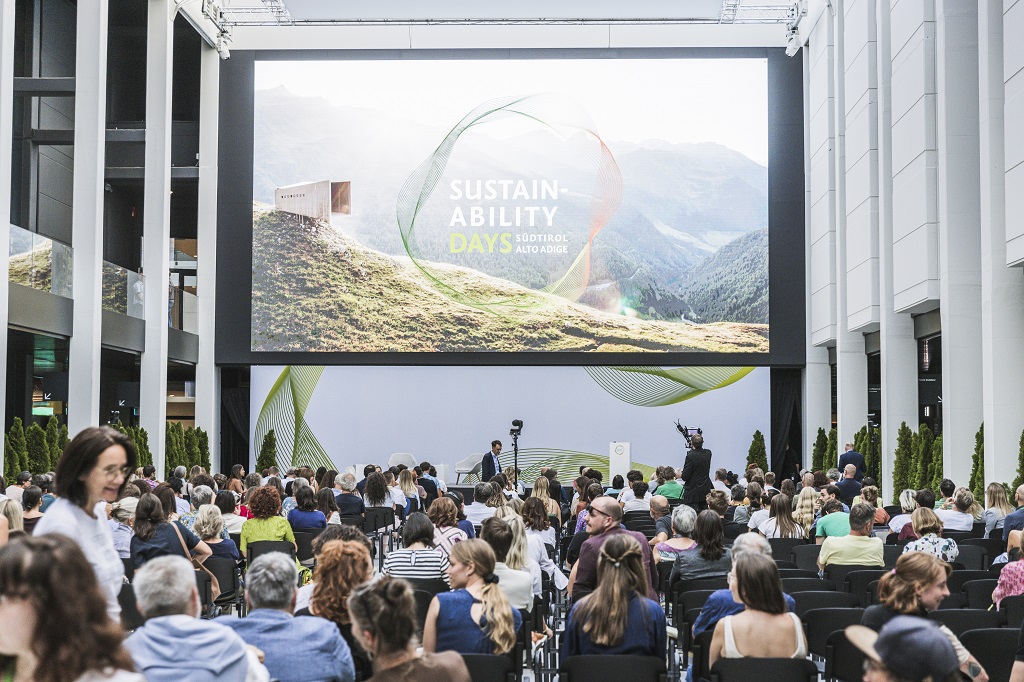
From 6 to 9 September, the first edition of "Sustainability Days" took place at the Bolzano Fair, an international event promoted by South Tyrol to discuss the best solutions for the sustainable development of European rural regions.
Sunday 11 September 2022 10 minutes reading time
The event saw the involvement of authoritative national and international institutional personalities such as the Minister of Sustainable Infrastructures and Mobility, Enrico Giovannini, the President of the Autonomous Province of Bolzano Arno Kompatscher, as well as Nobel Laureates such as Robert Fry Engle, academics, economists, researchers and internationally renowned experts.
During the first day there was the official presentation of the Climate Plan of the Province of Bolzano, officially approved by the Provincial Government on August 30th and presented today for the first time.
There are 5 general objectives aimed at climate neutrality that South Tyrol aims to achieve by 2040, 10 years ahead of the limit set by the European Union:
1. CO2 emissions must be reduced by 55% by 2030 and by 70% by 2037 compared to 2019. South Tyrol has set itself the goal of achieving climate neutrality by 2040.
2. The share of renewable energy must increase from the current 67% to 75% by 2030 and to 85% in 2037. Ultimately, to achieve climate neutrality, we must reach 100%.
3. Emissions of non-CO2 greenhouse gases, in particular N2O and methane, must be reduced by 20% by 2030 and by 40% by 2037 compared to 2019.
4. In South Tyrol, the focus is on exponential growth in those sectors that are developing in relation to climate change.
5. Despite the necessary adaptation of society and the economy, the share of the population at risk of poverty is expected to decrease by 10% by 2030 compared to 2019 (around 18% in 2019).
To achieve these goals, the climate plan provides for three types of measures:
• prohibitions and commandments, which would be effective in the short term
• incentives, in the medium term, which serve to reward certain behaviors
• long-term changes that can be defined as "cultural changes" that modify the behavior of the individual.
With the second day of the “Sustainability Days” conference we got to the heart of the proceedings. Many topics were addressed, focused on the responses of the territory and the environment to the climate crisis.
The first speech by Gail Bradbrook, activist, environmentalist and co-founder of the Extinction Rebellion movement, illustrated how the controversial method of civil disobedience can support change. In today's society, the focus is on GDP, but it is the environment that must have priority. The "more and more" paradigm must end. The political and economic system that dominates the world must change and acts of civil disobedience also serve this because they lead to new ideas and new solutions. Leonora Grcheva, responsible for cities and regions of Donut Economics Action Lab, is also of the same opinion. Donut Economics approach (the theory of the donut) that he illustrated proposes a vision that sees outside a series of circles, the planetary limits within which societies should act to preserve habitats. It is increasingly evident that these limits are not being respected and the planet, as a result, is in great suffering. The Donut Economy approach, as explained by Grcheva, is applicable to any level of social, economic and environmental complexity.
The third day of the Sustainability Days saw the comparison between science and youth activism. The work began with the intervention of Katja Diehl, founder of #shedrivesmobility according to whom, despite the talk of sustainability for 10 years, compared to other sectors such as industry and agriculture, nothing has changed in the field of mobility. Starting from this provocation, he illustrated his idea of sustainable mobility. Everything must start by bringing people back to the center, starting with giving them back those spaces now dedicated to cars (parking lots, for example) which could thus become a new agora. This is just the beginning for a serious and profound awareness of the future of sustainable mobility, from all points of view.
Alex Puzter, UN expert for harmony with nature and researcher on the rights of nature, also spoke, according to which the law of nature is the new way of protecting the environment. It is a human right to have a healthy and liveable environment and this can only be maintained by spreading the rights of nature. Particularly present in rural regions, the rights of nature are present in over 40 initiatives around the world. For example, since 2008 in Ecuador nature is seen as an element with legal personality; in 2017 the Maori people of New Zealand recognized their most important river as a legal entity; the Mar Menor in Spain is the first ecosystem with legal personality. But how can the rights of nature be promoted in South Tyrol and other rural areas? It is possible to do this by first understanding what the rights of nature are, what types of nature are included in them, whether individual animals, places or entire ecosystems.
During the fourth and final day, the experts present at the "Sustainability Days" prepared a summary document with concrete suggestions aimed at policy for the 4 areas of interest of this first edition of the event:
Agriculture and food: raise awareness of the biodiversity crisis and improve the effectiveness of political actions, act to regenerate ecosystems, support research on food production, promote sustainable diets.
Renewable energy & energy efficiency: reducing energy demand, setting up climate-compatible energy systems, giving more space to renewables, improving storage and energy networks, establishing synergies between existing projects, completing the projects that are started and promote the participation of women and young people.
Sustainable mobility & tourism: reviewing the regulations that prevent or slow down change, allow the intersection of services, bringing demand together, ensure that politicians involve stakeholders to become leaders in their rural regions.
Resilient regional habitats: identify and preserve the specific natural assets of each territory, improve local income by generating jobs, revitalize economic potential, enhance identity and self-confidence, strengthen the community system and social networks.
© ALL RIGHTS RESERVED
Social media engagement
LISTA DI LETTURA


21