
Alpine Skiingthe story

AGENCE ZOOM

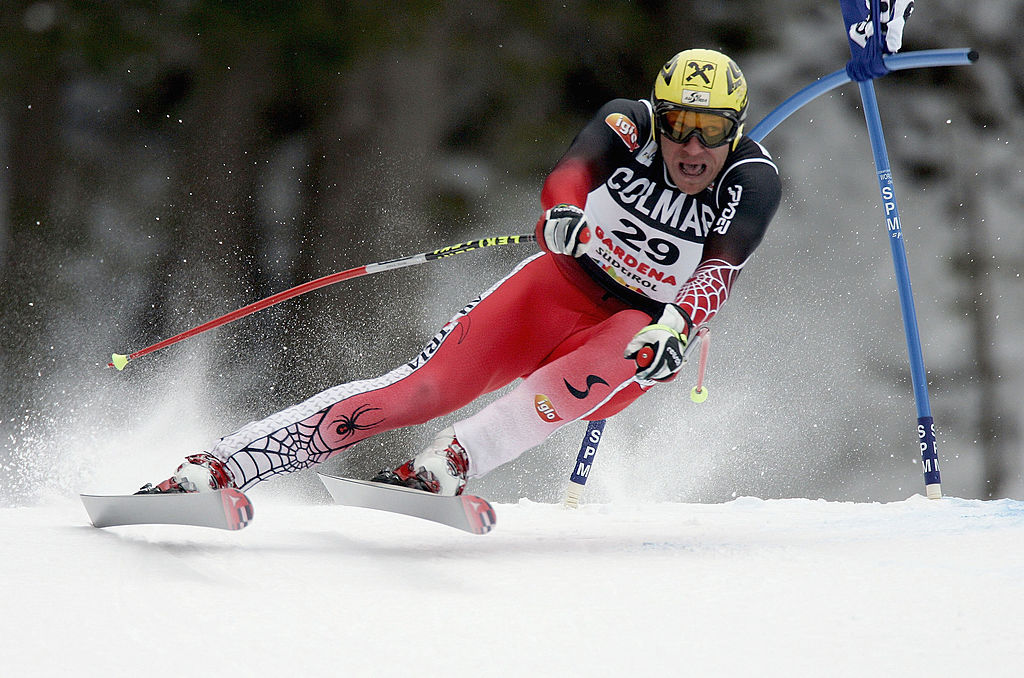
It has been 25 years since Hermann Maier suffered the devastating motorcycle accident that befell him when he was the undisputed dominant force in the skiing world. The Kronen Zeitung spoke to the key figures from that time, above all Dr. Artur Trost, who saved the Salzburg-born star from having his right leg amputated, although his liver and kidneys were also severely damaged. Fritz Strobl: “A unique athlete; we knew that only he could make it.” The four-time overall World Cup winner reflects on how he changed as a man after that day.
Monday 24 August 13 minutes reading time
A tragedy for him, for Austrian sport and for the world of skiing.
The seemingly invincible Hermann Maier lay in the ditch beside the B99 road he was travelling along to leave Radstadt and cover the final kilometres home to Reitdorf (a village just a short distance from Flachau), after another full day of training at the Austrian national team’s preparation centre in Obertauern.
Five years ago, on the 20th anniversary of that devastating accident which transformed the career of one of the greatest athletes—not just skiers—in history, we discussed it here on NEVEITALIA; today, as August 24 draws to a close, we are returning to the story because it is a unique sporting tale, especially considering the rebirth of “Herminator”: more human and certainly less dominant, given the condition of his right leg, and perhaps loved all the more for that very reason.
It was a Friday evening, at around 7 p.m. (which is why we are publishing this story at the moment marking 25 years since the event that changed everything), when the 28-year-old Salzburg-born champion, riding his Triumph motorcycle, came upon the car of a retired German man who was holidaying in the area and turned left where it was not permitted. The impact sent Maier flying more than ten metres. He remained conscious throughout, and what Hermann saw when he looked at his body was indescribable: his right leg was mangled—not only by the displaced, open fractures of the tibia and fibula, but also by nerve and tissue damage—meaning that, after first aid and helicopter transport to Salzburg University Hospital, amputation of the limb appeared to be the only option for saving the country’s most famous sportsman.
Only after spending an entire night in the operating theatre did the surgeon who treated him, Dr. Artur Trost, rule out amputation. He then waited through the early hours of Saturday to ensure that the danger of infection had passed, having achieved what many experts who saw the X-rays of that leg described as something close to a miracle.
The damage was extensive, including to his liver and kidneys. Rather than thinking about the Olympic season (the Salt Lake City Games offered the chance of a third gold medal after his two titles at Nagano 1998), Herminator was simply Hermann, and the first priority was to try to walk again and lead a normal life.
Maier had won three overall titles in the previous four seasons, along with downhill and super-G gold at the 1999 World Championships in Vail Beaver Creek and four Crystal Globes in the same season—a feat he achieved in 1999/2000 and 2000/2001, as Marco Odermatt would later do in two consecutive seasons.
And yet, in the days before Christmas that year, the Flachau ace was already able to make his first, very gentle return to the slopes on the snow of his home region, where he later built a family with his wife Carina (the couple had three daughters). The recovery was extremely difficult, and the summer of 2002 was complicated by a calf injury suffered in Chile. He returned to the World Cup only almost a year and a half after the tragedy in Radstadt, narrowly failing to qualify for the second run of the Adelboden giant slalom.
Some were already pitying him after that first appearance at the Chuenisbargli temple, but once again—as when he had not been wanted in the national team despite already astonishing everyone as a forerunner in the home giant slalom in Flachau and dominating the European Cup—Hermann drew on an extraordinary strength of will and took everything back.
Two weeks later, on January 27, 2003—521 days after the accident—came a stunning and unforgettable victory in the Kitzbühel storm, in a super-G made even more difficult by the weather conditions. It was undoubtedly the most significant win of his career, so much so that even the Iceman shed a few tears.
Then came the St. Moritz World Championships, where he won silver in “his” discipline behind an unbeatable Bode Miller, with the 36-centimetre intramedullary nail still lodged in the lower part of Maier’s right leg.
After undergoing another operation the following winter, he capped it all with a super-G of extraordinary mastery. By that point in his career, brute force was no longer enough; much more was needed to triumph at that level. He produced a simply unique performance at the Sestriere finals (the title was mathematically secured when the giant slalom was cancelled), placing a fourth overall Crystal Globe in his trophy cabinet. Then, just under a year later, he won his third world title, again in Italy, this time in Bormio, claiming the gold he had not yet secured: the giant slalom title, after the disappointments in the speed events, including a heavy crash during training at the San Pietro jump.
Italy, which had played a role in the final part of “Herminator”’s career, took centre stage again at the 2006 Turin Olympic Games. The Austrian ace came within a whisker of the super-G and giant slalom titles, taking silver and bronze by just a few hundredths. They were his third and fourth medals at his second and final Olympic appearance, as Maier retired on the eve of the 2009/10 season that would lead to Vancouver.
“Hitting rock bottom makes you human,” he said some time ago, reflecting on August 24, 2001, the day that changed him in so many ways. “I learned humility, because nothing can be taken for granted anymore. I thank God, and I believe the accident was a sign from above, proof that I, too, have my limits.”
Over the weekend preceding this quarter-century anniversary of an event that many fans cannot forget, the Kronen Zeitung interviewed Fritz Strobl, the Olympic downhill champion at Salt Lake City. On that August 24—also the former Wunderteam speedster’s birthday—just a few months before the greatest achievement of his career, Strobl immediately received the news while he was in Chile with other teammates. Maier had returned from that training camp only a little over 48 hours earlier. “It was a shock for us too,” he told the Austrian newspaper. “We immediately realised how serious it was, but at the same time we knew that if anyone could return to being an athlete, it was him alone.
Hermann was unique as an athlete, unique in his skiing technique and unique in the amount he trained and the strength of his will—something no one on our team could match. All of that made him who he is.”
Now 68, Dr. Artur Trost recalled—also speaking to the Krone—the day he reluctantly became famous for saving the life of a skier who was already a legend. His words are chilling: “It is incredible that 25 years have passed. When I think back to that evening, it was a whirlwind of emotions; we felt connected to this great champion who found himself in such a condition. It was an extremely complicated situation. We all did everything we could to save him and, fortunately, some time later we realised that, with his immense determination, he could also become a great athlete again.”
© ALL RIGHTS RESERVED
Social media engagement
Ultimi in Sport invernali
La CdM di skiroll in Val di Fiemme: dal 18 al 20 settembre si decide tutto sulle strade trentine e l'Italia...
Ancora una volta, l'ultimo atto del massimo circuito della versione estiva dello sci di fondo si concluderà nel territorio fiemmese. Tra Ziano e l'Alpe Cermis andranno in scena mass start, individual e team sprint e con Vigants e Aarekol leader delle classifiche generali. Grande attesa per gli azzurri, reduci dai Mondiali in Lettonia che hanno portato quattro medaglie, con Emanuele Becchis iridato nella sprint per la quinta volta in carriera, due anni dopo la perla proprio in Trentino.
2