
Snow and Weather ForecastsWinter 2026/2027
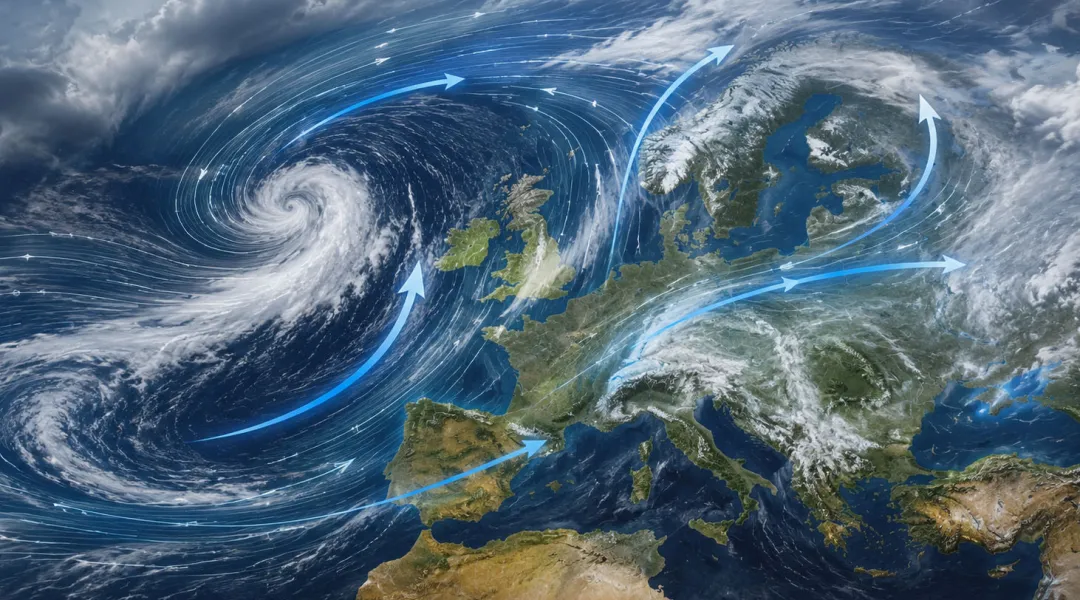

The NOAA (National Oceanic and Atmospheric Administration) published its latest update on the ENSO (El Niño-Southern Oscillation) climate phenomenon on July 9, confirming that El Niño is now fully developing and will continue to strengthen over the coming months. According to US climatologists, the phenomenon is expected to reach its peak during the boreal winter of 2026–2027, with a 97% probability of persisting through spring 2027 and increasingly high chances of reaching an intensity among the highest observed since 1950.
Friday 10 July 2026 8 minutes reading time
For snow enthusiasts, the question naturally arises: what could all this mean for next winter in the Alps?
The answer, however, is less straightforward than it might seem.
What is El Niño?
El Niño is a natural phase of the Earth's climate system characterized by a marked warming of the surface waters of the equatorial Pacific Ocean.
This enormous reservoir of heat alters atmospheric circulation on a global scale, influencing the path of upper-level currents and changing the distribution of precipitation and temperatures across many parts of the planet.
In the United States, South America and Australia, the effects of El Niño are well documented and often fairly predictable. In Europe, by contrast, the connection is considerably weaker and, above all, much less linear.
What could change in the Alps?
One point is important to clarify: El Niño does not make it possible to directly forecast the Italian winter.
For our continent, the phenomenon is more of a "background factor" that can increase the likelihood of certain atmospheric patterns without automatically determining them.
According to climatology, during El Niño winters, the following are observed with some frequency:
- a greater likelihood of a positive NAO (North Atlantic Oscillation), especially during the first part of winter;
- more active westerly Atlantic flows;
- above-average temperatures in parts of Europe.
As for precipitation and snow in the Alps, however, there is no statistically robust signal. Some winters have been very snowy, while others have been decidedly lacking in precipitation.
In other words, El Niño alone is not enough to determine whether winter will be favorable for ski enthusiasts.
The Atlantic and stratosphere will also need to be monitored
To understand how the winter season will actually evolve, it will also be necessary to follow other climate indicators that strongly influence Europe over the coming months, including:
- the evolution of the North Atlantic Oscillation (NAO);
- the state of the polar vortex and the stratosphere;
- sea-surface temperature anomalies in the Atlantic.
In most cases, these are the elements that determine whether cold-air outbreaks or long periods of unsettled weather will reach the Alps.
The major El Niño events of the past 40 years: what happened in the Alps?
Several particularly intense El Niño events have occurred over the past forty years, but their impact on Alpine winters has been far from uniform.
1982–1983
One of the most intense events of the last century. Winter was generally mild across much of Europe, but the Alps experienced significant snowy periods alternating with long anticyclonic spells.
1997–1998
Considered one of the strongest El Niño events ever observed. In the Alps, it was remembered above all for a very mild winter, with the snow line often high and below-average snow cover at many resorts.
2015–2016
This too was an exceptional El Niño event. The start of the ski season proved very difficult for many Alpine resorts because of high temperatures and a lack of natural snow. Conditions improved during the second half of winter thanks to several weather systems that allowed snow cover to recover.
The lesson is clear: even the most intense El Niño events have not always produced the same effects in the Alps. The phenomenon influences the global climate, but does not by itself determine the fate of the European winter.
The season is still waiting to be written
The NOAA update is an important piece of the puzzle for understanding the global climate picture over the coming months, but it is still too early to draw conclusions about the 2026–2027 winter in the Alps.
The first seasonal indications will become more reliable between late summer and early autumn, when it will also be possible to assess the behavior of the Atlantic, European atmospheric circulation and the polar vortex.
For skiers and mountain enthusiasts, therefore, the message is simple: El Niño deserves attention, but it is not yet a verdict on next winter.
© ALL RIGHTS RESERVED
Social media engagement
LISTA DI LETTURA

87