
Olympic GamesOlympics - Sochi 2014


Getty Images / AFP


The twelfth episode of the novel the Olympic winter: the capital of Colorado rejects the Games with a referendum and passes his hand to the capital of Tyrol, where one of the main protagonists are the German Kaiser Franz Klammer and blues of Alpine skiing.
Saturday 25 January 2014 12 minutes reading time
The 69th session of the CIO of the September 12, 1970 must vote for the four cities that have applied to host the 12th edition of the Winter Olympics of 1976. In the first round the U.S. Denver takes 29 votes to 18 in Switzerland, Sion, 12 of the Finnish Tampere and 9 of the Canadian Vancouver (with Garibaldi for the races in the mountains), which is eliminated. In the second round Zion takes 31 votes, but the absolute majority of the members of the session is not there yet, it takes 29 Denver, Tampere eliminated with 8. It goes well on the ballot in which the capital of Colorado Denver overrides the capital of the Canton of Valais Sion 39 to 30. But fear for the high costs of organization and the likely negative impacts sull'ambienti urge ecologists to propose a referendum and November 7, 1972, almost 60% of the voters of Colorado voters are opposed to the organization of the Games in Denver who officially renounces November 15.
The International Olympic Committee then provides the Games in Whistler but refuses in view of a likely change in the Canadian government, and is Salt Lake City, which has lost the race for the Games of 1972, to propose to replace Denver but this time it , the IOC to reject. Finally, February 5, 1973, the highest governing body of world sport chooses Innsbruck, home of the Games of 1964, as host city of the 1976 ones. There are two novelties of the second program of the Olympic capital of Tyrol: a distance of 1,000 meters speed skating men, won by American Peter Mueller, and the dance of figure skating, won by the Soviets Lyudmila Pakhomova and Aleksandr Gorshkov.
About the Soviet Union, the Eastern giant dominates the medal winning a crazy number of golds, 13, booty that no nation will be able to match for quite some time, even with the significant increase in the races on the calendar. So let's see these golds: In addition to dance, figure skating is also the Soviet artistic couples with Irina Rodnina which is confirmed on the throne in five circles but with his new partner in life, Alexander Zaitsev. In biathlon Nikolay Kruglov triumphs in the individual and with teammates in the relay. In speed skating titles in the 500 men's Evgeny Kulikov, Tatyana Averina in the 1000 and 3000 female and her compatriot Galina Stepanskaya. In the bottom male Nikolay Bazhukov won the 15 km, 30 km and Sergey Savelev the young Raisa Smetanina the 10km.
The Soviet Union dominated the women's relay Nordic skiers compete in which four representatives per country instead of three as before between the Soviet-bearer is also, in addition to Smetanina, even the Queen of Sapporo Galina Kulakova which has the unenviable distinction of being the first Olympic medalist disqualified for doping is removed from the ranking of the 5 km in which he won the bronze medal as positive for ephedrine, a substance taken by a nasal spray, but curiously they are left on the bronze of 10 km and l & rsquo , gold in the relay. Finally, the Soviet Union, there is the inevitable triumph in the tournament ice hockey still devoid of Canada.
In the disciplines of gut crazy hat-trick of East Germany: won two races of the bob crews led by Meinhard Nehmer, in the men's luge excels Dettlef Günther, in the women's doubles Margit Schumann and Hans Rinn and Norbert Hahn, East Germans they won two races in Nordic skiing with Ulrich Wehling that gives an encore of Sapporo in the Nordic combined and Hans-Georg Aschenbach, who triumphs by small trampoline while from the big one to take the gold is one of the athletes of the house, Karl Schnabl, first Austrian to win in ski jumping. In the individual competitions of the artistic and amazing double of our great coach Carlo Fassi that leads to the triumph of two of his pupils, the U.S. Dorothy Hamill and Briton John Curry, the latter unfortunately died of AIDS just like its predecessor Ondrej Nepela only 44 years, in 1994.
The remaining gold medals in speed skating go to the Norwegian Jan Egil Storholt (1500 men) and Sten Stensen (5000 men), Dutchman Piet Kleine (10,000 men) and the U.S. Sheila Young (500 women), Norway also earns the title of 50 km with Ivar Formo, Finland that of the men's relay of the fund and the 5 km women with Helena Takalo. Only two titles for Austria landlady but in addition to that of the second Schnabl, then that is the first in chronological order, is what I expect an entire country: Franz Klammer, the absolute monarch of the specialty Cup world, does not disappoint expectations ahead of Switzerland's Bernhard Russi, defending champion. In the women, who was absent for the sabbatical queen of skiing, Austria's Annemarie Moser-Pröll, the West German Rosi Mittermaier won downhill and slalom and can match Toni Sailer and Jean-Claude Killy hat-trick in making giant, held for the last time in a single run in Olympic history, but is beaten for only 12 cents from the Canadian teen Kathy Kreiner.
We have left for last downhill skiing because it is from here that the only arrive medals shipment blue. The best results of other sports are the fourth Willy Bertin in the individual biathlon race that had literally thrown away four years before committing four errors last polygon, the sixth place in the dance of Matilde Ciccia and Lamberto Ceserani and seventh in the artistic female Driano Susanna, born and raised in the United States of Italian parents. We spoke of the Alpine Italy: Herbert Plank is bronze in the men's downhill, the Milanese Claudia Giordani is silver in the women's slalom improving the two bronzes by Giuliana Chenal Minuzzo. And then there are the men's technical events, those of Blue Avalanche, but Gustavo Thoeni, after closing command to the first run of the giant on the day after the second relegated to fourth position, leaving the title to the Swiss Heini Hemmi. Finally, where the slalom with a second heat anthology Piero Gros graduated Olympic champion right in front of Thoeni: Italy ends Games with one gold, two silvers and a bronze medal for merit of the protagonists of our most popular winter sport.
Summary
12th edition of the Olympic Winter Games
Host city and date of the event: Innsbruck (Austria), 3-15 February 1976
Athletes participating: 1129 (898 men, 231 women)
Participating countries: 37
Italian participants: 58 (47 men, 11 women)
Italian flag-bearer: Gustavo Thoeni (Alpine skiing)
Securities allotted: 37 in 10 sports
Official opening: President Rudolf Kirchschläger
Olympic athletes' oath: Werner Delle Karth (bob)
Olympic Oath of Judges: Willi Köstinger
Last torchbearer: Josef Feistmantl
The medal
Soviet Union: 13 golds 6 silver 8 bronze
East Germany: 7 gold 5 silver 7 bronze
United States: 3 gold 3 silver 4 bronze
Norway: 3 gold 3 silver 1 bronze
West Germany: 2 gold 5 silver 3 bronze
Finland: 2 gold 4 silver 1 bronze
Austria: 2 gold 2 silver 2 bronze
Switzerland: 3 gold 1 silver 1 bronze
Netherlands: 1 gold 2 silver and 3 bronze
Italy: 1 gold 2 silver 1 bronze
Canada: 1 gold 1 silver 1 bronze
Great Britain: 1 gold
Czechoslovakia: 1 silver
Sweden: 2 bronze
Liechtenstein: 2 bronze
France: 1 bronze
Social media engagement
Ultimi in Sport invernali
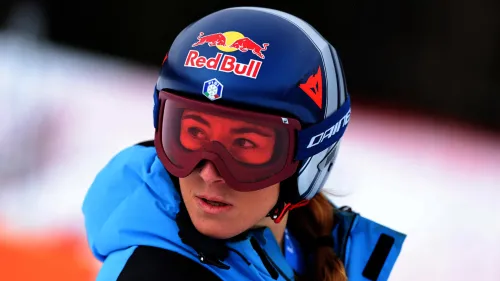
Sofia Goggia ha accusato un malore in Argentina: è già rientrata in Italia per accertamenti
Come ha comunicato questa sera la FISI, la fuoriclasse bergamasca ha concluso anticipatamente il camp sudamericano a causa di un malore durante la sua permanenza a Ushuaia e d'accordo con il dottor Panzeri ha deciso di tornare a casa.
2