
Olympic GamesOlympics - Sochi 2014


Getty Images


The twentieth episode of the novel the Olympic Winter characterized by far (unfortunately) last great Italian Games of snow and ice.
Thursday 6 February 2014 34 minutes reading time
Since the scandal of vote buying for the allocation of the 2002 Games in Salt Lake City broke out a few months earlier, in the 109th IOC session of June 19, 1999 in Seoul adopts a new procedure approved in the 108th session of Lausanne that year, for choose the host city of the Winter Olympic Games of 2006. A special college recruiter, since there are six candidates, will appoint the two cities deemed most suitable to go on the ballot: the choices are Italian in Turin and the Swiss Sion, excluding the Finnish Helsinki, the Slovakian Poprad-Tatry, the Zakopane Poland and Austria's Klagenfurt. It goes well with a challenge Italy-Switzerland and Italy prevailed by 53 votes to 36. Great satisfaction lawyer Gianni Agnelli, one of those who had strongly wanted the Games in white capital of the Piedmont, but that will not have time to enjoy it because he died January 24, 2003. The Winter Olympics then return to Italy after Cortina d'Ampezzo. Despite the strong contrasts between the organizing committee, TOROC, and the government, the funding necessary to optimal running of the event, after all the games were well organized, even if the inconvenience to fans and insiders in the movements between sites mountain were notable because of bad weather very common especially in the second half of the show (and the writer has tried them on their skin), certainly changed the face of Turin, which was literally throw a glossy becoming one of the most beautiful cities in the d & rsquo , Europe, not only in Italy, and the opening ceremony was certainly very beautiful, with Stefania Belmondo deservedly last torchbearer.
But the motto for Torino 2006, instead of the original and beautiful "Passion lives here", ie "Passion lives here" could be "not all that glitters is gold" ... we were the second games of missed opportunities for Italy. First, because, apart from the short-lived enthusiasm for sports such as speed skating long track and short and curling, unknown to almost all of the population, the rest of Italy continued to be rather indifferent to sports winter and during those games either, especially after: the disciplines of snow and ice over the past eight years they have had some space in the news on TV and newspapers only thanks to some sensational victories of our athletes, especially in alpine skiing. Second, the overall strength of Italy in winter sports, except for a few exceptions and unless downhill skiing and sledding that you always maintain good levels especially in the men's field, has gradually diminished: it is not working properly on young people to schedule a bright future as it had been the recent past. Third, many of the facilities and competition venues, especially those in the mountains, have been completely abandoned by the international events since 2011 are no longer held a competition of the World Cup snowboard in the Olympic venue of Bardonecchia, by 2009, there was dispute over World Cup races in Olympic venues other sports FIS, not to mention the biathlon center in San Sicario, dropped immediately after the Games, and the sports of track in Cesana Pariol gut, on which always hangs the ax of closure for the high costs of maintenance. In short, the Turin Olympics were, alas, not a starting point for the revival of winter sports in a big way in Italy, but the final culmination of a long and successful season.
Coming to the race schedule, the events rises from 78 to 84: snowboarding snowboard cross appears in the mass start biathlon, skiing in the sprint in pairs displace the intermediate distances, 30km for men and 15km for women, in order in the long track speed skating team pursuit, of course, all four new competitions are for both men and women. We said that Italy gets excited during those games in particular for the speed skating and it is thanks to Enrico Fabris, 24-year-Asiago that Lingotto of Turin guesses ten days of life, during which 3 medals picks up well, of course the first ever for Italy in the sport: in 5000 is bronze, gold is the American Chad Hedrick, who was also like Derek Parra to Salt Lake City from the speed skating skates, then in & rsquo , tracking, thanks to the fall of the young Dutchman Sven Kramer in the semifinals, along with Ippolito Sanfratello Fabris and Matteo Anesi with Stephen Donagrandi reserve, leads to the final where Italy is right of Canada winning a fantastic gold, which then repeats Fabris dramatically in the 1500 in front of the winner of the 1000, the American color Shani Davis and Hedrick. Even the 500 is an American former roller skating, Joey Cheek, silver behind Davis on double distance, while the 10000 makes them its own Dutchman Bob de Jong with Hedrick and a second exhaust Fabris now eighth.
All other winners among women and no individual gold for the German who only win the team pursuit: the 500 is the Russian Svetlana Zhurova beating the favored Chinese Wang Manli, rises suddenly in the 1000 Dutch Marianne Timmer that he wins eight years after the triumph over the mile and a mile and a half in Nagano, with two goals in the 1500 Canadian Cindy Klassen and Kristina Groves gold silver and Germany's Anni Friesinger spectacularly off the podium, fourth, the same placement that gets in 3000 where the Dutch are doing twice with Ireen Wüst Renate Groenevold gold and silver, and finally the German Claudia Pechstein is denied poker in a row on the 5000 Canadian Clara Hughes, already double bronze in cycling at the Summer Games in Atlanta in 1996 and in the individual road time trial . Much later also short track even if Italy gets only one medal, one of the women's relay but it is historic because it is the hundredth for our colors at the Winter Games, the Italians are Marta Capurso, Katia Zini, Mara Zini and a very young Arianna Fontana, who at age 16 still to go blue became the youngest medalist ever at the Winter Games. And South Korea to win the relay in addition to the male, the country dominates the Asian specialties with six out of eight gold medals: men Ahn Hyun-soo wins 1000 and 1500 in addition to the relay, the same achievements among races in the same women for Jin Seon-yu, Ahn is also bronze in the 500 male prerogative of the American Apolo Anton Ohno, the race is the shortest female Chinese Wang Meng.
Continuing with the sports of ice, artistic men's figure skating sees the triumph of Russian Evgeny Plushenko in absentia of his compatriot and rival Aleksey Yagudin, past the gala professional, in the artistic feminine charms Japanese Shizuka Arakawa, that in the absence the 15 year old compatriot Mao Asada too young to be taken to the Games and American Michelle Kwan, who defected to the U.S. Championships due to injury, he is right the other American Sasha Cohen and Irina Slutskaya of Russia. In couples twelfth consecutive gold for the former Soviet Union, the Russians Tatiana Totmianina and Maksim Marinin line up three Chinese couples, also speaks Russian dance with Tatiana Navka and Roman Kostomarov. The final of the women's curling sees 7-6 win for Sweden's Anette Norberg about Switzerland Mirjam Ott, the male in Canada's Brad Gushue surprising destroys Finland 10-4 in eight ends. With over Sweden 4-1 in the final of the maple leaf is also the women's hockey as four years earlier while Sweden is the eternal Peter Forsberg to do an encore of Lillehammer exceeding 3-2 in the last event of turin 2006, the arch-rivals of Finland. For Italy and Gerda Weissensteiner is also historic bronze in the women's two-man bobsleigh won by Germany's Kiriasis, Prokoff maiden, the former Olympic champion South Tyrolean of the sled brakeman has changed, no longer Antonella Bellutti but Jennifer Isaac , also coming from another sport, athletics. In the men's competition goals for the German Andre Lange, gold already in the "four" in Salt Lake City and the first to make the en-plein 22 years after his compatriot Wolfgang Hoppe. In the skeleton hits "long-lived" for the 39 year old Canadian Duff Gibson and the 33-year old Swiss Maya Pedersen.
In a men's luge gold for Armin Zöggeler, in another double-Alto Adige medal, bronze Gerhard Plankensteiner and Oswald Haselrieder that take place on the podium of the most popular fellow Christian Oberstolz and Patrick Gruber, fifths. The success goes to the Austrian brothers Andreas and Wolfgang Linger, and the third place of the double blue does not lack the usual controversy when the Italian instrumental Haselrieder says candidly do not know the words to the national anthem. German hat-trick as four years earlier with Sylke Otto is confirmed on the top step of the podium. The amazing Chinese Han Xiaopeng, ever winner so far in the World Cup, won the men's freestyle aerials, the female ones are Evelyne Leu of Switzerland in the men's moguls gold at Dale Begg-Smith, a Canadian who competes for the colors of his new country, Australia, is the entire Canadian Jennifer Heil of gold in the women's moguls. Men's halfpipe snowboard leaves everyone speechless the "Flying Tomato" Shaun White U.S., survived two heart surgeries in his first year of life, the U.S. is also the "half pipe" feminine thanks to the 19-year old Hannah Teter. The United States could have done twice in the two new races of the cross but that if he wins the men's Seth Wescott, in that the female superfavorita Lindsey Jacobellis when it is clearly in the lead on the penultimate jump attempt an unnecessary stunt falling awkwardly to the ground and giving gold all'incredula Swiss Tanja Frieden. To close the chapter snowboarding, the successes of the Swiss confederation in both parallel giant among men Philipp Schoch is confirmed by beating his older brother Simon, Daniela Meuli won the women's race.
Austria is dominant in the ski jump that in the Nordic combined, the Wunderteam won both team races, the sprint test strip with Felix Gottwald and large trampoline jumping, in which Thomas Morgenstern insult to one tenth of a point compatriot Andreas Kofler, the small trampoline and the losers are combined Gundersen's surprise, respectively, from the Norwegian Lars Bystøle by the German Georg Hettich, both will test individual bronze in the other their respective disciplines. The men's biathlon sees the dominance of the German Michael Greis, although not as pronounced as Ole Einar Bjoerndalen in 2002. Greis own beats Norway in the individual who then throws away the gold of the new mass start with two errors the last polygon leaving your success in the German relay team also won with compatriot, Germany is also the sprint with Sven Fischer, while pursuit Bjørndalen dates from the twelfth race shorter than silver but not enough to beat the Frenchman Vincent Defrasne. Thanks to a polygon there is a surprising success with transalpine Florence Baverel in the women's sprint, the pursuit goes to Kati Wilhelm of Germany with a great comeback from the seventh position, the mass start wins the Swedish Anna-Carin Olofsson, who takes the Olympic title to his great compatriot Magdalena Forsberg, winner of six consecutive World Cups, he failed to win in either 1998 or 2002. The individual is a Russian Svetlana Ishmuratova, which then contributes to the success in the relay, while Olga Pyleva, eighth in the race won by his compatriot was disqualified for doping.
And 'the resounding flop of Italy Alpine skiing, 26 years after the last time our team of our most popular winter sport does not collect any medal, but we will see this later. Another surprise win for France in the men's downhill is the one with Antoine Dénériaz, it was not expected that even in the combined Ted Ligety of the U.S. teen gets thanks to a super race in slalom after being thirty-down , instead of waiting two goals in giant slalom, which arrives on time, but for Benni Raich from Austria, about missed opportunities from Italy, to thank Giorgio Rocca, winner of the first five slalom season, who then accuses a loss of form on the eve of the Games and that after 20 seconds from the start of the Olympics ends with his face in the snow to the disappointment of all the Italian fans. In the super-G Kjetil Andre Aamodt an incredible wins third Olympic gold medal in the specialty after those of 1992 and 2002 mocking Austrian Hermann Maier survived a serious motorcycle accident in 2001, the Norwegian total of 4 gold Olympic medals says, 2 silver and 2 bronze medals in five holdings. There are far fewer precious metals Croatian Janica Kostelić that with first place in the combined and silver in super-G and downhill despite giving lump sum in giant weighs a total of 4 golds and 2 silvers in five circles. The speed events, downhill and super-G, are both going to Austria's Michaela Dorfmeister, who apprehends the only laurel that was missing, as well as Sweden's Anja Pärson, while the giant under a heavy snowfall if he wins the U.S. Julia Mancuso never before or since winning the World Cup in this specialty.
The new sprint races at the bottom of the couples are both classic technique of Sweden, the male Thobias Fredriksson and Björn Lind, the female Anna Dahlberg and Lina Andersson. Lind also triumphed in the men's individual sprint skating that sees three blue at the foot of the podium, in the order Cristian Zorzi fourth, fifth and Freddy Schwienbacher Loris Frasnelli sixth, the women's sprint is the Canadian Chandra Crawford. The so-called race "combined" rather than consisting of two tests becomes a single race, also called skiathlon, with the first half to the second half of the classical technique and free technique, 7.5 +7.5 km for women, 15 +15 km for men. Among women, the Estonian Kristina Smigun embraces this new format and a few days later will make an encore in the 10 km in alternately. Among men the skiathlon if he wins the Russian Evgeny Dementiev that joke in the sprint Norwegian Frode Estil and blues Pietro Piller and Giorgio Di Centa, bronze and "wood." Estonia also goes 15 km alternating with Andrus Veerpalu confirming the title in 2002. The women's relay wins Russia but the blue back on the lowest rung of the podium, and Italy is the fourth in the last five Olympics bronze thanks to Arianna Follis, Gabriella Paruzzi, Antonella Confortola and Sabina Valbusa. But in the men's relay is the blue triumph 12 years after the success of Lillehammer, and this time it is for the posting. After the first two fractions of Fulvio Valbusa and Di Centa Piller is to unplug all when it is almost at the exchange rate with Zorzi and passes the baton with about 5 seconds ahead. "Zorro" instead of waiting for the pursuers and risking the sprint, pulls straight and comes with more than 15 seconds ahead of Germany and Sweden, while Norway is the fifth and staccatissima.
There remain the two races skating starting in liean in the 30 km women's sprint final three with the Czech Kateřina Neumannová that prevails on the Russian Yuliya Chepalova and Polish Justyna Kowalczyk. Much more dense the final sprint of the men's 50 km, the uultima individual race of these Olympics, during which almost nothing happens for 49.5 kilometers, is the sprint launched by Giorgio Di Centa and Pietro Piller that its behind him a sort of "hole cycling" after trying in vain to remove all just minutes before, Friulian stays in my head for almost 40 seconds until it crosses the finish line to be Olympic champion, he had never won a race individual career so far, resisting the return of the bogeyman Dementiev while Piller is fifth. Di Centa was awarded the gold medal by his sister Manuela during the closing ceremony of the Games. It is worth mentioning that George just crossed the finish line was heard during the live broadcast, "I can also stop running now" and instead will play in his fifth Olympics in Sochi! Italy comes to a total of 5 gold medals and 6 bronze medals in the Games of the house that are worth the ninth place in the medals won by Germany. Turning to the other results of the blue, said the flop and disappointment of alpine skiing slalom Rocca, who, after reading the oath of the athletes during the opening ceremony and before the release of abrupt scene between the posts is tight which is fifth in the combined ninth Peter Fill, it should be at least slightly better as the number of top ten placings among women since Lucia Recchia, Nadia Fanchini and Chiara Costazza are eighth respectively in the super-G, giant slalom and downhill Nadia is the tenth .
In biathlon Christian De Lorenzi and veteran Wilfried Pallhuber are seventh and ninth in the individual men's and women's pursuit Michela Ponza fifth, the best result ever for the Olympic biathletes blue. In the men's bobsleigh not go beyond a ninth Simone Bertazzo and Matteo Torchio in race two, Sabina Valbusa is tenth in the women's 30 km of the fund in which Gabriella Paruzzi is fifth, the same result obtained in skiathlon, Arianna Follis is seventh in the individual sprint as well as in the pairs together to Paruzzi in the male always in pairs Schwienbacher and Di Centa are noni. In figure skating Barbara Fusar Poli and Maurizio Margaglio attempt a return that seems imporbabile after the bronze in Salt Lake City, but after the mandatory program are incredibly in the head but in the original Maurice stumbles during the last lift and drag in the fall that Barbara , finished the program incinerates him with his eyes, the two relegated to seventh place, and then sailed up free in a closed position, however excellent sixth. And then there's Carolina Kostner, who at age 19 was appointed by CONI-bearer coming so unexpectedly charged with a pressure that can not handle, the South Tyrol, cousin of Isolde, immediately falls on the first jump of the short program, a triple flip, compromising jumped at the chance of a great result: ending ninth after finishing eleventh on the first segment of the race. Nona is also Deborah Scanzio in the freestyle moguls, luge In the men's Reinhold Rainer eighth and Wilfried Huber in its sixth Winter Olympics, is tenth. Many placements in the short track: Marta Capurso is fifth on the 500 and ninth in the 1500, the 1000 sixth Arianna Fontana, Katia Zini tenth of the 1500s, Fabio Carta seventh and eighth on the 1500 1000 Nicola Rodigari seventh on the 500 and the 1000 Roberto Serra ninth on the 500 and fourth in the men's relay just over half a second from the bronze of the United States. Fantastic fifth for Constance Zanoletti in the female skeleton, even worse than the disaster in alpine skiing snowboarding where the best is Thomas Tagliaferri, eleventh in the cross. Finally, in the long track speed Chiara Simionato is the fifth and tenth on the 1500 500.
Summary
20th edition of the Olympic Winter Games
Host city and date of the event: Turin (Italy), 10-26 February 2006
Athletes participating: 2494 (1539 men, 955 women)
Participating countries: 79
Italian participants: 179 (106 men, 73 women)
Standard Bearer Italian Carolina Kostner (Figure Skating)
Securities allotted: 84 in 15 sports
Official opening: President Carlo Azeglio Ciampi
Olympic athletes' oath: Giorgio Rocca (Alpine skiing)
Olympic Oath of Judges: Fabio Bianchetti
Last torchbearer: Stefania Belmondo
The medal
Germany: 11 gold 12 silver 6 bronze
United States: 9 gold 9 silver 7 bronze
Austria: 9 gold 7 silver 7 bronze
Russia: 8 gold 6 silver 8 bronze
Canada: 7 gold 10 silver 7 bronze
Sweden: 7 gold 2 silver 5 bronze medals
South Korea: 6 gold 3 silver 2 bronze
Switzerland: 5 gold 4 silver 5 bronze medals
Italy: 5 6 golds bronzes
France: 3 gold 2 silver 4 bronze
Netherlands: 3 gold 2 silver 4 bronze
Estonia: 3 gold
Norway: 2 gold 8 silver 9 bronzes
China: 2 gold 4 silver 5 bronze medals
Czech Republic: 1 gold 2 silver 1 bronze
Croatia: 1 gold 2 silver
Australia: 1 gold 1 bronze
Japan: 1 gold
Finland: 6 silver 3 bronze
Poland: 1 silver 1 bronze
Belarus: 1 silver
Bulgaria: 1 silver
Great Britain: 1 silver
Slovakia: 1 silver
Ukraine: 2 bronze
Latvia: 1 bronze
Social media engagement
Ultimi in Sport invernali
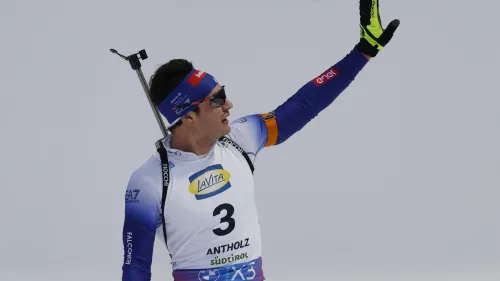
Due settimane ad Anterselva per la nazionale maschile, c'è anche Giacomel per il raduno in quota
Nel sito olimpico, da lunedì 14 a sabato 26 settembre ecco gli azzurri del biathlon impegnati in un blocco di lavoro cruciale: il trentino, nell'ultima fase del suo recupero, con una preparazione mirata ma di nuovo assieme ai compagni.
2