
Tourism
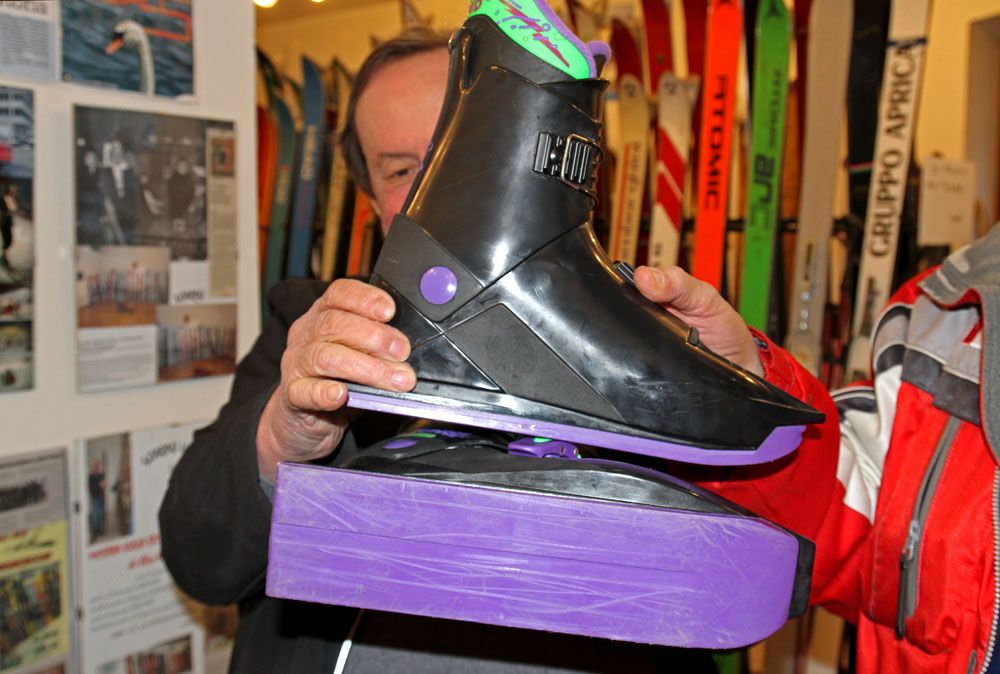


It's called Scarp & ugrave; U & egrave; cc l & rsquo; exposure in progress conceived by five enthusiasts ski-actors (Elio Negri (owner of the material), Angelo Negri Nino D 'Amico, Piero Moncecchi and Mauro Ciceri) time to show tourists and not the history of skiing that in Aprica sees the first station Lombard to host the World Cup in the late '70s.
Wednesday 27 January 2016 5 minutes reading time
Among the hundreds of pieces that the five friends have collected there are some rare or of considerable interest. Among the first, at least one piece of ski collapsible backpack dated late 1800s, skiing Pinless Altenhofer, skis Sertorelli marked with the five Olympic rings, those marked Ferrari and Lamborghini, ski boys created by Rolly Marchi, the boot-skiing, ski-boots complete with slats made of barrels, the 'attack with automatic locking, skis donated dall''ex preparer (aprichese) avalanche blue Luciano Panatti, etc.
Among the latter, a couple of freestyle skiing donated by Piero Troncatti those from downhill years' 30s donated by Martin Martinotta (Moro), those years & rsquo; 50 belonged to Don Augusto Azzalini, those of Claudio Clio Plona for her km launched at 178.80 times, those blowing Aldo Negri and his son Claudio frontrunners Championships national DL 1973 played all''Aprica, a couple of those worn by the Alpine Group to national parades, those of Valligiani background and / or Marcialonga belonged to Guido Carozzi, Arnaldo Negri Nino Plona, ​​Dino and Gianfranco Corvi (the team down the full also included Giulio Moraschini, Alessandro Negri, Gianfranbco Carozzi, Giancarlo and Massimo Corvi). But we forget senz''altro pi & ugrave; of 'one.
The walls also some photos, newspaper articles and posters of the European Cup 1975 in Aprica, designed by Amadio Bianchi, and the World Cup in Valtellina 1985.
& Nbsp;
& Nbsp;
& Nbsp;
& Nbsp;
The 'exposure & egrave; divided into the following chronological sections:
& Nbsp;
SCI
1900/1930. First skis: only wood, no sheets. Attacks: jaw-iron, leather cords or textile sleeves.
1940/1950. Wooden skis: first written manufacturers, first plates with screws. Attacks: jaw or metal cord, front closure.
1960. Skiing wooden laminated above and below. Attacks in processed cheese with cord, first attacks to back closure.
1970. First ski metal and plastic, first plates without screws, raw slabs Cofix in black or white. Attacks metal back closure with safety strap in leather.
1980. Skiing in metal and plastic, graphite slabs. First attacks metal and plastic with first ski stopper.
1990. First ski monocoque slightly straighter. Attacks metal and plastic, first plates (or thickness).
2000 Carving & more ugrave; Short and pi & ugrave; waisted: ski revolution. Attacks plated and pi & ugrave; sure.
& Nbsp;
BOOTS
1900/1940: leather with laces.
1940/1950: leather with top hooks.
1960/1970: the first plastic.
1980: with rear hook.
Following four plastic hooks.
& Nbsp;
& Egrave; You can visit the exhibition of historical skis from 16 to 18 every Saturday and Sunday until April 25 and every day 7 to 14 February and 24 to 28 March.
L & rsquo; input & egrave; free.
& Nbsp;
& Nbsp;
© ALL RIGHTS RESERVED
Social media engagement
More details
Ultimi in Regioni

Argentera
Argentera si trova nell’alta Valle Stura, a pochi chilometri dal Colle della Maddalena e dal confine francese, in uno degli ambienti più appartati e selvaggi delle Alpi Marittime. Il comprensorio si sviluppa sopra la frazione di Bersezio, tra circa 1.630 e 2.500 metri di quota, in un paesaggio di lariceti e pendii d’alta montagna dominato dall’Oserot e dalla Rocca dei Tre Vescovi.

2