
VenetoFaloria cableway

Dino Colli

In a journey between past, present and future the 80 years since the inauguration of the Faloria cableway will be celebrated, the new Scoiattolo slope will be inaugurated and the project to reopen the Staunies facility on Monte Cristallo will soon be approved.
Friday 1 February 2019 18 minutes reading time
Alberico Zardini. President of the Faloria company. "We are proud to have achieved these important milestones: our 80-year-old cableway is an important moment, 80 years of history, but it is also 80 years of tourism, excitement, skiing, fun and growth. The Faloria ski area is almost always the first to open the whole Dolomiti Superski area in both summer and winter, and is the last to close in. Despite the weather, there is plenty of snow, which does not snow, We are able to ensure that we are able to make progress at all. "We have also opened the Scoiattolo, financed by us.
Enrico Ghezze, CEO of the Faloria company. "We organized a simple ceremony on February 5, a date that follows the inauguration of the 80-year-old Faloria cableway, a ceremony that is meaningful to us, and we will remember the opening of our cable car, which was one of the first in Italy, but also our history, the ability to reinvent itself, to keep up with the times, to enhance the offer both on the track and in terms of hospitality, with the Faloria shelter that is now at the ' avant-garde, with a wellness area, which serves excellent cuisine, Tuesday we want to inaugurate the track Scoiattolo that is very much like.We realized that Cortina lacked a track dedicated to the Squirrel, so we decided to name this new track to the brand of Cortina , to his testimonial: the investment was all paid by our company, the project does not fall in line with those of the Alpine Ski World Cup in 2021, but gives added value to the sector. we are working to reopen the plant that leads to Forcella Staunies. "
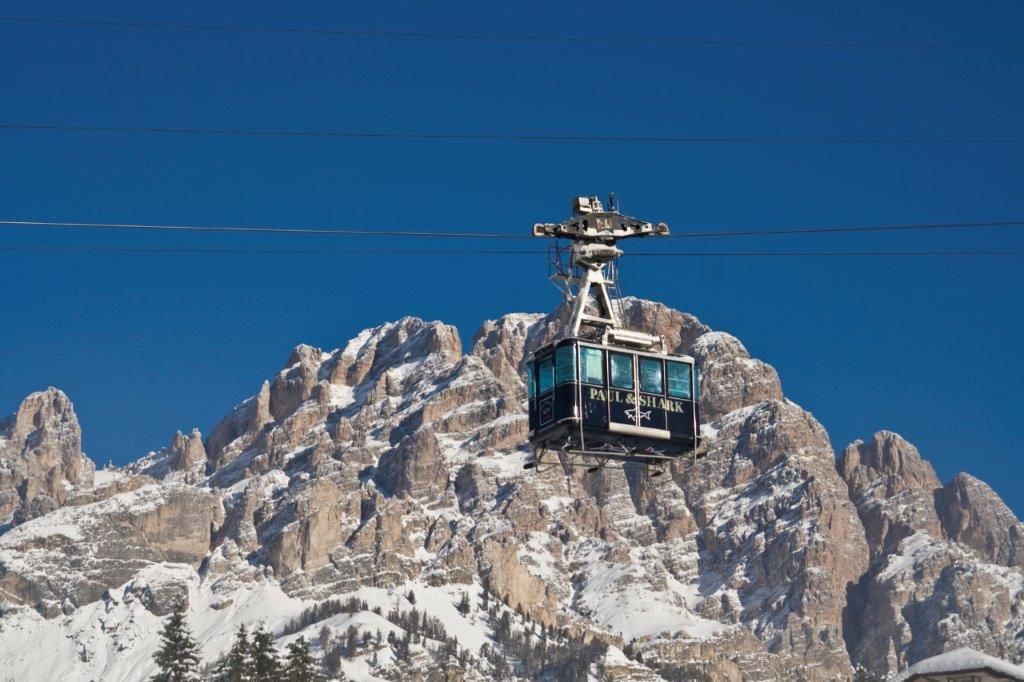
PASSATULA Faloria cableway is 80 years old. The plant that at the time was called "Principe di Piemonte" cable car was inaugurated on February 5, 1939.
Inaugurated in the presence of the Minister of Communications Antonio Stefano Benni and Countess Edda Ciano Mussolini. February 5, 1939 was a day of celebration in Cortina d'Ampezzo. Festival of tourism, labor day, autarky festival. The plant was immediately defined as powerful and daring, capable of honoring Italian technology and industry, which opened up new horizons for tourism and sport in the Dolomites, and which was then inserted into an efficient tool for work and production, in the context of the national economy and industry. The new plant was in fact a perfect creature of modern Italian mechanics, built in complete autarchic regime, at a very rapid rate of implementation: the provision of the Ministry of Communications authorizing the execution of the project is 2 April 1938 and from this date of 5 February 1939 miracles were made, only considering the difficulties determined by the seasons, by the quota, by the accesses. Its construction, which took place in 7 months of work, constituted for the time a great engineering enterprise that involved the major construction companies of the time: the S.A. Redaelli of Milan for the ropes, the Cerretti and Tanfani for the mechanical part and the assembly, and the SICEA of Merano for the part wall. A majestic work that made real a dream: connect quickly and comfortably to Cortina Faloria, thus allowing the ever-increasing number of ski and mountain lovers to easily reach the snow-covered paradises that overlook more than 2,000 meters on the Queen of the Dolomites. The inaugural ceremony of the cable car was simple and at the same time solemn. SELF. Benni, Minister of Communications, Countess Edda Ciano Mussolini, S.E. the Prefect, the Federal, the General Director of the Inspectorate cav. di gran croce Crispo, the Director of the Bank of Italy, seat of Belluno, the President of the Court and the other authorities, have first of all reviewed in the avenue of the station the deployment of the fascist formations commanded by the Fascio Commissioner dr. White and have therefore reached the lower station of the cable car, including wings of applauding crowd. And immediately the ceremony began: St. Em. Cardinal Piazza, Patriarch of Venice, who is the son of these mountains, a war poet, a prelate of great patriotism, has blessed the new work, thus exalting, in a short speech, the spiritual, as well as the material, purposes of the modern equipment that science places at the service of sport. "The Prefectural Commissioner of Cortina, Camerata Brissa," reads the historical documents of the time, "said his greetings to the representative of the Fascist Government, S.E. Benni, Minister of Communications, to Countess Edda Ciano Mussolini present at the ceremony, to the other authorities, interpreting the feelings of gratitude of the Community of Ampezzo for the provisions that the regime multiplies to enhance Cortina, the cornerstone of Italian tourism ".
At the time of its construction Cortina was present only another cableway, the Cortina-Belvedere (now disappeared) that connected the center of Cortina with the hill of Pocol, but nothing comparable to the grandeur of the Faloria cableway.
In total, the cable car exceeds 900 m in altitude and develops, then as now, through 3 stations: the lower Cortina, located near the bus station (1,230 meters above sea level), the intermediate in Mandres (1,500 m ) and an upstream station, reached with a single successive span, overcoming a difference in height of 646 meters which, "with a very rapid and exciting moment", arrives at the Faloria refuge. Exactly its last stretch of the climb that involves the transit of the car a few meters from the rock: running parallel to the mountain is given to passengers a spectacular view of the Dolomites that could hardly be captured otherwise.The letter to the Mayor of Cortina 1925
PRESENT The Faloria company inaugurates on 5 February the Scoiattolo track, the first brand new track that Cortina d'Ampezzo has made after years. In fact it is not a widening or extension of tracks as it happened on the Tofane side: in Faloria there is a new track, which starts at an altitude of 2,054 meters, from the arrival at the top of the Bigontina chairlift, and that descends downstream for almost 1 km, with a maximum gradient of 55% and a vertical drop of 238 meters. A black track suitable for expert skiers. The track has an average width of 32 meters, on a total surface of 27,400 square meters, the average slope is 27%, the maximum of 55%, in the final stretch.
The idea has been in place for a while now. The project started in 2011, but the complex and long bureaucratic process ended last winter and from Christmas the fans were able to ski on a completely new track.
The track built by the Faloria company for an investment of about 300 thousand euros, is in addition to the other four famous black slopes of the Faloria district: Vitelli, Franchetti, Stratondi and Bigontina to complete the offer aimed at expert skiers. The new black run will be served by the Pian Bigontina-Costa Faloria chairlift.
The black slopes, that is suitable for expert skiers, in the ampezzano area are today 10. The last one is the new track dedicated to the Squirrel. In the Faloria district there are 4 other black slopes. The 1758-meter-high Vitelli with a maximum gradient of 51%; the Canalone Franchetti 1,055 meters long with a slope that oscillates from a minimum of 31% to a maximum of 51%; the Stratondi, 846 meters long and with the same maximum gradient of 51%, and finally the Bigontina, a 766 meters long track with 221 meters of difference in height and a maximum gradient of 49%. The other five black tracks are in Tofana. The most leaning is the White Vertigo with a maximum slope of 60.4%. Then there is the Forcella Rossa, the longest track in Cortina that measures over two kilometers: 2,102 meters and has a maximum incline of 62%. It is also classified as a black track the Schuss included in the Olympic stratofana where every year the women's World Cup athletes challenge each other. A slope that has a slope that ranges from a minimum of 31% to a maximum of 56.1%. The Labirinti, a 683 meter long track with 284 meters in altitude, is also a black track. Finally in the area of the Col Drusciè, there is the A which is another black runway built in view of the World Championships in sic alpine that Cortina will organize in 2021: 807 meters long has a minimum slope of 36% and a maximum 57.5%.
FUTUROStaunies could soon be up and running thanks to the new project that includes a funifor with a 9 million euro investment.
The arrival station, which is about 3,000 meters above sea level, on the slopes of Monte Cristallo, was built for the 1956 Olympics, a system and a reserve runway in case of snow problems on the other slopes. The last forty-year concession is in 1971. In the eighties, works were carried out that saw the birth of an intermediate station. After five extensions, and some works carried out, the last one was rejected.
The company that manages the Cristallo and Faloria plants has filed a project for the replacement of the old plant closed from the summer 2016 with a funifor similar to those already installed in Arabba, Sella Nevea or Monterosa Ski and Arabba.
"The plant cabin", explains the architect Enrico Ghezze, CEO of the Faloria company, "will be replaced by lateral load-bearing ropes. The advantages of this solution, compared to a normal cableway, are the strong wind resistance and the possibility of having a single cab that reduces the overall dimensions and operating costs, there will also be only one pylon, leaving the Staunies gully free and avoiding going to undermine the delicate scree that over the years has created many problems for the pylons of the old plant ».
Another novelty is the absence of the intermediate station which will no longer allow to travel the lower part of the slope, characterized by a lower slope from the upper section; Ghezze states that it will be possible to regularly beat the whole track through a snow groomer, a stretch that was left freeride up until two years ago with the possibility of climbing only when the snow had been compacted. Despite the maximum slope of 67% is not among the most prohibitive, one of the main problems was the "first ascent" of the snow groomer that was carried out without a winch, creating many problems for the workers especially with lots of fresh snow.
"The plant", underlines Ghezze, "is also very important for the summer season, giving access to the Lorenzi shelter located in a unique setting and with the attack of important railways like the Bianchi and the Dibona".
© ALL RIGHTS RESERVED
Social media engagement
Ultimi in Regioni

Argentera
Argentera si trova nell’alta Valle Stura, a pochi chilometri dal Colle della Maddalena e dal confine francese, in uno degli ambienti più appartati e selvaggi delle Alpi Marittime. Il comprensorio si sviluppa sopra la frazione di Bersezio, tra circa 1.630 e 2.500 metri di quota, in un paesaggio di lariceti e pendii d’alta montagna dominato dall’Oserot e dalla Rocca dei Tre Vescovi.

65