
Mountain Flavours
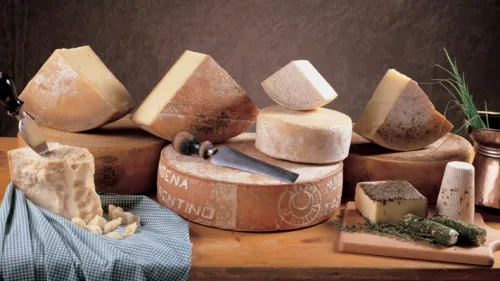

The typical products of the mountain are numerous. When you think of green pastures, the cows during the 'summer they enjoy the' air dell''alpeggio and 'fresh grass, to the trades that have always characterized the' rural valleys, you think a little ' 'also cheese, simple yet multi-faceted and a thousand uses. Downstream you go, you find cheese. And in fact, in a mountainous area and with one in biodiversity & agrave; developed as the Trentino Alto Adige, the cheeses are numerous; Let's discover some.
Thursday 26 November 2015 4 minutes reading time
Puzzone Moena & egrave; certainly the most & ugrave; also known outside Trentino. A cheese pasta soft and light holes, characterized by a unique smell (hence the name) due to a special process in aging. The forms, in fact, they are for at least three months in a humid environment and are washed with warm salt water a few times a week. The saline form cos & Igrave; a layer that does not allow all''aria to penetrate during the fermentation.
Vezzena & egrave; a cheese of traditional flavors. This cheese is produced only during the summer, when the cows graze in pastures. The semi-cooked & egrave; yellow and grainy, with un''occhiatura end. Is aged between 18 and 24 months, in this way enhances its taste bitter and spicy.
Canestrato Trentino & egrave; typical of the area of ​​Rovereto. To make this cheese is added to milk whey processing Trentingrana, which gives the pasta a sapidit & agrave; only. The aging of at least 90 days, is set within the baskets made, after which the cheese is named.
Spressa & egrave; instead a semi-fat cheese produced in the area of ​​the Giudicarie that is done when the cows are in the barn, fed with hay. Its fragrance is decided and an intense flavor, & egrave; great for both young is aged for about 6 months.
Graukäse produced in Pustertal and Ahrntal, not & egrave; really a cheese, because & eacute; It is accomplished without the 'addition of rennet. Cow's milk is heated and coagulated, the curd is then cooked, pressed and "seasoned" with salt and pepper. The paste is grainy and not very smooth, taste & egrave; only.
Caprino di Cavalese was typical of the Val di Fiemme, today the production & egrave; reduced. This cheese has a thin crust and a white compact texture. The forms are passed in brine and then left to mature in old stone cellars.
For cheese lovers, the pi & ugrave; greedy and the most & ugrave; curious, The Cheese Route of the Dolomites & egrave; a path to be tested, a trip to the taste of these products simple, but fundamental for historical mountain areas. Here you can find more information: http://www.tastetrentino.it/le-tre-strade/strada-dei-formaggi-delle-dolomiti/strada-dei-formaggi-delle-dolomiti/
& Nbsp;
© ALL RIGHTS RESERVED
Social media engagement
Ultimi in Turismo
Stazioni sciistiche tra rincari e sostenibilità: l'efficienza energetica coniuga equilibrio economico e tutela ambientale
Venerdì 26 giugno a Luino, nel corso dell'evento Destinazioni in quota: costruire strategie condivise per il sistema montagna organizzato da MMA Studio, in collaborazione con SPM SpA Società Benefit, Davide Franchi, Senior Advisor Business Strategy e Referente MMA per le Alpi Centro-Occidentali, nonché collaboratore di Neveitalia, ha presentato un'analisi sullo stato attuale del Turismo di Montagna. In questo terzo e ultimo articolo approfondiamo l’impatto sul consumo di gas serra delle stazioni sciistiche riprendendo le evidenze emerse da una ricerca condotta, nel 2022, dal Politecnico di Torino, nell’ambito del progetto italo-francese ALPIMED CLIMA.

2