
TourismMMA Studio Report

YouTube

On Friday, June 26, in Luino, during the event "High-Altitude Destinations: Building Shared Strategies for the Mountain System" organized by MMA Studio, in collaboration with SPM SpA Società Benefit, Davide Franchi, Senior Advisor Business Strategy and MMA representative for the Central-Western Alps, as well as a Neveitalia contributor, presented an analysis of the current state of Mountain Tourism. In this third and final article, we examine the impact of ski resorts on greenhouse gas consumption by revisiting the findings of a study conducted in 2022 by the Polytechnic University of Turin as part of the Italian-French ALPIMED CLIMA project.
Tuesday 4 August 2026 17 minutes reading time
Among the topics addressed in the analysis of Mountain Tourism presented during the morning's proceedings on June 26 in Luino, the "carbon footprint of a ski resort" deserves particular attention. Discussing the impact of ski resorts on greenhouse gas consumption also means considering the efficient management of water and energy resources. Adopting an emissions containment policy makes it possible to contain operating costs and, especially with regard to electricity, implement strategies that can mitigate market price fluctuations arising from the current difficult geopolitical situation. In the 2022/2023 ski season, ski resorts had to deal with sharp increases in energy prices resulting from the Russian-Ukrainian conflict. This situation could recur in the coming months if a lasting and decisive agreement is not reached regarding the conflict between Iran, Israel and the United States. These situations inevitably raise a ski resort's break-even point and cannot be entirely passed on through higher lift-pass prices: users are themselves grappling with rising household expenses, resulting in reduced purchasing power.

The Polytechnic University of Turin Study as Part of the Italian-French ALPIMED CLIMA Project
To address these issues, a contribution of fundamental importance comes from the research conducted in 2022 by the Polytechnic University of Turin as part of the Italian-French ALPIMED CLIMA project.
The study analyzed the impact of ski resorts on greenhouse gas consumption, demonstrating that the carbon dioxide emitted in this context is much lower than expected. The researchers collected data on electricity and fuel consumption over several seasons at the ski resorts of Limone Piemonte, Isola 2000 and Prato Nevoso, comparing it with the number of daily ski passes sold.
The result is that each skier produces a maximum of 12 kilograms of carbon dioxide per day, equivalent to a 100-kilometer car journey or transporting one kilogram of out-of-season strawberries from America to Europe. These initial results are promising and make it possible to envisage concrete actions to reduce emissions.
Most emissions come from three sources: the operation of the lifts, piste grooming and artificial snow production.

The research demonstrated that the operation of the lifts generates the largest carbon footprint, but that this can be significantly reduced through a simple measure such as adjusting lift speeds, as tested in the French resort of Isola 2000. As for piste grooming, here too an experiment concluded that fuel consumption was reduced by 15% thanks to IMREDD researchers and the installation of geolocation systems on snow groomers. Finally, a last study demonstrated that artificial snow production is a relatively minor element of a resort's energy requirements.
An operational guide was prepared analyzing the individual elements with the greatest impact at a ski resort.
Lifts: the power absorbed is proportional to the vertical rise covered and, to a lesser extent, to the length of the route. It also varies depending on the type of lift, with drag lifts representing the lowest-consumption type of cable lift, while gondolas and modern versions of aerial tramways have the highest consumption. Lift consumption for each meter of vertical rise was estimated at between 300 and 1,300 kWh/year. The energy consumption of a ski resort with 70 km of slopes selling 480,000 tickets was estimated at 5 GWh/year, equivalent to that of 2,500 households.
Artificial snowmaking: snowmaking machines are divided into snow lances, which are more economical and efficient but, being installed in fixed positions, are less adaptable to weather conditions and cannot cover wide slopes, and fan guns, the classic “snow cannons,” which can be moved and guarantee maximum adaptability to different cold and humidity conditions.
One cubic meter of snow contains approximately 400–450 liters of water, which is stored and then melts in spring.
Producing one cubic meter of snow is estimated to consume between 0.5 and 2 kWh, including the consumption of lances and fan guns and that required to pump the water. A resort with 50 km of slopes uses 200,000 cubic meters of water per year and consumes 500 MWh for technical snow, equivalent to the consumption of 250 households.
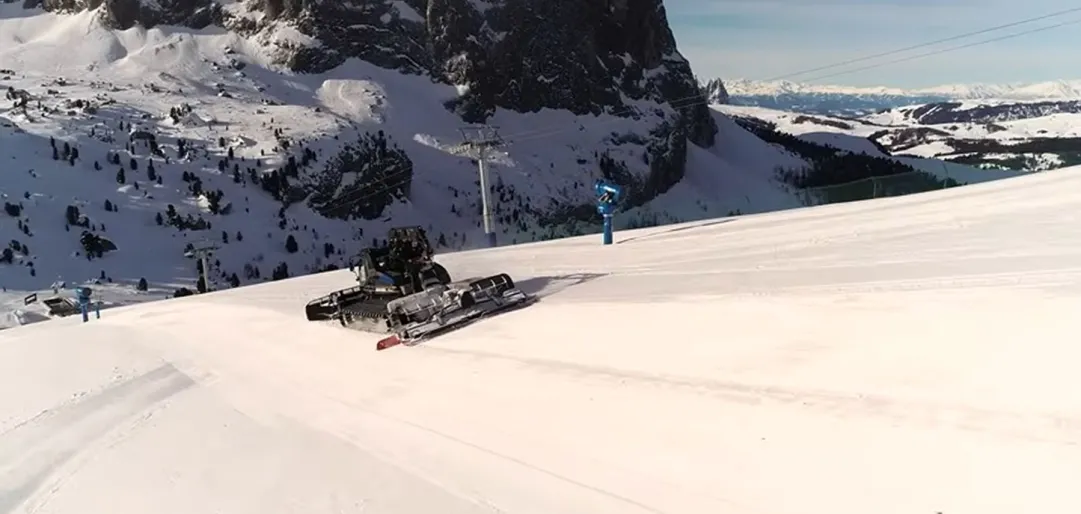
Piste grooming: a snow groomer with an output of 500 hp consumes approximately 35 liters of diesel per hour. Each season, between 2,000 and 5,000 liters of diesel are consumed for every kilometer of slope. Much depends on how difficult or wide the slopes are and on how much snow falls during the season.
Mitigating the carbon footprint: using electricity produced from renewable sources is the most effective method for reducing emissions at ski resorts. Photovoltaic panels can be installed on lift buildings. Heat pumps can reduce emissions in buildings (hotels, bars and restaurants), especially those not connected to the natural gas network. High-altitude reservoirs can be used to produce energy with hydroelectric turbines installed in snowmaking systems.

A ski resort's energy efficiency can be increased in various ways:
- adopting satellite tracking systems (GPS-GNSS systems) for snow groomers, providing real-time information on snow depth beneath the vehicle and recording their routes. These systems have been developed by several companies and have led to a 20–25% reduction in diesel consumption;
- by upgrading the artificial snowmaking system, it is possible to reduce operating hours and therefore take advantage of the coldest hours of the year, reducing electricity consumption and increasing the chances of successfully snowmaking the slopes every year;
- reducing operating speed during periods when the slope is less crowded results in an approximately proportional reduction in absorbed power.
A ski resort with 50 km of slopes consumes an average of 125,000 liters of diesel per year: with a GPS-GNSS system on its snow groomers, it can save 25,000 liters. Snowmaking one hectare of slope at a wet-bulb temperature of -7°C instead of -3°C cuts the snow cannons' electricity consumption in half and saves 7 MWh of electricity. Reducing the speed of a 400 kW chairlift by 20% outside weekends and the Christmas holidays saves 46 MWh, equal to 12% of that lift's consumption.

The research document presents a concrete case study: A small ski resort has an old chairlift (1,300 m long with a vertical rise of 313 meters). It is used during the winter season (December 1–April 13) and summer season (May 25–September 30) for 8 hours a day. Its absorbed power is 130 kW, and its estimated requirement is 274.5 MWh in a good ski season. This figure decreases by approximately half if the slopes cannot be opened during the winter.
A 550-square-meter surface area was identified on buildings near the lift for the installation of a photovoltaic system with a peak capacity of 84.6 kW. Estimated production is 85.111 MWh/year, equal to 31% of the requirement for a full season.
The installation represented an investment of €80,000–90,000, with an economic benefit of approximately €11,000 per year, calculated on the basis of energy prices in the first months of 2021 (before the energy crisis resulting from the Russian-Ukrainian conflict).

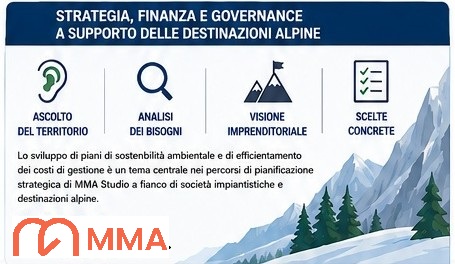
MMA's Role: Strategy, Finance and Governance Supporting Alpine Tourist Destinations
As discussed during Destinazioni in Quota, the development of environmental sustainability plans and operating cost-efficiency measures is a recurring theme in the strategic planning processes that MMA Studio has addressed through its numerous support projects for lift companies and Alpine destinations.
An approach that always begins by listening to the local area and analyzing its needs in order to transform an entrepreneurial vision into concrete choices.
READ ALSO:
Snow tourism: strategies for addressing climate change, overtourism and the abandonment rate
© ALL RIGHTS RESERVED
Social media engagement
Ultimi in Turismo
Stazioni sciistiche tra rincari e sostenibilità: l'efficienza energetica coniuga equilibrio economico e tutela ambientale
Venerdì 26 giugno a Luino, nel corso dell'evento Destinazioni in quota: costruire strategie condivise per il sistema montagna organizzato da MMA Studio, in collaborazione con SPM SpA Società Benefit, Davide Franchi, Senior Advisor Business Strategy e Referente MMA per le Alpi Centro-Occidentali, nonché collaboratore di Neveitalia, ha presentato un'analisi sullo stato attuale del Turismo di Montagna. In questo terzo e ultimo articolo approfondiamo l’impatto sul consumo di gas serra delle stazioni sciistiche riprendendo le evidenze emerse da una ricerca condotta, nel 2022, dal Politecnico di Torino, nell’ambito del progetto italo-francese ALPIMED CLIMA.

2