
Biathlon

Getty Images

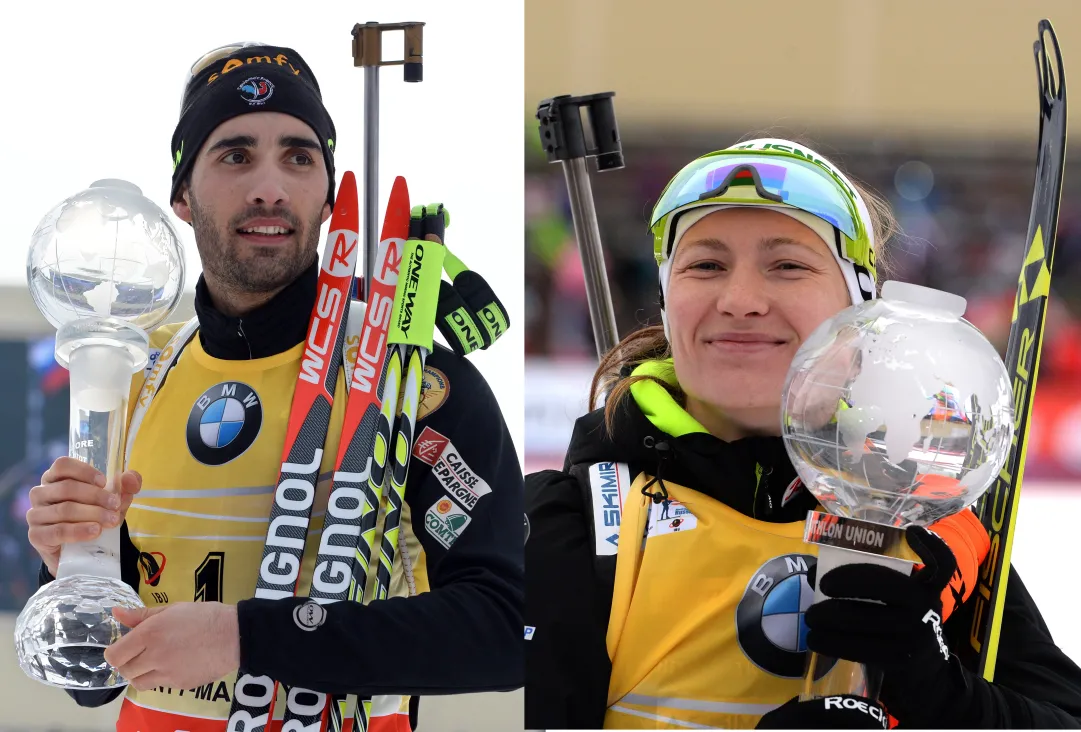
The 'winter just ended saw the dominance of the class in 1988 in the men and 1986 in women's field. Both vintages are rich in talent, we then asked what are the years of birth pi & ugrave; prolific in the history of the biathlon.
Friday 27 March 2015 4 minutes reading time
For instance the 1988 & egrave; the 'year of birth - among others - Martin Fourcade, Simon Schempp, Tarjei B & oslash ;, Dominik Landertinger, Erik Lesser, Evgeny Garanichev, Jean Guillaume Beatrix, Alexey Volkov, Sergey Semenov and Timofey Lapshin. Incidentally in the season just ended 24 of 25 races have seen at least one athlete on the podium of this class which also has monopolized the top-three of a competition.
1986 instead & egrave; the 'year as they have become the world Darya Domacheva, Marie Dorin Habert, the twins Semerenko, Weronika Novakowska, Susan Dunklee plus noble decayed or desaparecide which Kathrin Lang, Svetlana Sleptsova and Tina Bachmann.
SECTOR MASCHILEA today 1988 brings together 56 wins with seven different athletes, 156 podiums with ten athletes and five World Cups with two athletes. It is remarkable that numbers in all three entries placed this vintage in second place all-times, both from the quantitative point of view that the pnto qualitatively.
If we talk about quantity & agrave; successes of 1988 ranks behind only the 1974 has collected 140 wins, 280 podiums and 10 World Cups. These are impressive numbers for & ograve; children almost exclusively the performance of Ole Einar Bj & oslash; rndalen (94-171-6) and Raphael Poir & eacute; and (44-103-4). For the rest there & egrave; only one other man to win (Alexei Aidarov) and one on the podium (Julien Robert).
On quality & agrave; athletes, however, 1988 & egrave; behind the & nbsp; 1967. This class has collected 42 wins, 127 podiums and two World Cups, but now holds the record for number of athletes capable of winning (9, Frank Luck, Sergei Tchepikov, Oleg Ryzhenkov, Ludwig Gredler, Wilfried Pallhuber, Birk Anders, Wolfgang Perner, Pavel Mouslimov, Ulf Johansson) and get on the podium (13 to gi & agrave; mentioned above are added Henrik Forsberg, Tomas Kos, Gilles Marguet and Ivan Masaryk).
About Quality & agrave ;, must be stressed as 1964 is the 'only class to boast among its ranks three winners of a crystal ball (Frank-Peter Roetsch, Andre Sehmisch and Patrice Bailly-Salins).
So, if hardly 1988 potr & agrave; exceed 1974 in terms of quantity & agrave ;, & pu ograve; instead aspire to challenge the 1967 and 1974 in primates related to quality & agrave ;.
The following is a statement of vintages that have put together at least 25 wins or have sent at least eight different athletes on the podium.
© ALL RIGHTS RESERVED
Social media engagement
Ultimi in Sport invernali
Due settimane ad Anterselva per la nazionale maschile, c'è anche Giacomel per il raduno in quota
Nel sito olimpico, da lunedì 14 a sabato 26 settembre ecco gli azzurri del biathlon impegnati in un blocco di lavoro cruciale: il trentino, nell'ultima fase del suo recupero, con una preparazione mirata ma di nuovo assieme ai compagni.
2