
Figure SkatingFigure skating - interviews

Getty Images

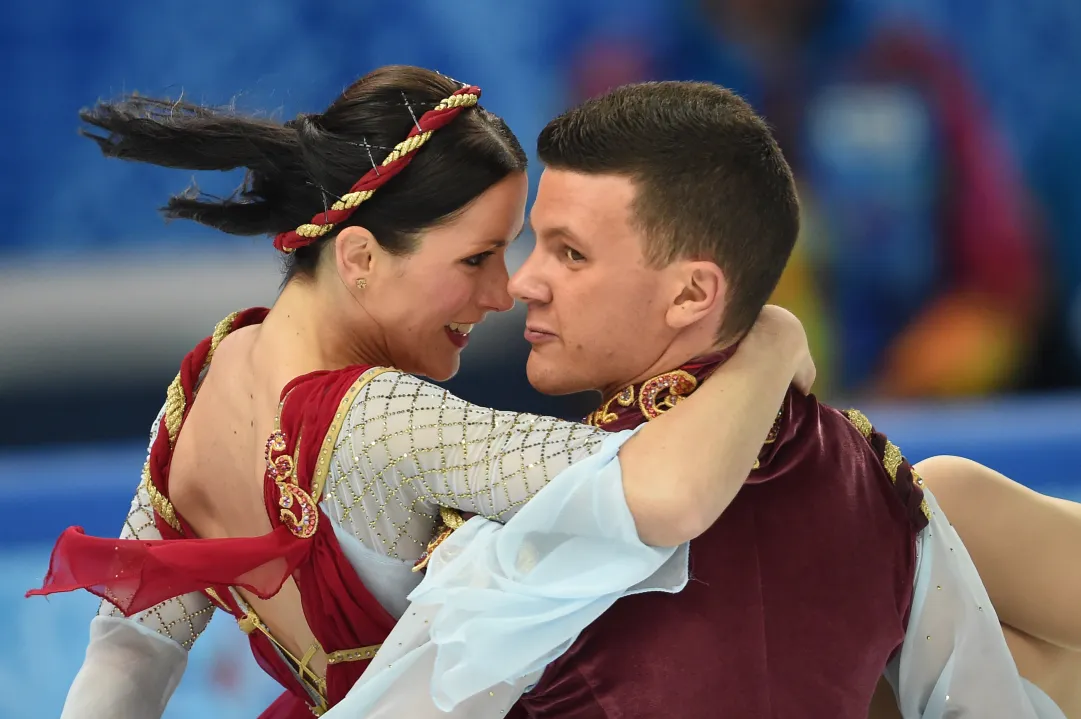
Laura Sciarrillo met the ice dancers Charlène Guignard and Marco Fabbri a few days before their departure for Ondrej Nepela Trophy in Bratislava, in order to talk about the past season, their Olympic experience, their goals for this season and their new competitive programs.
Here is what Barbara Fusar Poli's pupils said during a long chat at the Agorà ice rink in Milan.
Laura Sciarrillo met the ice dancers Charlène Guignard and Marco Fabbri a few days before their departure for Ondrej Nepela Trophy in Bratislava, in order to talk about the past season, their Olympic experience, their goals for this season and their new competitive programs.
Here is what Barbara Fusar Poli's pupils said during a long chat at the Agorà ice rink in Milan.
Friday 10 October 2014 34 minutes reading time
Let's start by talking about the past season.
Marco: We are very happy with how it went. Our main goal was to have consistent results throughout the season, and that is what happened. We were able to skate consistently in every competition, the important ones and the small ones, and we are thus happy because we could reach this goal of ours. We couldn't risk a lot in programs, elements and music-wise, as it was an Olympic season and we were fighting for a spot at the Olympic Games.
The only regret we have was not skating a good Short Dance at the World Championships, which prevented us from having a good overall placement. With the two main pairs not skating in the event, we could have really had a good result, but after all skating a Free Dance after placing 17thin the Short Dance we couldn't aim at climbing the standings that much. We placed 12thin the Free Skating and 14thoverall, but we know we could have done better, placement-wise. Anyway, you cannot always be perfect, so that's ok.
What about the European Championships in Budapest?
Marco: I think we have skated our best programs there. Unfortunately there are competitions where your scores reflect your skating and competitions where they don't fully represent what actually happened on the ice. I am not saying this because I am cocky or arrogant, because Charlène and I are very strict towards our skating, but in my opinion out eighth place in Budapest was not fair, we could have placed seventh or even sixth. When you are at this level in the overall standings, every place higher or lower makes a huge difference. Our main problem were the levels: we got level 2 in the steps, while at Olympics and World Championships we always got level 3. That's a lot of points at the end of the competition.
Are you able to talk with the Technical Specialists at the end of the competition, in order to understand why you did receive such levels?
Marco: We consult with the Specialists we have the chance to talk with. Not everyone is available to talk about your performance or to give you suggestions, some of them prefer to keep their distance.
How was it to attend the Olympic Games?
Marco: It was amazing. We left for Sochi without knowing what we were going to find, and even before landing you feel the special atmosphere that surrounds the competitions, you understand that it's a different competition from the ones you have attended until that moment. At the same time you think that the competitors are going to be the same, that it is going to be more or less like the World Championships. The beginning of our Olympic adventure had been quite shocking: we landed on the day of the Opening Ceremony, and the following day took place the Short Dance of the Team Event. The very same day of that competition we learned we were going to skate the Free Dance.
Therefore before leaving you didn't know whether you were going to skate in the Team Event or not?
Marco: We had been told that in case Italy was going to qualify for the Free Program, they were going to insist for Anna and Luca to skate the Free Dance as well. At the same time, we knew that Anna and Luca would have preferred not to skate the Free and to rest for the individual competition. Anyway, as soon as we arrived in Sochi, we were told that we were probably going to skate the Free Program, thus within a day we had to compete against Virtue/Moir, Davis/White, Ilinykh/Katsalapov...that's not something that happens everyday!
I have to day that that has been useful for our individual competition, as we had the chance to break the ice, in retrospect we are happy we had the chance to skate in the Team Event as well.
So you think it was correct to put the Team Event before the individual events?
Marco: Absolutely not, it was better to skate in the Team Event first for us, but if I put myself in the shoes of a skater who were fighting for an Olympic medal I'd prefer to skate in the individual event first, and later in the Team Event. At the end, although being wonderful, an Olympic Team Event medal is not as valuable as and Olympic individual medal. Of course if Italy had placed third in the Team Event I wouldn't have refused a bronze medal, but if I think of an athlete who goes to Sochi for winning a medal and who has to compete in the Team Event first, I think that competition could have penalized him or her. It's not that tiring for the body – we are all used to train and repeat our programs all over again – but much more for the mind, the pressure is so high. On the other hand I also understand the organizers who didn't want people and athletes to lose interest in the Team Event.
What was the thing that you liked the most of the Olympic Games?
Charlène: Unfortunately we were flying towards Sochi while the Opening Ceremony was taking place, and we flew back two days before the Closing Ceremony, so we didn't have the chance to see both ceremonies. We only watched some videos on youtube.
Marco: The thing I liked the most was to really feel as a part of a team, to represent a country. When you go to European or World Championships you do feel that, but all of this is hugely amplified. You really feel part of a team, and not only one that represents your sport, but a team that represents the whole sport movement of Italy. We often had lunch with athletes from short track or in any case athletes playing sports different from figure skating.
Charlène: I loved that aspect as well, being with athletes belonging to different countries or different sports, and supporting each other during the Games.
Marco: Paradoxically the cafeteria was the place where you could meet different people, where you could relax and take a break from the competition nerves. The Olympics are such an indescribable experience. It is so particular and unique that I cannot think of a single aspect I prefer more than others, something that made an impression on us. Even everything concerning the competition itself is different: you enter the rink, look at the Olympic rings on the boards and feel such a strong emotion.
Charlène: Before leaving Barbara (Fusar Poli) told us: “You will see, it's so exciting when you enter the ice and see the Olympic rings”. We thought “Whatever, they are prints on the boards, what's different in seeing the written World Championships or the Olympic rings?”. But once you are in the arena you see them everywhere, on the ice, on the walls, everywhere, and you think “Wow, this is it!”, but at the same time you understand you cannot think too much about it, otherwise the pressure will crush you.
Marco: You see all of that as the achievement of a huge goal.
It was also nice to watch some competitions after the end of our events. We stayed in Sochi four or five days after our competition was over, and we visited the other athletes' villages...
Charlène: We watched the ski competitions...
Marco: And we saw that in the endurance athletes' village they had a heated outdoor swimming pool!
Charlène: And we could have gone there, because with the athlete's pass we could go everywhere, but we had left our swimsuit in our room! We didn't expect to find an outdoor swimming pool in middle of snow and mountains.
What about the public? Many skating fans complained about the support of Russian fans in the stadium, what do you think about it from your point of view of athletes?.
Marco: In my opinion it was difficult for the athletes who were fighting alongside Russian athletes for a medal, because in those occasions you could feel the public supporting home athletes as much as they could. If you look at Davis/White, for example, they skated an amazing program, performance-wise. You can prefer other dancers from a stylistic point of view, but Meryl and Charlie's Free Dance gives goosebumps. The public was very cold, while for the Russians Ilinykh/Katsalapov, they supported them a lot.
Charlène: When the announcer said the points the Americans had received, everyone was shouting “Rossiya, Rossiya!”, and I honestly thought that was not nice of them.
Marco: On the contrary, the public was very supportive and cheering for us. We were not fighting for a medal against Russian athletes there: as long as skaters in higher rankings were performing, the support for the non-Russian athletes diminished. It is true we have done competitions with a public more supportive throughout the whole competition, but among these there are for sure the 2011 World Championships in Moscow. Everyone was super nice and supportive.
Anyway, as the tickets for the Olympic Games were very expensive, probably the organizers weren't able to sell all the tickets in advance and decided to give them away right before the beginning of the competition. Many people were in the arena almost by chance, and obviously, as they didn't know anything about figure skating they just supported Russian athletes and not the other skaters, as they didn't know who they were.
Charlène: Exactly, for example when Plushenko withdrew from the individual event, many people in the standings left the building. It was so sad, and it made us understand that those were not fan of figure skating, many didn't know anything about the sport.
We were also sorry because our parents would have liked to come, and we would have liked to have them there with us, but as we had the official news about our qualification for the Olympics after Nationals, at the end of December, it would have been impossible even just to buy the flight tickets. Our parents are not millionaires and didn't want to book everything in advance for maybe not even seeing us compete at the Olympic Games.
We are now at the beginning of the new season, tell us something more about your new competition programs.
Marco: For the Short Dance we have chosen a Flamenco and a Paso Doble, for the Free Dance Lord Of The Dance, Riverdance and an Irish waltz from Secret Garden. We have decided to change style this season, as it is not an Olympic one. I am not saying that for four years we have always skated the same programs, because you cannot put on the same level The Godfather, Romeo and Juliet and The Four Seasons. But style, approach and transitions-wise The Godfather and Romeo and Juliet are very similar. As we think that a program more dynamic, fast and strong would better suit our skating skills, we have decided to choose a different music that would highlight our main features: speed, energy, power. With the first competitions of the season we will see whether this program will receive positive or negative feedback. Anyway, we are happy with the dance we have created, moreover this time we didn't think whether it would have been liked or not: we liked this music and thus we chose it. We didn't want to play it safe: last year we chose Romeo and Juliet, and it was the right choice in my opinion, but you don't risk a lot with such programs. We still belong to the middle of the ice dance standings, we neither are at the bottom nor on top of the ice dance world. Perhaps this program is not going to work, but we want to make a turning point that would allow us to climb up the rankings.
Charlène: This music is less unknown, it is not something overused.
Marco: Honestly in the past season there hasn't been a similar program in the ice dance category.
Who created the choreographies?
Marco: As always, Barbara (Fusar Poli) helps us with the choreographies as well. About building the entire programs, we have worked a lot on the steps with Igor Shpilband. The Short Dance has been made alongside with two ballroom dancers, Show Dance Latin World Champions, Francesca Berardi and Giacomo Lucchese. For the Free Dance we have been helped as always by Corrado Giordani, who gave us suggestions for the Short Dance as well. We have watched many Irish dance videos and added several steps to the program. It is not easy to perform those steps on the ice: the skate is heavy while the legs' movements are fast, and the steps are usually performed while standing still, whereas you are almost always moving in figure skating.
What are your goals for the competitions of the season? You have Ondrej Nepela Trophy in Bratislava, then a Grand Prix, if you won't be given a second assignment.
Marco: I pray everyday...We are sad to see pairs who have two assignments while we just have one. Even with taking into account the World ranking, there are dancers below us who received two assignments without any problem. The only thing we can do now is to hope for a spot to become available somehow.
About the other competitions, Ondrej Nepela is the first one and we are going to approach it very calmly. Our programs are not easy, even the Short Dance is a strong program, it is difficult, thus we are going to take this competition as a test. We have ambitious programs and we don't expect to be on top of our physical condition from the very first event. This year we want to grow throughout the whole season in order to be fully ready for the most important competitions.
There are not going to be tests, qualifying national competitions and so on, therefore we have the chance to spend a calmer season, more balanced and with longer recovery times.
Therefore you are not going to compete in the national ice dance competition in October?
Marco: We don't know yet, but skating there would mean have one week to rest between Nepela Memorial and the national competition, and then leaving for Skate America right after those. Honestly I don't think we will take part in it. We hope to have a good placement at Skate America, if you look at the competitors there we have the chance to achieve a good result. If we don't receive a second assignment we will compete in the Ice Challenge of Graz, in November. If we skate in a second Grand Prix we will go to Golden Spin in Zagreb instead of Graz.
How did you work during the off-season?
Marco: We went to Igor Shpilband in July, where we finished creating our programs. In August we trained in Russia, in Moscow with Alexander Svinin and Irina Zhuk. We had already been there two years ago and we had loved it, therefore this summer we have decided to use that training base again. We have done a good job there also regarding off-ice conditioning. Every person who works there follows us closely, the training environment is complete with ballet, gym, acrobatic lifts and so on. Once you get there you have everything already organized. You can have the same activities in the USA as well, but for every course you have to pay and organize everything.
Charlène: We have worked in different ways in the USA and in Russia, but they have been two complementary trainings. We completed the programs in July, while in August we did an intensive training for physical conditioning, which we really needed because our Free Dance is very tough and thus we had to be fully trained.
You know, you reminded me of Anna Cappellini and Luca Lanotte. Exactly one year ago, while talking about their new programs and how they required a much higher physical conditioning, they too had said that they were not going to be worried if in the first competitions they wouldn't have received a good result, as for making a further step ahead in their career they needed programs way more difficult from the ones they had skated until then. I hope this is going to bring good luck to you!
Marco: We hope so! Anyway, it is true, this is one of the things you realise as you mature as an athlete. That's the right path, especially with the program we have chosen this season; you are not 100% ready you cannot even make it to the whole four minutes. It is a rule which works for everyone, and Anna and Luca are the proof of it. They went to the World Championships and when they had to deliver a perfect program, they did it better than anyone else.
Charlène: In those moments even the smallest mistake will bring you down: they handled the pressure at their best.
Marco: Exactly, making the minimum required is not enough. They surprised me in the Free Dance, as they have also told me that they went to Saitama expecting to perhaps win a medal, but not THE medal. They approached the competition with the correct mindset. They had nothing to lose: in the Short Dance everything went fine, but they skated the Free Dance being in first place and they surprised me by not playing it safe, they attacked and gave everything they had. They had to demonstrate that placing first in the Short Dance hadn't happened by chance. And often skating the Free Dance after being first in the Short Dance is not easy.
For example, if I think of myself, the competition where I was more nervous last season was the one in Dortmund. Even now I don't know why, as the Turkish pair was behind us with a wide margin since the Short Dance. I was more nervous there than at the Olympic Games or the World Championships, and I really don't know why.
Perhaps you were afraid of winning. Often you work so much for a goal and then you get so close that it doesn't look real that you are finally there, and fear is just a reaction to subconsciously protect yourself.
Marco: Perhaps yes. Even if I rationally think of it, there wouldn't have been a reason to be nervous, and still in that event I have probably skated the worst Free Dance of the season.
What do you think of the swaps, splits and retirements that have happened in the off season?
Charlène: Well, at the end of an Olympic cycle it is normal that some skaters retire or that others split. The unpredictable events were the several pair swaps.
Marco: I didn't expect Ilinykh/Katsalapov to split, especially after their results at the Olympic Games. It is such a pity they split, in my opinion they are the most talented dancers out there and I think both of them have lost a lot in not skating together anymore.
© ALL RIGHTS RESERVED
Social media engagement
Ultimi in Sport invernali
Sofia Goggia ha accusato un malore in Argentina: è già rientrata in Italia per accertamenti
Come ha comunicato questa sera la FISI, la fuoriclasse bergamasca ha concluso anticipatamente il camp sudamericano a causa di un malore durante la sua permanenza a Ushuaia e d'accordo con il dottor Panzeri ha deciso di tornare a casa.
2