
Figure Skating

Getty Images

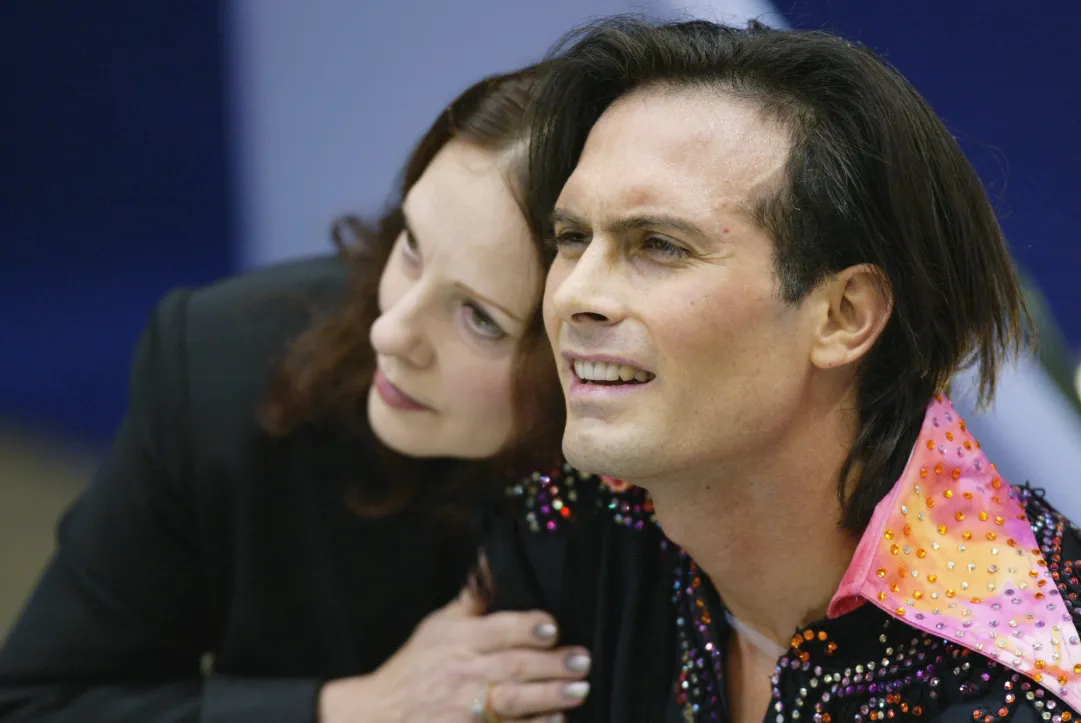
BY ELEONORA'' D'' LEGACY AND LAURA Sciarillo - Maurizio Margaglio, born in 1974, is a name that means a lot to the history of Italian ice: his'' s only Olympic medal (bronze in Salt Lake City 2002) '' conquered by Italy in a discipline of figure skating on the ice paired with its historic dance partner Barbara Fusar Poli.
Thursday 5 September 2013 29 minutes reading time
An Italian legend that, after the final withdrawal in 2006, began to lend his expertise to the new generations of talent in the sport. From a couple of years'' Maurizio began a fruitful collaboration with the Finnish Federation, who wanted to collaborate with in Helsinki before the synchronized skating team "Rockettes", former world champions, then as a technician of the pairs of Finnish dance. In this long interview Maurizio us a window into his new life in Finland, skating and his vision of its future prospects.
Maurizio, we start by making a few remarks on the European Championship from your point of view, that of coach of the pair of Finnish dance Karmi / Lindholm. "This couple is breaking from the first experience important right now, I started working with them'' from last year and I'm trying to direct them towards a more professional approach, which at times in Finland is not easy to make it clear to athletes. The real leap in quality it is done only by working in a super-professional:'' there is no other way they can, and sometimes I have trouble to understand all of this.'' Clearly where there is a tradition , where there are other couples who can act as a reference point, you have to build everything from scratch and this is a bit'' my mission. I would say that these two guys are improving and they still have a lot of room for improvement. To we get here and qualify is already a great success, in fact what we got was also popular in Finland, where I immediately got many compliments even by Susanna Rahkamo, almost as if we had won, which makes however, very pleased.'' This was the goal and we managed to achieve it.'' Then there is always the'' other pair, Lindholm / Kanervo, the boys who participated in the'' Last year, the European and World Championships for Finland . too have improved a lot in just two seasons and in the end did not come here just for a difference of a few hundredths of a point. The criterion of the Federation for Finnish participation in the EU, in fact, take into account the average of the scores of the last three races and the gap with the'' other pair was only half a point, so to speak. I think even they could have done a'' good figure, are slightly larger, have a few more years but even they suffer a bit '' lack of tradition in this discipline in their country, a strong national team in the dance. Naturally'' s lack of tradition is also accompanied by the'' absence of technical discipline,'' there is a lot of dance culture on the ice and I'm working on this. " Quite the opposite if we speak of synchronized skating .. "With the sync, the situation is completely different. Finns have managed to do a great job over the past 25 years and now the fruits are clearly visible at all because they are competitive at the highest level and have a basic exceptional youth. Every year Clubs can make a selection and decide which girls to pursue or not, and have a wide choice, c'' is a strong internal competitiveness. Joining a senior team means joining one of the 20 best of everything a club that maybe during history has had to turn hundreds of skaters who have tried to make the team, all of which leads to the teams with skaters of excellent level. Clearly the synchronized requires a commitment different from other disciplines, and perhaps it is precisely for this in Finland that works so well and is very popular: it indeed requires a great effort everyday, as the girls are on the ice every day, in addition to performing athletic training and everything else, but always in the limits of '' "human." All of them are students or have the time to work, and this is a sport that has found great support among the'' public opinion and families. As a parent I can think of sending my daughter to a world, perhaps it can also win it but in the meantime can also graduate, or work, make up your own life, and so on. Unlike in the ice dance or art'' in if you want to think of entering the top 20 in the world you know you should do just that: everything else is very difficult to carry on, so this is a big difference. For the synchro I started working in Finland after calling Kaisa Nieminen for the team of the Rockettes and their demand towards me was this : "we want to skate as in ice dancing." This was the mission, from which he was born a little'' the speech of the choreography where I began to make my contribution. Obviously Kaisa remains the head coach and is its always the final decision on where to place the items. serves a great expertise for this because any change of formation is'' the coach who knows where it will end a line intersecting with the other''. My contribution mainly concerns the'' choreographic idea in general, how to tie the various parts of the program as well as a lot of work on technique, of course.'' The Rockettes have had the opportunity to compete in the world championships in Finland in 2011 and then during the first year in which I worked with them I found myself working with very experienced girls, because they were part of the team for the championship. Within two seasons, however, have renewed 70% of the team so we're somehow starting to work with the new and the level is always very high. Finntastic The junior world champions are from 6 years old, are very strong in the ranking. As I said they have a "green lung" at the base of the movement, so much generational change, it's all another world. "
What are the differences between choreographing for dance on the ice and the synchronized? Where do you feel you have more freedom, perhaps in ice dancing?
"They are two different kinds of freedom.'' C In the dance is this all about man / woman who can carry all'' potentially infinite, can the decline in various ways.'' Then there is the concept of the dance, intended in the strict sense of the term, which should be important, or at least, we Italians always continue with this philosophy of the dance, which is not always followed by others, but I think it's very fair.'s choreography for the dance generally rely greatly on this type of approach. Together with a group of girls necessarily have to do something different: there'' is'' the intimacy of the couple, the demonstrating love or things like that.'' D On the other hand, however, , c'' is a dramatic amplification of the movements that any, even small, choreographic idea when applied to the movement of an arm, when multiplied by the movement of sixteen arms becomes an extraordinary passage, or even just make everyone together at the same time a bending the legs and then leave, are all things that are amplified by the number of people who carry it out. Moreover, in my opinion, with the synchronized c'' is the beauty of being able to use abstract ideas. With a pair of dance describe, For example, a watch .. how would it be possible? With the team, you'll make. Want to give the feeling of a gust of wind? With the couple, it is not possible, with the girls does. You can make sure that the girls seem moved by a gust of wind and you have the impression that it is'''' passed a wave of air. All this opens to a considerable creative freedom. "
 Tell us about your new life in Finland, how did you personally organized, how do you facilitate the structures that we know to be good? "I have a premise: I have lived in many places in my life, maybe not for a long time but the petty philosophy that I can learn from these experiences is that wherever you go at the end of life is not so much different. Eventually the Our life consists of sleeping, eating, moving from one place to another and work''. If, in addition to everything you can to also have a family and a love life, so much the better, but this is roughly how much. So I can not Helsinki to say that I do something completely different from what I do when I'm in Milan or when I go to stay a couple of months in the United States. often joke with the Finns, I always say "But how do you stay here, it is very dark, very cold "and I respond saying that they have mica copyright on such things! The short days, the'' cold winter we are also here: I lived four years between Milan and Val Gardena in Val Gardena you get to -20 °, with snow for six months already in October. The big difference for me right now is to live in the center of Helsinki to that is yes, but with a capital one dimension, if we want to , more human. I can move anywhere in 20-25 minutes. C'' is an organization in the city that you can easily find everything from restaurants to offices to whatever you need. course I live in a & ldquo ; metropolis "or any other metropolis like Milan even bigger raises other problems: in Milan, for example, the shift in the car is terrible. A Helsinki does not have this kind of problem. Then there are many other differences, clearly we are two peoples who see things very differently, but we also strive a little'' to adapt and understand their mentality and we are slowly finding at ease. But at the end of the day consists of: wake up, get ready, bring children to school, go to work and come home in the evening looking for a minimum of tranquility, which is clearly impossible until 9. Once all sent to bed, I have my time available in which I can see the news, since we are an hour ahead'''' s Italy. The big difference in living'' s foreign now than 15, 20 years ago is that today, if you want, you can keep a complete contact with the ' 'Italy thanks to satellite TV but above all thanks to the Internet, where can I download all the papers that I want and keep me constantly updated. " Let's go back to the dance: there is already talk a lot of choice of the pattern for the Short Dance of next year, or the Finnstep. '' It was a choice discussed, c'' is the one who does not agree with the selection of a relatively new dance so crucial for a season, or an Olympic c'' are those who say that you will not find at home. What do you think? "I think for any dance you choose you will always be the consensus of the disagreement. Personally I see it simply as a choice for a compulsory dance that is introduced into the Senior Short Dance and if they had put the Tango Romantica I would have been happy, if they put the Ravensburger I would have been happy, but then someone would say, however, that it would be repetitive. I do not see the problem, rather I would think that it would be prudent to take our old required for entry into the Short Dance, distorting, but this argument does not apply only Finnstep, is a general discussion. Indeed, I would say that among all the dances Finnstep is among the ones that draws on the tradition of ballroom dancing, the true nature of the dance. Rather, I would like to see adequately rewarded own this aspect, that'' s interpretation of the dance, not only the'' aspect of the perfection of the wires because I am convinced that in the end who wins in this discipline should know how to dance. This is right at the base of my mentality and this does not transigo, otherwise it would be called "technical ice." Do not even think that import the judgment of the dance sport can help us in this regard. I have worked a lot with dancers from the room, great people, but it was world champions difficult for them to understand our needs, difficult to interpret what we do then we go on the ice. When Barbara and I worked with them, in fact, what we always asked was just to show what they could do and then we'd find a way to "translate" on the ice. Therefore, trivially, when you go to a Quickstep or one Slow Fox ballroom dancer wants to see how it works with the heel-toe. But on the ice you do not have anything like that, you have a fixed blade, what we do is almost a jump'' to give only the idea of ​​that movement. dancers on ice We can not always work on your toes, otherwise continue to stop instead of skating. Another example is the same "hold" in arm position may be different in ballroom dancing and dance on the ice: we must comply with certain technical requirements of Regulation but a ballroom dancer would have much to say about the same position, nevertheless this is "tolerated" on the ice , as clearly run with their partners on a dance floor rather than on the ice where you go to 20, 30 to'' now is definitely different. Instead, what I think is important is to give some "education" to dance, both in terms of the skaters that the coaches and judges of all. The specialist should look at the steps and the judges should look at the dance: this often seems forgotten. " We understand that even by many skaters there is a bit of'' aversion to this new solution of the Short Dance. Some emphasize how difficult it is to integrate parts of the compulsory dance in the program without losing continuity. What do you think? "I can not be said to be totally" against "the Short Dance. I think it's the concept of having a short program and a long program, difficult to make alternative proposals, we need a broad consensus and arrive at this solution has already been a very tiring journey. Like all new things, I think could be improved. I repeat, I would like to see more played the character of the dance, as well as we did in the compulsory and original in'', then in fact have free liberty to fill new roles. During the mandatory was important to perform the steps correctly so slipped and at the same time show the spirit of the dance interpreted, to understand that you are dancing a waltz rather than a tango.'' It's a skill that you are a '' bit lost. " Susanna Rahkamo is the president of the federation Finnish and was recently named vice president of the Finnish Olympic Committee. How do you find working with her? "By Susanna I have a lot of respect and a great friendship binds us. His last European (paired with Kokko, ed) in 1995 was the first European to me and Barbara, so we were a bit''" adopted ", which had given me immense pleasure. To me they were the idols for some years, to meet and become friends was special.'' It was she who call in Finland, to get in touch with Kaisa Nieminen and to propose this project of ice dance: for me to work with a Fed chairman who is from my own discipline is very important and gives me great satisfaction.'' d We do not always agree on everything but we both know where we are going and we know the dynamics to achieve this goal: it is a very constructive cooperation and for this I am very comfortable working with her. Finnish Federation is structured in a very slim, very few people who work there come from the world of ice, I see it as a federation very close to sports. Finland in the end is a small country, demands that we express in a few hours reach the Olympic committee then you can have a more direct and faster decision making. " The same Rahkamo has hinted he would like to give more importance to Finland Trophy, it also speaks of the fact to make it a stop on the Grand Prix in the future. "Yes, c'' is a big project with regard to the Finlandia Trophy, First of all it should be noted that they have a contract with the Barona Areena in 4 years. Structure is also a sponsor of the National, which ensures their the certainty of the venue, which is very very important in optical Grand Prix. Clearly there are many high costs to be incurred for that type of race so I'm still in the process of looking for sponsors, some of which have already but still serve.'' The idea is in fact, in a future yet unknown, or to propose it as a stage of the Grand Prix itself or as a stage to alternate to a'' other, maybe the French. " To conclude we would like to know more about your plans for the future. "For now I look at Sochi as a primary objective, as set to'' beginning of this collaboration, all the efforts we make at the time of an optical'' converge in Olympic qualifying. D'' c'' is the other part of speech dance in the youth who are beginning to bloom, we made a international podium in Riga with the Basic Novice recently, which has been in his small, an important milestone. It is a type of work the longest, most important if we want more difficult. My hope is to be able to help young coaches to approach the Finnish ice dance, to consider take up the sport for the purpose of a real career, possibly begin doing the exercise'' this discipline already between 8 and 10 years.'' This is the right age, one in which you can learn the basics very well that'll keep for a lifetime: the seniors that I follow have now begun with dancing only around to 18 years, so it is very complicated for them.'' And a project that, to be fully realized, can see the light in'' period of twenty years, it takes time to reap the benefits. currently no I pose the question of how I will stay, I know that by the Olympic Committee c'' is a high volume, but we'll talk after Sochi, I think. " Com'' is known, however, your collaborations also take place outside Finland. "Of course. My collaboration with Marina Zueva is the most beautiful that could happen to me, at this time c'' is great harmony between the Finnish federation, the American and the Canadian and this makes things easier. Therefore, as , it will be possible, we will continue on this path. "
Social media engagement
Ultimi in Sport invernali
Rulfi rassicura sulla situazione di Goggia: Non sentiva di potersi allenare, ma non c'è stato nulla di traumatico
Alla Gazzetta dello Sport, il direttore tecnico della nazionale femminile ha aggiunto qualche dettaglio sui motivi del rientro anticipato di Sofia dal Sudamerica, rinunciando al blocco in Cile che era previsto dopo quanto di buono fatto per due settimane abbondanti a Ushuaia specialmente sul gigante. Nelle prossime ore gli accertamenti medici: Non li abbiamo fatti in Argentina perchè non c'era la possibilità di approfondire al meglio.
2