
IPCPARALYMPIC ALPINE SKIING
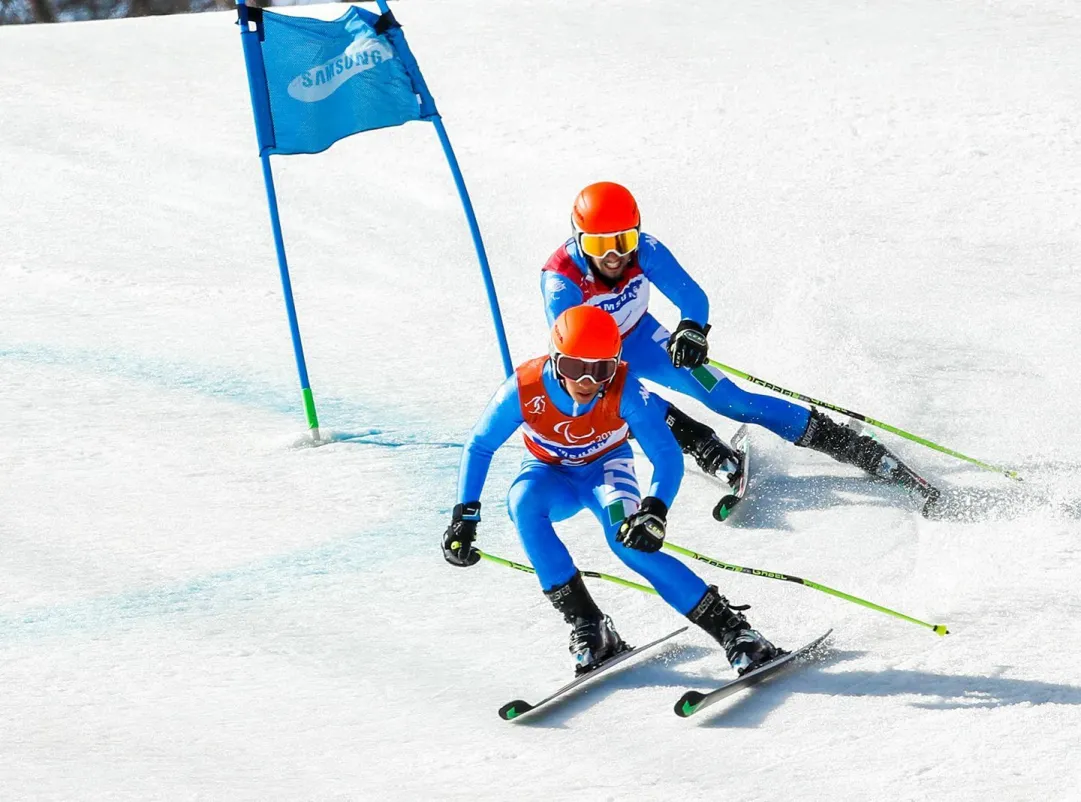

pg Jack e Fabri fb

He lives in Val di Fiemme, in Cavalese, and at the World Championships in Paralympic skiing he made everyone dream with the conquest of 5 medals out of 5, including 4 golds. A talent, a passion that has been cultivating since he was young despite his problems with sight. Giacomo Bertagnolli, 20, is always hungry for victories. Compete in the "Visually Impared" category together with his guide Fabrizio Casal. Jack and Fabri, so they decided to call themselves, are always looking for success. Because Giacomo Bertagnolli is never satisfied.
Tuesday 19 February 2019 10 minutes reading time
How did your passion for skiing come about?
Living in the mountains, near the slopes, I started skiing as a child. It's a sport that I've always liked and that over time has become my passion.
How did you approach the world of agony?
I discovered at the age of about 13 years the Paralympic world that gave me the opportunity to compete with people who had disabilities, even visual, as in my case. It gave me the chance to put myself to the test and compete on a competitive level. So I started doing some races. I did the Italian Championships where I saw that I was doing very well and then I moved on to the European Cup until reaching the World Cup.
What is your favorite discipline?
The giant because it is the one where I train more and then I like it as a discipline, it is fast and technical, it combines the two characteristics of skiing. But I also really like the slalom and also the super-G. The only flaw is the downhill where, being light I'm a bit 'in trouble. But all in all I get along with it in all disciplines.
How many hours do you train a day?
More or less I train every other day, about 3 times a week on skis and once or twice a week in the gym with the equipment to maintain physical fitness.
What is your relationship with Fabrizio Casal, your guide?
Fabrizio is a very good guide and this is a very important factor because he skips well and directs me in the right way. It's been my guide for 4 years now, it gives me the information I need and therefore it becomes much easier for me to follow it. With him in front I have no worries. Obviously there are some days when we are skiing better and others less, but it can happen that there is a day where you are not completely in shape.
You and Fabrizio are the same age. Are you friends even outside of sports commitments?
Yes, we are friends even outside the sport. But we have different companies because we do not live close to each other, we are about 15 km away. We'll see you mainly to train.
You won four medals at the PyeongChang Paralamp Games and five medals including four golds at the World Cup. What was the secret of success?
The secret is definitely to continue to train without being satisfied with the results already achieved. We won 5 medals at the World Championships, one of which silver can be improved. We know what the mistakes were and we are trying to correct them. Only by improving can you win the races. It is important to be sure of what you know how to do and to give everything in the race.
Among Olympic and world medals, what is the medal that has thrilled you the most?
The first gold medal at the PyeongChang Olympics that we won in giant. It was a race that we played at full potential. We gave everything and we also risked making mistakes that could have compromised the race. Getting to the end with 5 seconds on the opponents was a great satisfaction. Without taking anything away from the other medals, but that of the giant was the best performance. The same is true for the World Cup. We started with two races (slalom and giant) where we made big mistakes, especially Fabrizio, and despite that we managed to recover them and bring home the medal.
And the most fought medal?
The World Cup giant was great, we arrived second. It was a race where, between my mistakes and those of Fabrizio, we came into difficulty. At the end of the first run we were second and then we had to do a second run well done. We gave the maximum. We took the silver medal behind Marek Kubacka, a completely blind Slovak boy who did a perfect race. And when he plays a perfect match it becomes quite difficult to beat him. It was a hard fought race even though we did not finish first. We have fought to the end.
The subject of the reconciliation between competitive sport and study is currently very much discussed. In the PyeongChang Olympic season you had your high school exams. How did you manage both of these things?
It was not easy, but I did it quite well. I graduated with 82 out of 100, a pretty good mark considering that I did more than half the days of school absence It was stressful. I managed to give the right weight to the situations. In preparing the Olympics, the month before I focused on skiing and I left the school. After taking home the Olympic medals, I started to study a lot to recover everything I had lost. We must have will. And it is a double satisfaction to be able to carry on two things. Indeed, in my case, it is a triple satisfaction as I have problems with sight. At school my teachers gave me a big hand, because when I came back from the races they gave me time to recover and rest. It was useless to question me the day after returning from a two-month trip. It makes no sense and professors should understand this. We must have time to study. I did two years of high school language, the teachers did not help me and I had to change and attend the socio-economic high school.
You are a very young athlete and you already have a great record. What are your goals for the future?
Keep training because winning is never easy and my opponents are getting stronger and stronger. If I continue to train, I have the chance to remain among the top in the world. Next year's goal will be to win the overall World Cup and specialty cups. I already won a cup three years ago and I finished second in all the specialties. Next year there are no important dates so I will focus on this. They have already told me that we will travel a lot, the stages will be spread all over the world: Norway, China and probably also in Australia. It will also be a good opportunity to get to know new places. And I will also begin to prepare myself for the upcoming Olympics, which are the highlight of this sport.
© ALL RIGHTS RESERVED
Social media engagement
Ultimi in Sport invernali
Sofia Goggia ha accusato un malore in Argentina: è già rientrata in Italia per accertamenti
Come ha comunicato questa sera la FISI, la fuoriclasse bergamasca ha concluso anticipatamente il camp sudamericano a causa di un malore durante la sua permanenza a Ushuaia e d'accordo con il dottor Panzeri ha deciso di tornare a casa.
157