
Nordic SkiingJump male - Sapporo
![Il salto maschile alla Grande Classica del Sol Levante [Presentazione Sapporo]](https://www.neveitalia.it/foto/albums/userpics/14360/1081_GettyImages-159711332.webp)

Getty Images

The World Cup men's ski jumping is getting ready for its Great Classical. At the weekend, garegger & agrave; Sapporo, where top-level competitions have been staged in almost every winter and where & egrave; played the highest number of individual tests in the history of the maximum circuit.
Friday 29 January 2016 6 minutes reading time
NEWS & rsquo;
& Nbsp;
HISTORY Sapporo skiing early & ograve; to be practiced in 1909, at the instigation of the German university professor Hans Koller. The first jumps were made in 1917 and already & agrave; in 1923 the Japanese cities could rely on a complex of three ski jumps (K20, K25, K50)!
In 1929 the Prince Chichibu Yasuhito, younger brother of & rsquo; Emperor Hirohito, visit & ograve; the CITY and facilities dedicated to the jump, promising to build the trampoline more & ugrave; Japan's largest.
In 1930 it was identified the slope where erect the structure, which was fully funded by the local noble Kishichir & # 333; & # 332; kura. In his honor, still today, the Large Hill Sapporo is named & # 332; kurayama.
The trampoline, often the scene of competitions over the years & rsquo; 30, was completely destroyed during the Second World War.
However, the war ended, in 1952 cypr & Igrave; new plant, then completely renovated between 1969 and 1970 in view of the Winter Olympics of 1972 when the race witnessed a crowd of over 40,000 people. In the following years & rsquo; & # 332; & egrave kurayama; has undergone several renovations, the & rsquo; last of which just under a decade ago in anticipation of the 2007 World Championships.
A day in the capital of the prefecture of Hokkaido were held 69 individual events first level 65 World Cup + 2 + 2 Olympic rainbow. Only Planica with 67 approaches to this figure.
Among them as many as 50 have been staged on '' & # 332; kurayama (K120 / HS 134), which would therefore have l & rsquo; honor of being the springboard where they played as many competitions valid for the ball crystal.
So far on the large hill 32 different athletes have excelled, including the most & ugrave; emblazoned & egrave; Roar Lj ø kels ø y. The Norwegian & egrave; He was able to impose itself on 5 occasions in & rsquo; span of four consecutive winters (2003, two in 2004, 2005 and 2006).
Nine jumpers activities & agrave; to boast at least un''affermazione on Large Hill & nbsp; & # 332; kurayama.
Simon Ammann (gold world champion in 2007 and 2010), Daiki Ito (both in 2012), Jan Matura (back-to-back in 2013) and Peter Prevc (2014, 2015) have two wins. Single statement instead of Gregor Schlierenzauer (2009), Severin Freund (2011), Andreas Kofler (2011), Jernej Damjan (2014) and Roman Koudelka (2015).
In terms of countries, on the step pi & ugrave; top of the podium thirteen different flags waved. Controls the 'Austria with 13 victories. 8 follow Japan and the German movement (7 as West Germany and as a DDR). Are then Norway (7); Slovenian movement (4, one as Yugoslavia); Finland, Poland, and Czech Republic (3); Switzerland (2); France, and Sweden (1).
Despite on '' & # 332; kurayama there have been 52 races of first level (48 World Cup Olympic + 1 + 1 World Championships), victories are 53 accredited since January 21, 1996 Ari-Pekka Nikkola and Andreas Goldberger you They imposed a tie.
The official record of the trampoline & egrave; shared by Norwegian Roar Lj ø kels ø y, dall''austriaco Andreas Kofler and Polish Kamil Stoch, all landed 140 meters (6 over the 'Hs), respectively, in 2006, in 2014 and in 2015.
However it should not forget how to January 18, 2015, in a race of Continental Cup, the Slovenian Anze Lanisek is pushed to 146.5 meters, or more than 12.5 l & rsquo; Hs!
© ALL RIGHTS RESERVED
Social media engagement
Ultimi in Sport invernali
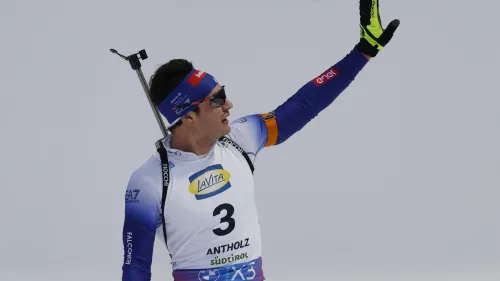
Due settimane ad Anterselva per la nazionale maschile, c'è anche Giacomel per il raduno in quota
Nel sito olimpico, da lunedì 14 a sabato 26 settembre ecco gli azzurri del biathlon impegnati in un blocco di lavoro cruciale: il trentino, nell'ultima fase del suo recupero, con una preparazione mirata ma di nuovo assieme ai compagni.

2