
BiathlonOlympic Games
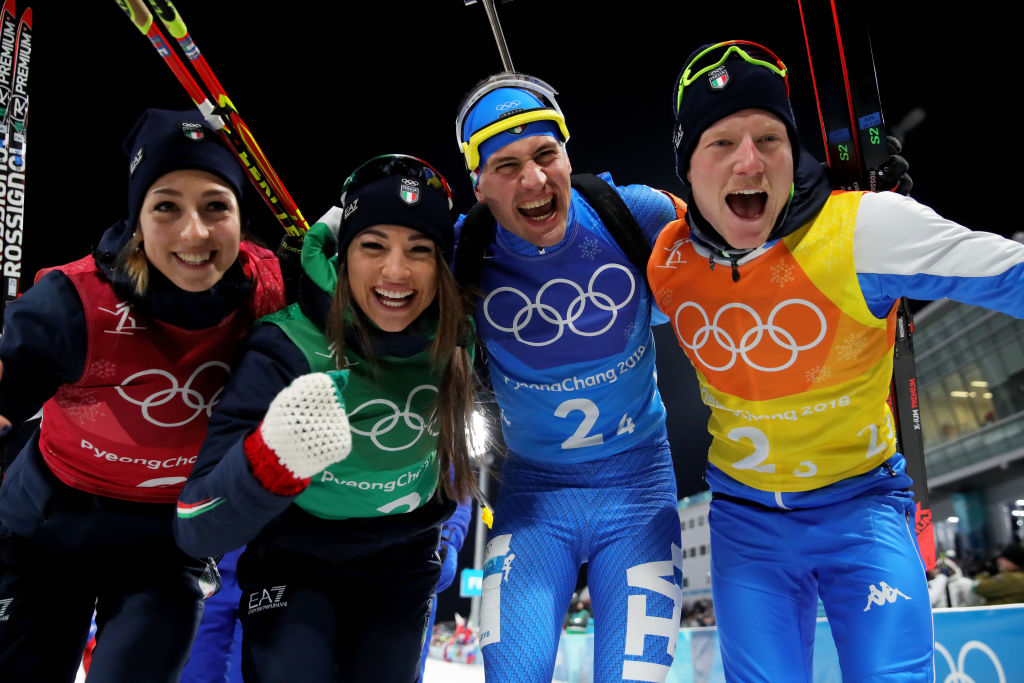

2018 Getty Images


A few days before the start of the XXIX edition of the Winter Olympic Games, which for biathlon will start on February 5 with the mixed relay, we retrace the blue path in the five-circle review, from the dawn of the discipline to the present day, between beginnings and medals .
Thursday 27 January 2022 9 minutes reading time
From Anterselva to… Anterselva. The blue Olympic course in terms of medals, exactly thirty years long, could be summarized as follows: started and ended, for the moment of course, in that valley which is the cradle and homeland of our local biathlon. But before retracing the triumphs of Italy, let's take a step back, to the beginnings of the discipline in the five-circle panorama.
After a series of editions in the first half of the century in which the "military patrol", progenitor of the discipline, was part of the Olympic program as a demonstration sport (in 1924 it was actually part of the Olympic calendar), biathlon made its debut at the Olympic Winter Games in 1960 in Squaw Valley (USA) and for two editions the only race on the calendar was the men's 20 km. From Grenoble 1968 the relay was added, for a program that remained unchanged until Lake Placid 1980, when the Sprint was also introduced.
It's Italy? The first biathlon olympians of our country took part in the 1972 Sapporo Games: two Piedmontese, Bertin and Astegiano, one from Aosta, Jordan and a Trentino from Tesero, Corrado Varesco. These are the names of the four "pioneers" who took part in the Individual and the relay race in Japan, without significant results. It went better four years later when Bertin touched the podium in the 20km, finishing 4th and Jordan took an excellent 7th position.
And Anterselva? To find the South Tyrolean location in the biathlon Olympic books it is necessary to wait until 1984, when the twenty-two year old Andreas Zingerle made his debut in Sarajevo, a native of the famous valley, which in the meantime had already established itself as the cradle of Italian and world biathlon and had already hosted three editions of the world championships.
But 1988 was the year of the turning point. In fact, the first medal, or rather, medals, arrived in Calgary (Can). Johann Passler, also a native of Anterselva, won a fantastic bronze in the 20 km, crowning a magical season, which a few weeks earlier had seen him triumph for the first time in the World Cup right on his home track. After a Sprint closed in 8th place, on February 26th here is the second laurel: another bronze in the men's relay, in the company of Werner Kiem, Gottlieb Taschler and Andreas Zingerle, for a quartet with three natives of Anterselva.
From Calgary to Nagano, ten years after the magical edition, here is the third blue medal in the history of the Winter Olympic Games. In between the debut of the women's sector, in Albertville 1992 with Nathalie Santer, Erica Carrara and Monika Schwingshakl to represent the tricolor. But as we said, it is in Nagano 1998 that history is made. And to write the most glorious page from the Italian biathlon to the Olympic Games is Pieralberto Carrara from Serina (Bg). Once again, the Individual gives satisfaction, where he wins with a perfect test at the shooting range a splendid silver behind an impregnable Halvard Hanevold.
Carrara remains the highest point reached by Italy in biathlon in its Olympic path. From that moment on, a sixteen-year long break before returning to the podium. It is February 19, 2014 and the mixed relay race is staged in Krasnaya Polyana, the first in the history of five circles. Italy boasts a good tradition in the new format, with two podiums obtained in the World Cup between 2008 and 2009 and presents itself to the appointment with a well-established quartet that boasts two consecutive fourth places obtained in the last two races. On the day of the consecration in the legend of Ole Einar Bjørndalen, who wins the thirteenth Olympic medal, becoming the most successful ever in the history of the Winter Olympic Games, Italy returns to the podium. Dorothea Wierer, Karin Oberhofer, Dominik Windisch and Lukas Hofer win a historic bronze, finishing behind Norway and the Czech Republic.
The story repeats itself four years later, at the end of four years as a protagonist for the Italian team. At Pyeongchang 2018 Lisa Vittozzi, Dorothea Wierer, Lukas Hofer and Dominik Windisch conquer the bronze again, this time preceded by France and Norway. For Dominik, a native of the Anterselva valley, Korea offers many emotions and consecrates him as the most medalist in the history of Italian biathlon. Nine days before the encore in the relay, Windisch finishes third in the Sprint, bringing Italy back to an individual medal exactly twenty years after the silver in Carrara.
From Johann Passler to Dominik Windisch, from Anterselva to… Anterselva, for a history that recurs cyclically. Italy comes to Beijing with six medals and a booty to increase, but almost with the lights off, after a first part of the season that has given little satisfaction. Zhangjiakou in terms of altitude is very reminiscent of Anterselva and Italy, despite all the difficulties, presents itself at the start of almost all the races with the possibility of a podium. So will the medal record arrive? The first gold? The first female individual medal? Or maybe both? Between a "bankruptcy" expedition and a historical one, to remember, the step may be short, but the certainty is that the most lively hope always comes from the usual valley ...
© ALL RIGHTS RESERVED
Social media engagement
More details

Più letti in Sport invernali
L'Italia dello skiroll saluta Madona e un Mondiale da 4 medaglie, l'ultima è di Boccardi nella Mass Start
La roveretana è di bronzo nella partenza in linea a skating, firmata dalla solita Ragnhild Aarenkol, con la gara maschile vinta dal padrone di casa Vigants (amaro 4° Dellagiacoma). Titoli juniores alla norvegese Lia e allo svedese Blomberg Gerle.
240