
Nordic Skiing63. Vierschanzentournee

Getty Images

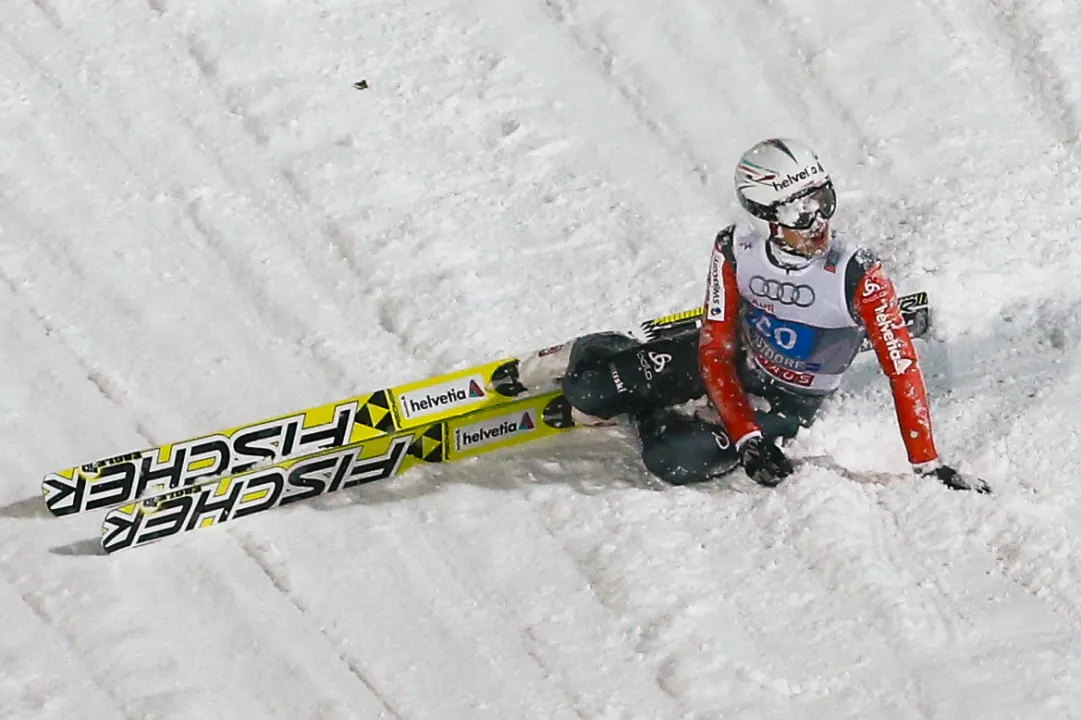
L & rsquo; exclusion of Simon Ammann from the second series of jump Oberstdorf has generated discussions and doubts about the & rsquo; implementing Regulation.
Wednesday 31 December 2014 12 minutes reading time
To be precise, the rule that arouses perplexity & agrave; & Egrave; what if dropped allows the & rsquo; admission to the second set of: & rdquo; a jumper, who Has Reached 95% of the maximum length of the longest jump & rdquo ;.
The problem, in particular, & egrave; related to the meaning of & rsquo; meaning & ldquo; The Longest Jump & rdquo ;.
In this regard, & egrave; need to go back in time to clarify the situation.
Until the 2008/2009 season, when there was no form of compensation tied to the wind and the pole base, l & rsquo; use of & ldquo; The Longest Jump & rdquo; did not create any kind of problem as corresponded exactly to the best extent obtained in the race series. The calculation of the 95% in the case of jump was dropped perci & ograve; rather trivial.
The situation & egrave ;, however, has become more & ugrave; complicated since the 2009/2010 season as were introduced compensation coefficients in points related to the change of pole departure and all & rsquo; incidence of the wind. Just on this point, for & ograve ;, & egrave; emerged l & rsquo; approximation of & ldquo; & rdquo ;, which legislator, laziness or superficiality & agrave ;, did not introduce a trivial rule designed to explain how it would change the meaning of & ldquo; The Longest Jump & rdquo; in the light of the new system of scoring. In truth & agrave ;, the best solution would be to use a & rsquo; meaning different than did pi & ugrave; reference to the measure, but the points earned net assessments of the judges. However, in this case, would not have been pi & ugrave; can assign 60 points in the case of landing on the point K, but it would have to multiply the measurement obtained for 1.8 (LH) or 2 (NH), depending on the pad used.
Essentially, & ldquo; The Longest Jump & rdquo ;, the second & rsquo; idea of ​​the FIS, guilty of not having explicate the concept on paper, does not mean pi & ugrave; & Nbsp; from & rsquo; summer of 2009 & ldquo; the jump pi & ugrave; long & rdquo ;, but bens & Igrave; the jump of greater value considering:
A) score on the measure (assuming that reach the point K means getting 60 points on trampolines LH and NH) B) compensation linked to the wind C) l & rsquo; any compensation tied to the pole base
Put simply, the calculation of the infamous 95% in the case of jump should not be dropped pi & ugrave; equated to an actual measurement actually got on the field, but bens & Igrave; u hypothetical measurement result of a complicated conversion of points in meters.
In truth & agrave ;, you & egrave; only all & rsquo; beginning of the explanation because, once learned the theoretical part, & egrave; necessary to illustrate a methodology to identify unequivocally the jump better, according to FIS & ldquo; The Longest Jump & rdquo ;, and translate it in meters.
It & egrave ;, & perci ograve ;, decided to analyze precisely what happened in the first series of the offending Oberstdorf.
The basis of the calculation & egrave; clearly stanga starting early in the race with the wind zero.
The best jump of the first series & egrave; was that of & rsquo; Austrian Stefan Kraft quantifiable with 139.5 meters, resulting from the sum of 136.5 m. (Measurement achieved) + 5.4 / 1.8 m. (5,4 & egrave; the result into positive relative to the compensation of the wind and the pole base, 1.8 & egrave ;, however, the value of a meter on a trampoline LH). & Nbsp; & Nbsp;
The length of the jump of Peter Prevc, author of the jump on the field pi & ugrave; long, you & egrave; revealed, however, of 136.2 meters, arising from 139.5 m. (Measure actually reached) & ndash; 5.9 / 1.8 m. (5.9 & egrave; the data in negative relative to the compensation of the wind and of the shaft of departure, 1.8 & egrave ;, instead, the value of a meter on a trampoline LH).
The length of the jump fell necessary to access the second series amounted perci & ograve; to 132.525 meters, equivalent to 95% of 139.5 meters.
Simon Ammann & egrave; stopped at 127.67 meters, resulting from 132 m. (Measure actually reached) & ndash; 7.8 / 1.8 m. (7.8 & egrave; the data in negative relative to the compensation of the wind and of the shaft of departure, 1.8 & egrave ;, instead, the value of a meter on a trampoline LH).
Obviously, the whole procedure is illustrated brainy and could be challenged by those who attribute all & rsquo; meaning & ldquo; The Longest Jump & rdquo; its literal meaning, what & egrave; & Ldquo; & pi jump ugrave; long & rdquo ;. However, in reality & agrave; the facts, these subtleties regulations are unknown to the vast majority of the experts want because & eacute ;, except for rare cases, missing a deepening of existing legislation, because you want & eacute; cases of fallen jumps are a rarity & agrave ;.
Not surprisingly, in the last three seasons, you & egrave; occurred only previous jump fell, measure the hand not all & rsquo; inside of 95% of the best jump, but eventually more than 95% in virt & ugrave; dell''incidenza of compensation criteria.
L & rsquo; & egrave athlete involved; Severin Freund was, fell in the first Test series Sochi Olympic sailed on small trampoline. The German, in & rsquo; occasion, he was admitted to the series finale, while coming in at 99.5 meters, a measure that was not included in 95% of 105.5 meters achieved by the Polish Kamil Stoch, author of the jump pi & ugrave; long.
Applying the modus operandi used previously, the jump best of the series was to Stoch length of 106.7 meters, arising from 105.5 meters (measurement achieved) + 2.4 / 2 m. (2.4 & egrave; the data in a positive relative to the compensation of the wind and of the shaft of departure, 2 & egrave ;, instead, the value of a meter on a trampoline NH).
The length of the jump fell necessary to access the second series amounted perci & ograve; to 101.365 meters, equivalent to 95% of 106.7 meters.
In virt & ugrave; the recalculation of the measure, Freund & egrave; reached 102.7 meters, resulting from 99.5 meters (measure actually achieved) + 6.4 / 2 m. (6.4 & egrave; the data in a positive relative to the compensation of the wind and of the shaft of departure, 2 & egrave ;, instead, the value of a meter on a trampoline NH).
Who writes, and & ograve; indeed in crisis for what happened in Sochi coming mistakenly and hastily to think it was the norm changed with the result that it was necessary to overcome the series fell to a jump & rsquo; inside of 90% of the best fit. The mistake was inexcusable to not delve for superficiality & agrave; matter.
In summary, in the light of Simon Ammann & rsquo; regulatory interpretation given by the FIS should not have taken part in the second series of Oberstdorf. Ci & ograve; Accordingly, by following, however, the text of the regulation in force, its size (133 meters) would be greater than 95% of the best measurement obtained from Peter Prevc (139.5 meters) and would allow him to jump in the series finale.
© ALL RIGHTS RESERVED
Social media engagement
Ultimi in Sport invernali
Brignone, Goggia e Bassino, un avvicinamento a Soelden (e alla stagione) totalmente differente
Le tre stelle della nazionale, mentre Pirovano e Curtoni continuano a lavorare bene a Ushuaia, stanno vivendo momenti opposti quando mancano 40 giorni all'opening: la bi campionessa olimpica continua il recupero e nel week-end ha raggiunto le amiche (ed ex colleghe) Pircher e Agerer, per la fuoriclasse bergamasca il rientro dall'Argentina e gli esami in arrivo per chiarire la situazione. E la cuneese due volte iridata? Il dt Rulfi ha svelato a Gianmario Bonzi che i tempi negli allenamenti di gigante sono già molto buoni...

2