
Alpine Skiing
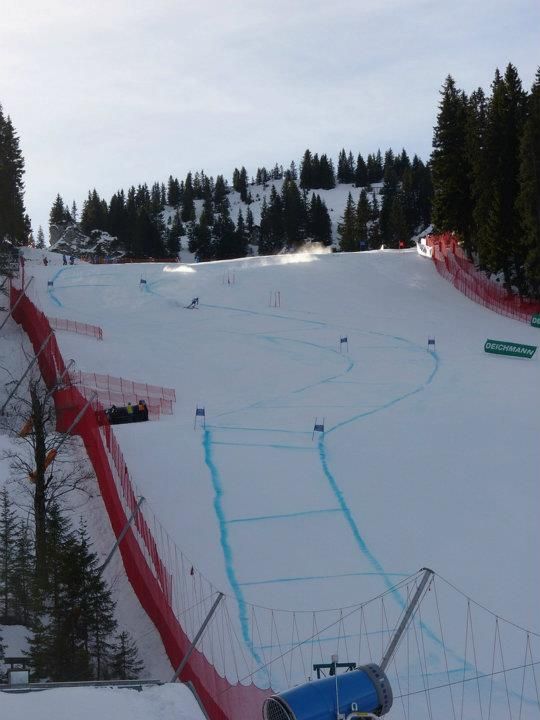


Back Into the appointment this weekend's World Cup in Garmisch-Partenkirchen on the track Kandahar since 1970 home tests downhill and giant slalom, home two years ago, the World Ski Championships in 2011 and the Olympic Games in 1936.
Friday 22 February 2013 3 minutes reading time
Into The start is located at the level of 1,690 me immediately after the double curve, the "Seele", leading to a rapid acceleration. This is followed by the jump-called Panorama Sprung and continues with a section of the scroll, the Stegerwald. You then come to the jumps of the cable car "Seilbahnstadelsprung", and Kramer, "Kramersprung" veer to the right, toward the wall more challenging, the Fall Freire, a descent with a slope of 92%, the passage steep of a race of the World Cup.
Into Until 1990, the Kandahar is also disputed women's events until January 29 of that year, fell the Austrian Ulrike Maier, during a test of the downhill World Cup, thus abolishing the dispute the evidence of female this track until in 2008 there was a rehash of the track in terms of security for future World Championships that were to take place in 2011. The same Lindsey Vonn, the greatest skier of recent times, described in the past as the Streif Kandahar women.
Into A track, that despite the technical difficulties, it has been able to give our team a lot of emotions, especially in the World Championships two years where Christof Innerhofer won three medals (gold in super-G, silver in super combined and bronze in downhill) , making it the protagonist of that World Cup that attributed the nickname Winnerhofer.
Into The Kandahar downhill, has never won any Italian. They got on the podium but Marcello Varallo, Herbert Plank, Michael Mair, Peter Vitalini, Peter Runggaldier, Kristian Ghedina and Alessandro Fattori.
In Into World Cup took place only two giants instead, the last of which, in 2010, was won by Switzerland's Carlo Janka in front of Davide Simoncelli and Philip Schoergofer and Ted Ligety, tied for third.
Social media engagement
More about Alpine Skiing
Women’s Alpine Skiing
Sofia Goggia fell ill in Argentina: she has already returned to Italy for medical tests
Fabio Poncemi, Saturday 12 September, 21:40
Alpine Skiing
Fabio Poncemi, Saturday 12 September, 18:20
Women’s Alpine Skiing
Fabio Poncemi, Saturday 12 September, 09:10
Alpine Skiing
Fabio Poncemi, Friday 11 September, 17:50
Alpine Skiing
Fabio Poncemi, Friday 11 September, 13:40
Alpine Skiing
Fabio Poncemi, Friday 11 September, 11:15Più letti in Meteo e neve

NOAA: torna El Niño, come potrebbe influenzare l'inverno 2026-2027 sulle Alpi?
La NOAA (National Oceanic and Atmospheric Administration) ha pubblicato il 9 luglio il nuovo aggiornamento sul fenomeno climatico ENSO (El Niño-Southern Oscillation), confermando che El Niño è ormai in pieno sviluppo e che continuerà a rafforzarsi nei prossimi mesi. Secondo i climatologi statunitensi, il fenomeno dovrebbe raggiungere il proprio massimo proprio durante l'inverno boreale 2026-2027, con una probabilità del 97% di persistere fino alla primavera 2027 e con possibilità sempre più elevate di raggiungere un'intensità tra le più elevate osservate dal 1950.
2